Understanding the science of para ice hockey
By Alicia M. Gal
It brought me such joy and pride to watch the amazing and inspiring athletes at the Paralympic Games in Pyeongchang, South Korea. As an avid sports fan, I cheered on Canada’s para ice hockey team as it went all the way to final game before losing to the U.S. in overtime. As a biomedical engineer, I also have a fascination with how para athletes perform and how I can help to make them better.
Many years ago, when I played on a men’s recreational hockey team, a good friend and my linemate had an accident off the ice that left him a paraplegic. As he lay in the hospital bed, I introduced him to the local para ice hockey coach to show him there was something to look forward to — he could still play hockey.
As his rehab went on through the years, my friend took his para hockey skill level from requiring a pusher to being a goal scorer. A pusher is an able-bodied skater who pushes the para hockey player, allowing them to become involved in community level games.
His upper body mobility returned. It was inspiring to watch. My friend’s life-changing accident became something that would also change mine.
Over the years, I have coached many hockey schools and teams. My love for hockey has inspired my research in engineering and science and allowed my research to blossom. I have focused my career on the biomedical and biomechanical analysis of skating — rehab, performance enhancement, injury prevention and sport development.
When it comes to para hockey, the biomechanics are completely different than “upright” hockey, so current research on hockey is of no use because the motion is so different. I started to participate in friendly para hockey games gaining respect and admiration for those who played. Skating, let alone stick handling and shooting, was one of the hardest things I had ever done.
Skating styles and skills
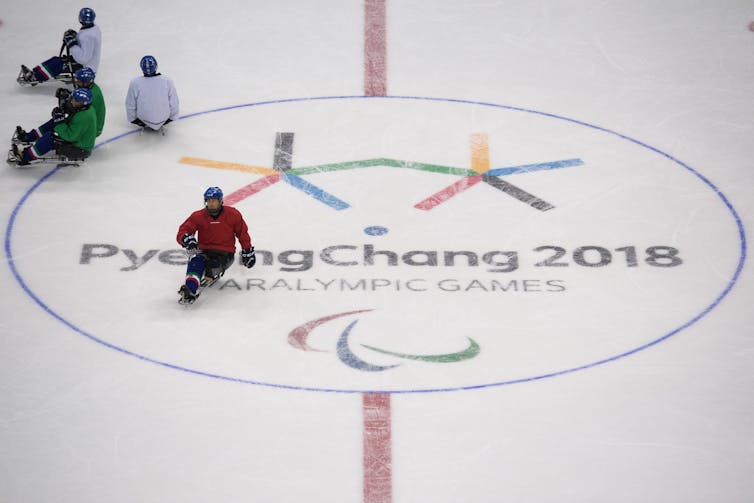
Skating in para hockey closely resembles double poling in cross-country skiing. Sitting on a sledge equipped with two skate blades and chassis (para hockey was originally called sledge hockey), players use two sledge hockey sticks to move themselves and the sledge across the ice surface. The sticks have elongated blades at one end for puck control and a flip of the stick with the picks at the other end allows the player to produce motion, the only way to produce motion.
When I found out there was little research involving para hockey — and no biomechanical research — I started working with my co-prof Dean Hay, a researcher and professor at Nipissing University, to investigate key skating styles.
Using community and provincial level players, we investigated various skating styles on-ice with video analysis and surface electromyography (sEMG) — a process used to collect biological signals from the muscle of intent to infer the level of muscle activation.
As my research progressed, I created an off-ice sledge that replaced the double skate blades of the ice sledge with roller blades. Taking the sledge off the ice allowed me to conduct biomechanical specific research involving motion capture (MOCAP), sEMG and force plates.
MOCAP regenerates three-dimensional marker locations onto a computer screen. From these marker locations, many mathematical and physics laws can be used to gain information regarding the tracked movement. Force plates collect three-dimensional ground reaction forces and positioning during contact. From these impact forces, many physics laws can be mathematically calculated to determine information regarding the body segments and joints.
My research produced some key biomechanical information. A typical impact force from a single stick with minimal to no effort produces two times the body weight of the person producing the stroke.
To put this into perspective, jumping can be greater than four times body weight and running and stair climbing is more than two times body weight — meaning skating in para hockey is more similar to lower limb activities than it is to upper limb sports.
Physics laws applied to hockey
Some key mechanical results involving skating were also found. Skating is harder than predicted, with balance in the sledge being the major limitation in order to perform the stroke correctly.
As well, a majority of the strokes from the lower-ranking participants involved a pulling motion instead of the mathematically and mechanically correct pushing motion. Again, to put this in perspective, a person would typically push a box across the floor instead of pulling the box because it’s easier.
This information is paramount to those beginning their athletic careers in para hockey and for those who are coaching para athletes. Ensuring players can maintain balance in the sledge, and guidance to produce the pushing motion, should be seen as fundamental skating skills.
Here are some key techniques coaches and new para players should focus on:
- Skating is fundamental to the sport. The ability to balance within the sledge is an important skill that can be developed both on and off the ice.
- To develop the push motion instead of the pull motion, skaters should plant the sticks in a forward direction. New players tended to keep their sticks upright rather than forward.
- When double poling, which is the most common stroke, players should aim to have their arms move as symmetrically as possible.
- Results suggest that a more open arm (less bent elbow) allows for a more forward stick plant, which should improve the stroke.
I have presented some of my research at international conferences on the biomechanics of sport.
My research continues on-ice and in the direction of READi (Research and Education in Accessibility, Design, and Innovation) with the help of Prof. Adrian Chan. We plan to conduct a longitudinal study involving the potential for injuries caused from skating, which will hopefully bring awareness and knowledge to players and coaches at the international level.
My end goal and hope is to create a long-term development plan for the sport of para hockey in order to help it continue to grow from grassroots to Paralympians, hopefully helping some young hockey player reach their gold medal dreams.
This article is republished from The Conversation under a Creative Commons license. Carleton University is a member of this unique digital journalism platform that launched in June 2017 to boost visibility of Canada’s academic faculty and researchers. Interested in writing a piece? Please contact Steven Reid or sign up to become an author.
All photos provided by The Conversation from various sources.

Related Stories

5 min read
Beyond Zohran Mamdani: Social Media Amplifies the Politics of Feelings
Zohran Mamdani's election as New York City mayor has spurred global celebrations and pride. Scores of social media users worldwide celebrate and claim him as…

5 min read
Reality Check: The Supreme Court Actually Did the Right Thing in Its Child Pornography Ruling
The Supreme Court of Canada's decision in the Attorney General of Québec v. Senneville struck down one-year mandatory minimum sentences for accessing or possessing child…

5 min read
Motherhood Changes How Women Spend, Save and Think About Money
Mothers aren't just losing income, promotions and career advancements. They're also quietly spending their own money, absorbing more day-to-day costs and making financial sacrifices that…