Index
Explore what the BWB UAV Project has in store!
About the Project
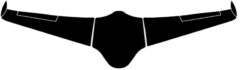
Starting in 2017, the Peregrine is an ambitious final-year capstone project dedicated to designing, optimizing, building, testing, and soaring with an additively manufactured Unmanned Aerial Vehicle (UAV) featuring a revolutionary Blended Wing Body (BWB) configuration. Next-generation airliners are proposed to have a BWB configuration due to their enhanced fuel efficiency and reduced noise levels, significantly lowering operational costs. This project leverages additive manufacturing to promote sustainability by minimizing material waste and energy usage. Additionally, it overcomes traditional manufacturing limitations, allowing for the creation of complex geometries that would be challenging or impossible to produce using conventional methods.
The Peregrine was initially developed to serve as a foundational aerial system, opening doors for groundbreaking research at Carleton University in areas such as aircraft configuration design, aerospace materials, structural optimization, stability and control, avionics, and aerodynamics.. However, the project has since been reexamined under a possible commercial lens, with the current year aiming to modify the design to be used in long-distance mapping applications.
Unmanned Aerial Vehicles (UAV) are complex systems that require a blend of skills in aerospace engineering, mechanical engineering, electronics, and control systems. This project aims to provide students with the opportunity to develop expertise in these interdisciplinary areas. The project focuses on three key aspects to enhance the skills of Carleton engineering students:
- Advancing engineering research, analysis, and design.
- Simulating a “real world” industrial environment that emphasizes teamwork.
- Exercising the design-prototyping-ground testing-flight testing product development cycle, typical of the aerospace sector.
The project is structured to mirror a real-life development team that graduates will encounter in their careers. Students will start with design requirements outlining specific technical and financial needs that must be met throughout the engineering process. They will create and review designs, manufacture essential components, and verify results through ground and flight testing by the end of the course. This practical approach prepares students to quickly become valuable members of a project team upon graduation.