Over the last couple of years, we’ve been active but a little slower in updating our site. Here’s what we’ve been up to in the Winter term 2026:
Ethnography During Difficult Times
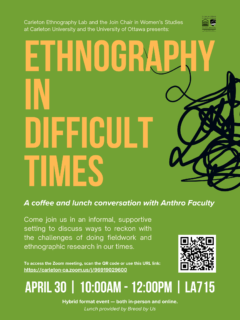 To offer a space for gentle camaraderie, students and faculty gathered on April 30, 2026, to reflect on the endurance required for conducting ethnography in difficult times. Over coffee and lunch, we discussed the challenges, responsibilities, and possibilities of conducting research amid ongoing global violence, displacement, and political uncertainty.
The conversation began with a reading shared by anthropology PhD student Ali Nazar from Munira Khayyat’s Introduction: Another Season of War in South Lebanon. Khayyat’s reflections on writing during war framed our discussion around a series of questions: What is writing for in times of crisis? Can ethnography become a form of witnessing? And what can anthropology offer when words seem insufficient in the face of violence and loss?
These questions opened into a conversation about what writing is for, what knowledge is for, and what ethnography can offer in times of heightened conflict and polarization. Together, we reflected on the limits of academic writing, the affective tensions of diasporic positionality, and what it means to be differently situated and differently responsible in relation to the stories we hear, record, and circulate.
Throughout the discussion, students shared experiences and insights from their own fieldwork and reflected on the responsibilities and commitments that extend beyond the research encounter.
Let’s Draw Together: a workshop on turning feminist research into comics/zines
Held on April 16, 2026, this workshop was a collaboration with students at the Feminist Institute of Social Transformation at Carleton University and the Institute of Feminist and Gender Studies at the University of Ottawa, along with the Joint Chair in Women’s Studies at both universities.
In this hands-on workshop, participants were guided through drawing exercises and the making of a mini-zine/comics to explore ways to story research otherwise. The workshop was led by the Joint Chair in Women’s Studies (Marie-Eve Carrier-Moisan) and drew on the teachings of American cartoonist Lynda Barry and her approach to drawing. We discussed the uniqueness of the language of comics and how it can be mobilized in our feminist/ethnographic research to narrate embodied experiences. We also talked about approaches to integrate drawings into our practices, including through journalling and “ethno-graphic” journalling, combining both image and text in our ethnographic observations. By the end of the workshop, participants had crafted a mini-zine or 4-panel comic, and we were excited about the possibility of continuing to engage with different modalities for storying research.
This workshop was also an opportunity for us to get together, learn about what other students are researching, build camaraderie, and think about how creative work can help us address some of the challenges of our time, in academia and beyond.