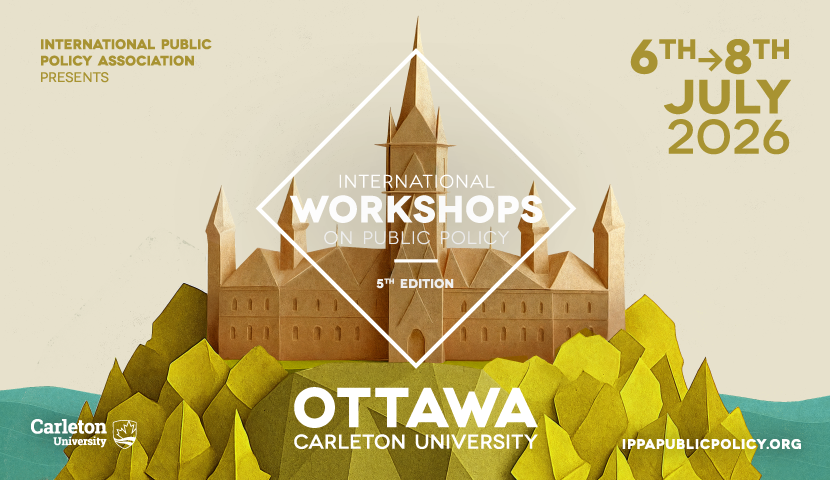
International Workshops on Public Policy – 5th Edition
Workshop: Corporate power and public policy: Shaping and controlling knowledge, practices, policies, and regulations
Call for Papers: November 10, 2025 – January 20, 2026
How do corporations strategically shape knowledge, practices and attitudes to steer policy and influence agenda-setting? Corporations do far more than market products: they strategically shape entire knowledge ecologies and, through them, professional practices, public discourse, regulatory agendas, and policy outcomes. A substantial body of scholarship in public policy, political economy, and science and technology studies (STS) has documented how the pervasive influence of large corporations shape and redefine public policy, the public interest, and market.
The term “ghost-management” refers to systematic corporate strategies to shape science, culture, policy agenda and public narratives, to hide risks and downplay harms of specific products and to influence experts, opinion leaders and policymakers, all while keeping the corporations’ roles obscured or in the shadows. Ghost-management encompasses practices such as planning, funding, and scripting of research; authorship and sponsorship arrangements; control over data, study design, and selective publication; deployment of key opinion leaders and “independent” intermediaries; revolving doors; litigation and lobbying strategies; and the architecture of social programs and public expenditures. Taken together, these practices can significantly influence or manipulate agenda-setting in public policy by steering what counts as evidence, which problems are seen as urgent, whose risks matter, and what regulatory solutions are “feasible.”
Because of ghost-management activities, public policy, especially when it came to sectors in which risk assessment has been central to earning-capacity, has long been vulnerable to corporate influence. The post-truth context in which disinformation, “alternative facts”, and “fake news” are becoming a growing challenge for the democratic governance of policy, is now amplifying these vulnerabilities to a whole new level.
This workshop invites contributions that theorize or empirically examine corporate ghost-management as a mode of governance. This workshop will bring together people from different disciplines to discuss how to study the influence of corporate power over public policy and to identify existing ghost-management strategies, so as to develop policy tools to counter these corporate dynamics detrimental to the policy process.
We welcome submissions from public policy, political science, STS/STS-informed policy, sociology, law, public health, communication studies, economics, information science, and adjacent fields. We particularly encourage team-authored work that bridges disciplines or pairs academics with practitioners, journalists, or civil society organizations. We welcome three types of contribution:
- Empirical work analyzing hidden corporate strategies at work to influence the policy process, or mapping its mechanisms across sectors;
- Theoretical work supporting an analytical framework to investigate these strategies; refining the conceptual approach based on ghost-management; connecting to theories of policy processes; or exploring governmentality and post-structural approaches;
- Analytical works translating findings into policy options and recommendations for institutional and policy remedies.
All accepted contributors will be invited to participate in the workshop discussions at Carleton University, where they will have the opportunity to present and receive feedback on their papers. Following the workshop, participants will be encouraged to submit revised versions of their papers for consideration for a special theme of the journal Studies in Political Economy.