Intelligent Connected Assistive and Autonomous Vehicles (ICAAV) Core
The ICAAV core at the Advanced Biomedical and Learning (ABL) Lab conducts cutting-edge research on intelligent vehicular technologies, including autonomous driving and advanced driver-assistance systems (ADAS). Our work spans the full development pipeline—from building experimental testbeds and hardware–software platforms to advancing algorithms for driver behaviour detection, road-user intention prediction, accident risk modelling, shared control, sensing, perception, and sensor fusion. We also focus on intelligent learning-based control, optimization, and dynamic authority allocation to enable safer, more adaptive, and collaborative driving systems.
Shared Control of Driving Based on Human-Machine State Detection and Risk Model using Assistive Haptic Controllers
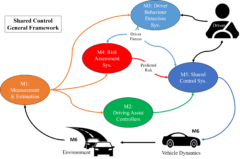
Driving is a complex task where human error remains the leading cause of fatal accidents, and current Advanced Driver-Assistance Systems (ADAS) fall short in covering all scenarios, adapting to individual drivers, and assessing machine competence. This research introduces the Shared Control System of Driving (SCSD), a collaborative human-automation framework that dynamically manages driving authority across tactical and control domains to reduce risk. SCSD builds on standard ADAS architecture—Acquisition, Perception, Decision, Control, and Actuation—with added modules for driver monitoring and arbitration, unified by a comprehensive risk assessment model that guides risk-averse trajectory planning and automation authority. The control system comprises high-level planners and low-level haptic controllers for real-time assistive action. Human-in-the-loop experiments are conducted using a custom-developed driving simulator and a real vehicle data collection platform. Key contributions include: a situationally adaptive assist framework; improved perception via stochastic sensor fusion; advanced learning-based control methods; multi-modal driver behaviour classification; a novel real-time risk prediction model; agile trajectory planning; and haptic shared control strategies ensuring stability, comfort, and driver acceptance.
Research Platform and Equipment
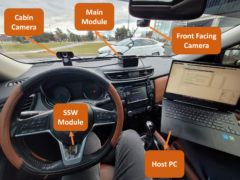
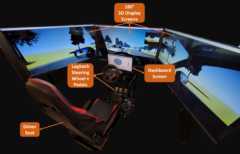
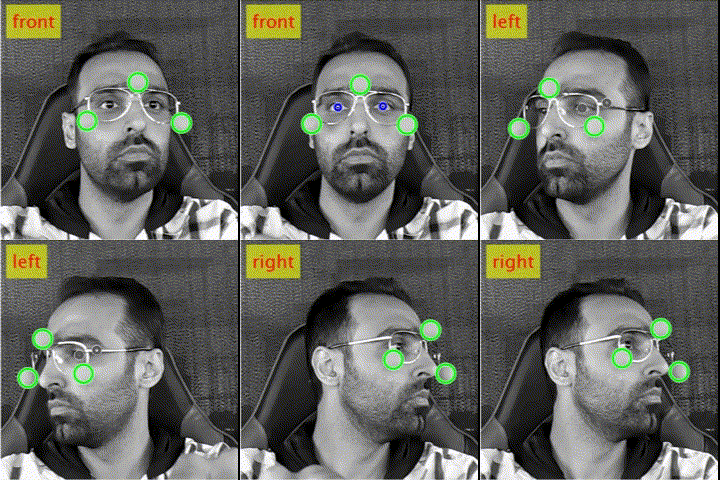
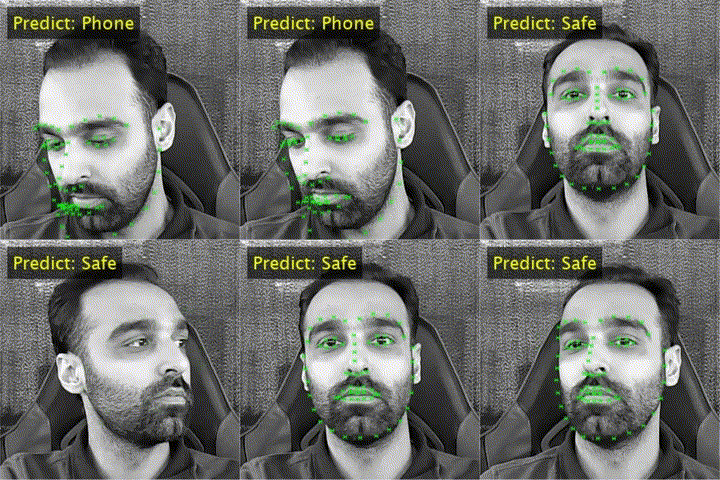
The ICAAV core has developed an advanced experimental platform for intelligent and assistive driving research. It features a mid-fidelity driving simulator for human-in-the-loop studies and a real-vehicle data logging system equipped with OBD-II, GPS, IMU, cameras, and custom steering wheel sensors to capture detailed driving and environmental data. A face–head–eye tracking system is also integrated to monitor driver gaze and attention, enabling comprehensive analysis of behaviour, intention, and interaction with shared control systems.
 |
|
   |
|