Nanomechanics
Ron Miller’s Research Group at Carleton University
Engineering Materials at the Nanoscale
We study the mechanical behaviour of materials, mainly using computer simulation. For us, “materials” usually means metals or polymers, but sometimes it means lubricating oils or even plasmas (so we are stretching the definition a bit). “Behaviour” is usually related to mechanical properties. Since materials are ultimately made of atoms, we ask the question: Can we understand, describe and predict the behaviour of materials from our underlying knowledge of how those atoms interact? To answer that question, we have to turn to computers, since the collective behaviour of many atoms is a complicated thing to describe mathematically.
Sometimes, we do experiments to synthesize materials or measure their properties, but we are almost always thinking about how the nanoscale features of the material microstructure participate in material response.
Related Sites
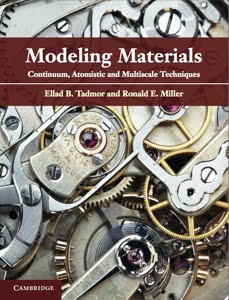
Modeling Materials
Textbooks co-authored by Professor Miller with Professors Tadmor and Elliott
QuasiContinuum Method
Multiscale Modeling

Open Knowledgebase of Interatomic Models (OpenKIM)
Standardization of interatomic potentials and data
Mechanical & Aerospace Engineering
The group’s home department
News
-
Arnav Rana successfully defends PhD thesis
Congratulations to Arnav Rana, who successfully defended his PhD thesis today. Arnav’s work, entitled “Studies of Anisotropic Ductile Fracture Behaviour in Pipeline Steels,” is an…
-
Arnav Rana’s work to appear in Engineering Fracture Mechanics
Arnav has made a nice contribution to the literature on J-Q theory, quantifying the limits of applicability of the theory in ductile fracture students, especially…
-
Alireza Rezvanpour paper accepted to Thermal Science and Engineering Progress
Alireza’s second paper with the group, “Prediction of PAN oxidation in a gas turbine bearing chamber using coupled chemical kinetics and CFD simulation of lubricant…
-
Our article on the use of scaling analysis as a tool for the validation of CFD results appears in the journal of Thermal Science and Engineering Progress
In this article, we proposed scaling analysis as a simple approach to replace experimental measurements to validate CFD results. In fact, we used scaling analysis to validate the…
-
Rafaela Aguiar’s work accepted to Scientific Reports
Rafaela’s second paper, “Microstructural evidence of the toughening mechanisms of polyurethane reinforced with halloysite nanotubes under high strain-rate tensile loading,” has been accepted to Scientific…
-
Our article on the MD simulations of spallation in polymers appears in the Journal of Applied Mechanics
In this article, we computed the spall strength of polyurethane samples by following two methods: (1) The indirect method (from the free surface velocity history,…