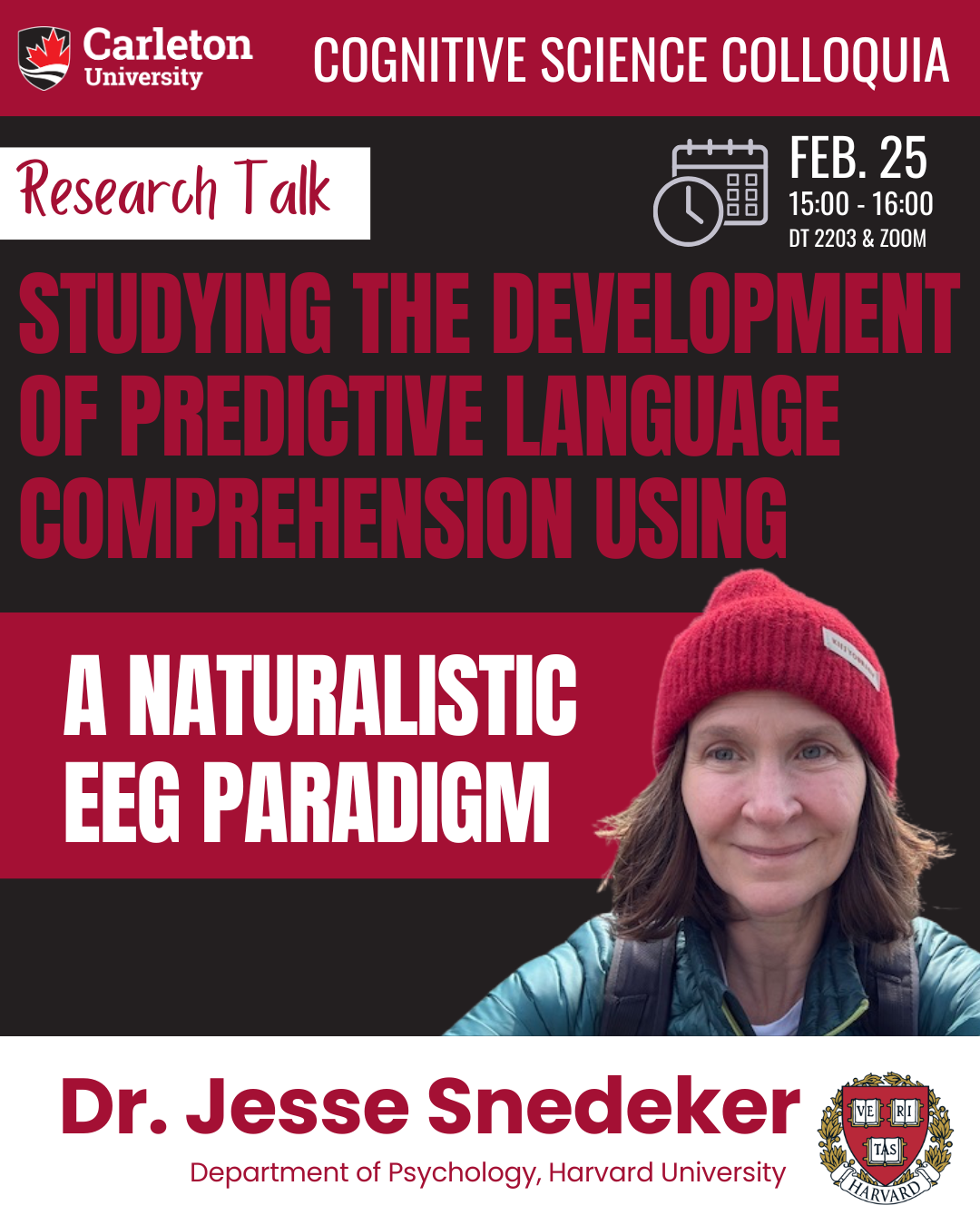
Join us on February 25th from 15:00 – 16:00 for our next Colloquium.
You can join on campus (DT 2203) or Zoom https://carleton-ca.zoom.us/j/96979364539
Follow this link for a complete listing of our Colloquia for Winter 2026.
Studying the development of predictive language comprehension using a naturalistic EEG paradigm
Featuring Professor Jesse Snedeker
Prof. Jesse Snedeker is a cognitive scientist at Harvard University who investigates how humans create, acquire, comprehend, and produce language. Her research spans from infancy through adulthood, examining both typical development and special populations including international adoptees, users of emergent sign languages and people with autism spectrum disorders. Using diverse methods, including eye-tracking and EEG, her lab explores fundamental questions about how language conveys meaning. Her work emphasizes methodological simplicity while addressing complex theoretical questions about linguistic representation and development.
Comprehension in adults is incremental, interactive and predictive. Not only do we interpret speech and text in light of top-down constraints, we also make predictions about upcoming lexical items before a word begins. For about 25 years, my lab has been exploring spoken language comprehension in 4- to 6-year-old children, who have considerable language experience but limited literacy. In our early work, we found that children’s syntactic processing was both incremental and interactive, but curiously impervious to top-down information. Recent work in my lab uses EEG to study lexical processing using a naturalistic listening task (the Storytime Paradigm). Our findings demonstrate that young children use top-down constraints to make form-based lexical predictions. Predictive skill improves with age and with linguistic knowledge (as measured by vocabulary). This raises several questions. Why do syntactic and lexical processes show such different trajectories? How does prediction shape language learning and early literacy? When does lexical prediction first emerge?