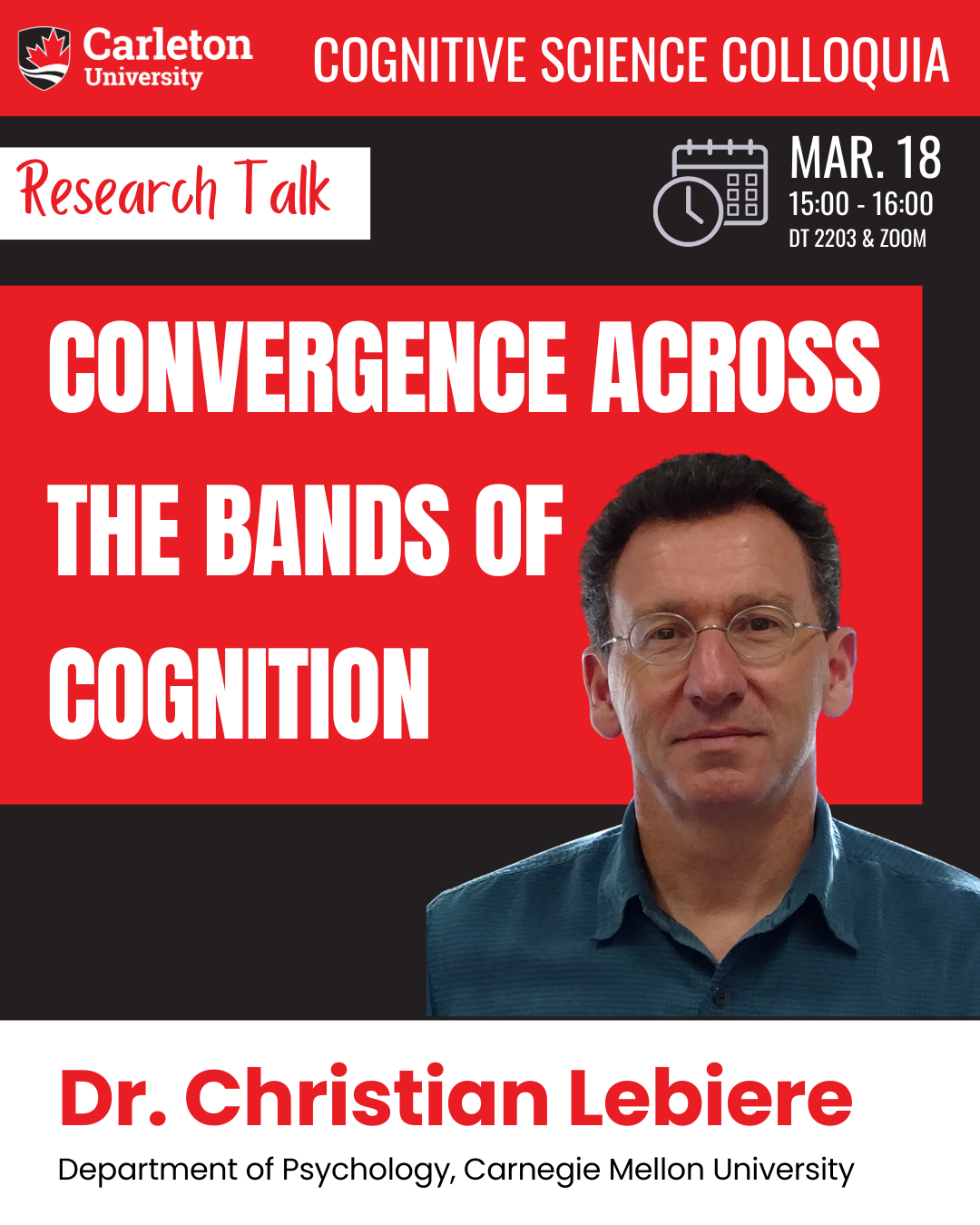
Join us on March 18th from 15:00 – 16:00 for our next Colloquium.
You can join on campus (DT 2203) or Zoom https://carleton-ca.zoom.us/j/96979364539
Follow this link for a complete listing of our Colloquia for Winter 2026.
Convergence Across the Bands of Cognition with Dr. Christian Lebiere of Carnegie Mellon University, will join via Zoom
Human cognition involves processes and phenomena taking place at scales ranging across orders of magnitude in time and complexity that Allen Newell called the bands of cognition. He proposed the concept of cognitive architecture as a theoretical framework for integrating cognitive mechanisms across task domains and scales of activity. In this talk, I present evidence that this approach has enabled convergence within and across the bands of cognition. A variety of cognitive architectures, developed in distinct disciplines including cognitive psychology and artificial intelligence, have converged in the cognitive band onto a consensus framework called the Common Model of Cognition. Going down to the neural band, the structure of this framework and its cognitive mechanisms have been validated using neuroimaging data. Functionally, this mapping enables the development of neuro-symbolic architectures that combine the strengths of neural learning and generalization and symbolic representations and inference. Going up to the rational band, bounded rationality is enabled by reflecting the statistical regularities of the environment in the design of the cognitive mechanisms. However, systematic deviations from rationality known as cognitive biases emerge from the interaction of knowledge and processing limitations of cognitive architectures. Further up into the social band, integrating large groups of interacting cognitive agents enables the emergence of social and organizational behavior.
Christian Lebiere is a Research Professor in the Psychology Department at Carnegie Mellon University. He received his Ph.D. from the CMU School of Computer Science where he studied connectionist models and was the co-developer of the Cascade-Correlation neural network deep learning algorithm. Since 1991, he has worked on the development of the ACT-R cognitive architecture and was co-author of the 1998 book The Atomic Components of Thought. Most recently he has been involved with the specification of the Common Model of Cognition, a community-wide effort to consolidate and formalize the scientific progress resulting from the 50-year research program in cognitive architectures. He is a founding member of the Biologically Inspired Cognitive Architectures Society, of the International Conference on Cognitive Modeling, and of the Journal of Artificial General Intelligence. His main research interests are cognitive architectures and their applications to psychology, artificial intelligence, human-computer interaction, decision making, network science, cognitive robotics and human-machine teaming.