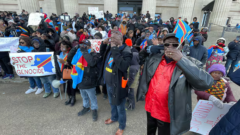
A protest in Winnipeg in support of the DRC (Radio-Canada/ Amine Ellatife)
Written by: Sienna Scullion.
The first time I was introduced to social justice movements was in 2020 during the Black Lives Matter (BLM) protests. It was the middle of a global pandemic and as I sat at home in my house my family and I watched thousands marching against police brutality. I had always cared about social justice, but this event truly spurred me into the fight for all. Since then, I have dabbled in the causes of Palestine and Sudan, for the rights of the disabled and women, but one cause has drawn me in like no other. This cause is the fight for the freedom of the Democratic Republic of the Congo (DRC). The DRC is one of the most exploited nations in the world. When I first started fighting for this cause I was surprised to see how few people seem to know let alone care about the DRC.
Here, I aim to explore why the DRC should be a cause all young people care about. I will first provide a brief history of the DRC and how it relates to the world at large. I will then cover what is currently occurring in the DRC. This will lead into a discussion of how the DRC and the issues there impact us all and why it’s particularly important for young people to care. Closing thoughts will follow.
The DRC’s history
The DRC was not always named the DRC, in fact, history has granted it various different names. The DRC was initially called The Congo Free State, a name given to it by Leopold the II of Belgium. During the late 19th century Africa faced a new wave of colonization in which European empires vied for different territories. Belgium came late to this scramble leaving it with few options. Or so this is how it first appeared. Leopold, through the help of explorers and academics was able to “discover” the Congo. Leopold then claimed to the world that he was taking on a humanitarian mission in the DRC to bring “civilization” to the Indigenous people there. In reality this was a cover for exploitation and brutalization. Leopold’s government stole land from communities using unfair contracts which the chiefs and leaders of villages could not read. The exploitation was first done for minerals and other general resources until it was discovered that the DRC was rich in rubber trees. Rubber was a heavily coveted resource at the time used in the manufacturing of various resources such as military equipment. Leopold’s extraction of this rubber was brutal and amounted to slavery. People were forced to work in dangerous conditions and if they refused to work they faced brutality such as the amputation of hands and other extremities. It is estimated that anywhere between just over one million people to ten million died during Leopold’s reign.
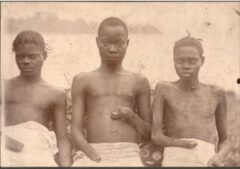
A photo showing workers, boys, in the DRC with amputated hands (Presbyterian Historical Society/Unknown Author)
When the other imperial nations discovered Leopold’s reign, they were so horrified at the abuses that they quickly put a stop to it. This did not, however, bring peace to the DRC. The DRC continued to face exploitation and conflict until the election of Patrice Lumumba. Lumumba was an anti-imperialist African who was democratically elected by the people of the DRC. He promised to end the exploitation of the DRC and was a beacon for a nation that had so long been exploited by others. A few months after his election Lumumba was assassinated. Lumumba’s assassination was backed by the US government who opposed his anti-imperialist beliefs. This resulted in the implementation of Mobutu Sese Seko, a brutal dictator who continued the exploitation of the people of the DRC. Seko also was the leader that the DRC became Zaire under for a period of time.

An official portrait of Patrice Lumumba (Wikiquote/author unknown)
The 1990s continued to bring struggles for the DRC as thousands fled to the DRC during the Rwandan genocide. Initially, it was thousands of Tutsis that were forced out of Rwanda and into the DRC as they tried to avoid being slaughtered. By the end, the Genocide forced thousands of Hutus out of Rwanda who feared repercussions after participating in the genocide of the Tutsi. During this period, we also saw a United Nations mission to the DRC. These factors led to the first and second Congo wars which were some of the bloodiest wars in Africa’s history.
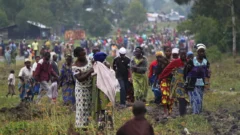
A photo showing hundreds displaced during the Second Congo War (OXFAM/ Maire Cacace)
Where are we now/ Forever exploitation, war and human rights exploitation
DRC is still facing heavy exploitation to this day. While materials like rubber and uranium have been side-lined targets of exploitation, other materials such as cobalt, lithium, copper and coltan have taken the spotlight. All of these minerals are needed in the creation of modern technology such as electronic vehicles, solar panels, computers, phones, vapes, and other modern electronics. In particular the minerals of cobalt, copper, and lithium are needed in the creation of electric lithium-ion batteries which are used in most modern electronic devices.
The way these minerals are extracted is extremely exploitative, violent, violates human rights, destroys the environment and rubs the young of their future. The mines, run by North American, European and Chinese firms, aim to maximize their profit at the expense of people, their cultures and the environment on which their livelihoods depend. When a company secures a mining concession, community’s land is grabbed, people are dispossessed, infrastructures are destroyed and artisanal miners are unemployed. In those mines, even children are sometimes employed. When companies employ adult men and women, they are given next to no legal protections and often work in dangerous job sites where, if they are physically injured, they are not given compensation. The mines themselves, beyond being dangerous, also host other dangers for the communities in the area. Firstly, these mines are often heavily militarised by security firms or local para-military groups, and national armies. These groups intimidate the communities and perpetuate sexual and physical violence against men, women, and children.
The mines are also extremely environmentally damaging. To purify the minerals, mining companies use chemicals such as mercury and cyanide acid which are dangerous to human life and the ecology. The mines themselves decimate local communities and the run off of the minerals and metal toxins, mines release chemicals into water, soil and air. This results in people being more susceptible to illness and physical conditions. It also raises the risk for birth defects and reproductive illness. Animals are equally venerable particularly fish who live in waters polluted by waste dumping and mineral run off.
The Congo is also currently under threat from the Rwandan backed military group March 23 (M23). In spite of the peace agreements that have been signed in the united states (link) and Quatar (Link), M23 and other militia groups have not stopped attacking Congo (cite the attack of M23 today) The M23 is a primarily Tutsi group that is currently terrorizing the regions near the DRC/Rwanda border. These areas include Goma and the Great Lakes Region particularly around Lake Kivu. The M23 invades spaces, the exploitation of the DRC’s resources, and commits acts of violence including sexual assault against the people of the DRC. The president of Rwanda, Paul Kagame has actively denied the interference of Rwanda in the DRC and has denied they are funding the M23. The global community has had little response to help the DRC and many nations continue to allow their companies to exploit the DRC and its minerals. Uganda has also contributed towards the suffering in the DRC through their use of Allied Democratic forces (ADF). These groups terrorize civilians and further contribute towards the exploitation of minerals in the DRC.
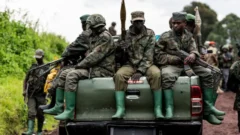
A photo showing M23 soldiers on the back of a car (AP Photos/Moses Sawasawa)
Why we must care
Young adults, millennial and generation Z, are the first generations to grow up with affordable technology. Our generations have swiftly learned how to use computers, phones and more, turning them into a part of our daily lives. Our generations are also the ones to create new technologies. We are the pioneers of the future. Due to this, it is important that we care about the DRC, their people, and their resources. As we work our way up the corporate ladder or secure jobs in the ever-evolving tech industry, it’s important that we know where our resources come from and how to assure, they aren’t conflict minerals. If the minerals must come from the DRC, then it is imperative they come from ethical mines which protect their workers and care about the communities they exist alongside. This will not only assure that we can feel comfortable knowing the work we do is not powered by blood but will also allow us to feel comfortable knowing we are actively supporting global communities rather than exploiting them.
As a young adult I have been privileged to be exposed to the revival of the Palestinian resistance. Although Palestine is not yet free, young adults across the world have fought for the rights of Palestinians against the Israel-settler state, striving towards freedom and the recognition of the Palestinian state. If this can be done in Palestine, then this can be done for the DRC. As young people we have the ability to protest and lobby for change and eventually make that change ourselves. In nations like Canada and the United States this is particularly important as operations stemming from said nations are the main perpetrators of abuse and exploitation. I do not expect that young people travel to the DRC themselves or get arrested in their home country as they fight for the rights of those in the DRC. However, young people are able to educate others and lobby for their local politicians in order their nations may change how they relate to the DRC.
Here are examples of things that you can do to support those in the DRC:
- 1. Demand justice for Congo: As we have done with Palestine, we must not forget Congo. We are all benefitting from Congolese exploitation. Demand tech companies to engage in just access to minerals and metals. For example, companies need to develop the infrastructure- schools, roads, hospitals etc. (I have removed those organizations because they are not helping)
- 2. Educate others about the DRC and how many of our minerals are sourced from there. Whenever I try to speak with people on the DRC, I find they are often uneducated. While education is not a direct fix it is the first step into action. People cannot fight for a cause they do not know exists.
- 3. Avoid purchasing new technology. While new technology is often exciting it is also a major factor contributing to the exploitation in the DRC. If you can repair or continue to use your older technology, then do so. If you must buy new technology, then buy second hand.
- 4. Keep up with the news. By keeping up with DRC related news you will be able to better understand the conflict and what can be done to fight against it. You will also gain important knowledge about central Africa which may be useful in other aspects of your life.
Final thoughts
I have spent the last two years of my life working towards freedom for the DRC. I have written many articles, researched for hours, and educated tens of others on the conflict and mineral exploitation taking place in the DRC. This cause has not been the only one I’ve fought for, far from it. I have long been involved in the fight for Palestine and for Indigenous rights in Canada; however, the DRC has always held a special place in my heart. The DRC is a beautiful nation that for the past two centuries has faced some of the worst exploitation possible. This exploitation is something the DRC continues to face so that the rest of the world may have access to technology. Despite this fact, the DRC is continually ignored by activists and protestors.
I wrote this article in hopes to change that. By covering the history and modern-day context of the DRC as well as why we should care I hope to encourage young people to take up the cause. I do not believe that this article will result in all those that read it to take on the burdens and struggles of those in DRC. Nor do I believe that this is needed. But if this article is able to educate those that read it and spark on even the smallest action then we may be able to spark change for all those in the DRC and Africa at large. An injustice anywhere should never leave us indifferent. We are so interconnected more than we think and should work together to build a better world especially for our generation and that of our children. Let us dare to dream a world that the capitalist world systems have failed to create.

A photo from 2016 showing those in the DRC protesting their corrupt government (REUTERS/Francois Lenoir)