Today, January 16, 2026 Ugandans are electing a president and parliamentarians. For forty years the country has been ruled by President Museveni, his family and cronies many of whom originate from the same ethnic group. Uganda has gradually transitioned from ‘becoming a democratic state to an autocratic government. The Museveni government has used hard and soft forms of repression to suffocate dissent. The young people’ , many of whom are under the age of 30 and have known only Museveni as president. Under the leadership of Robert Kyagulanyi (aka Bobi Wine) Ugandans, and especially the youth are struggling for freedom and democracy and are the targets of increased state repression. To prevent Uganda and the entire Africa’s Great Lakes Region from sinking into increased violence, human rights violations, influx of refugees, and mass killings it is important to support the young people’s struggle.
 A man with the Uganda flag going though tear gas
President Museveni’s rule
During his inauguration in 1986, Museveni asserted that it was a “fundamental change” for the country and “Any individual, any group or person who threatens the security of our people must be smashed without mercy. The people of Uganda should only die from natural causes… but not from fellow human beings.”
In the same speech, he castigated African leaders who fail to uplift their people from poverty. “His excellence is going to the United Nations… and he is there for meetings” when his people have no shoes, health care, food and other basic needs. He has written books: What is Africa’s problem? (2002) and his answer is ‘leaders who overstay in power and propagate evils including corruption, human rights violations and destruction of the environment. He criticized his predecessors as dictators who failed to serve people, enriching themselves while the population remains impoverished. His second book: Sowing the Mustard Seed (1997) is about Uganda’s struggle for freedom and democracy. However, gradually President Museveni became the autocratic ruler he had condemned when first elected.
To sustain himself in power, the regime has deployed various forms of political repression and human rights violations,
Authoritarianism and vote rigging. Authoritarianism is reinforced by personal/family control of institutions particularly the military, police, the judiciary, the legislature and the electoral commission. Museveni has rigged votes in every political election, using tacts such as ballot staffing, killing and kidnapping of opposition polling agents. This year, the electoral imported electronic/biometric voting machines but never educated the population on how to use them. On many polling stations, the machines failed to work, to the extent that even President Museveni was unable to use the machines. Authoritarianism is reinforced by institutional control by the president, his family and members from his ethnic group. Institutions are headed and monopolized by people from the president’s ethnic group even when they lack the necessary qualifications. The President’s son Muhozi Kainerugaba is Uganda’s Chief of Defence forces (CDF). The first lady is the minister of education, a member of parliament and was the minister of Karamoja, although she is not a Karamojong. This means she received three salaries. Several times, Museveni has asserted that he is a freedom fighter, working for higher authorities, himself, children and grandchildren.
Corruption and control of national wealth: He refers to national natural resources such as oil estimated at 6.65 billion barrels as “my oil”. In fact, revenues from oil, gold, and other natural resources never feature in the national budget. Land, especially where it is fertile and suitable for cultivation, or rich with natural resources (e.g. minerals, metal and oil), locations for business and cattle grazing has been grabbed from Ugandans and is in the hands of people from the president’s family, ethnic group, prominent government officials and business people working for the first family. The president, his family and his cronies in power have amassed wealth through corruption. President Museveni’s manifesto is now about protecting their gains. The UK government sanctioned Uganda official including the Speaker of parliament for corruption and the U.S. did the same. However, the majority of the population languish in poverty, During political campaigns, their poverty is used to bribe them with cash, food and T-shirts to elect the president.
Poverty and unemployment: Uganda has one of the youngest populations in the world. As of June 2025, Uganda ranked 157th out of 193 countries on a UN global development index. This index measures standards of living. Children still study under trees and hospitals are dilapidated. According to the World Bank, nearly 60% of the population lives on less than US$3 a day. Unemployment is between 64 % and 70%. Many youth the majority with university degrees ride motor cycles, locally known as Boda Boda and pay huge taxes to the Uganda revenue agency.
Human rights violations: human rights abuses are rampant in Uganda and perpetrators going unpunished. Supporters of Bobi Wine have faced beatings, torture, arrests, disappearances, imprisonment, trials in military courts and extrajudicial killings. Kenyan activists who were kidnapped while attending Bobi Wine’s campaign narrated the ordeal political opponents face in torture chambers commonly known as safe houses. Museveni refers to torture chambers as ‘cold rooms.’ Bodies of some victims have been found thrown in different places. It is also alleged that some people are buried in mass graves at night and others are thrown to crocodiles. In 2020, security forces killed dozens of opposition supporters. Bobi Wine himself has survived several assassination attempts. His campaigns are frequently blocked. He has been pepper sprayed, tear-gassed, beaten, shot at and prevented from accessing hotels to sleep. . While the police and military brutalizes civilians, the government is banning streaming of such brutality.
Digital repression. On the eve of the election day, the government suspended internet access, and blocked platforms to prevent citizens from sharing evidence of state violence. This digital clampdown is a central tool of political control.
Bobi Wine’s Defiance and Leadership in the struggle for democracy
Bobi Wine, famously known as the “people’s president” to restore Uganda to its original glory as the Pearl of Africa. He is promising to restore democracy, constitutionalism, justice, and civilian rule. He recently contributed to the Playbook for African Democrats. He avowed to end corruption, unify and heal the country, ensure equal access to public services, create jobs, provide quality education and restore respect for human rights and the rule of law. At the risk of his life, Bobi has campaigned throughout the country for more than 100 days. As people headed to the votes, he encouraged Ugandans not to be afraid. On his facebook page he wrote: “The world needs to know what is happening in Uganda on election day. Internet switched off. Massive ballot stuffing reported everywhere. Our leaders, including Deputy President for Western Region, arrested. Many of our polling agents and supervisors abducted, and others chased off polling stations. BVVK machines have failed everywhere. The PEOPLE OF UGANDA MUST RISE TO THE OCCASION AND REJECT THE CRIMINAL REGIME. THE WORLD MUST NEVER GIVE ANY LEGITIMACY TO THE REGIME OF BLOOD AND SHAME.”
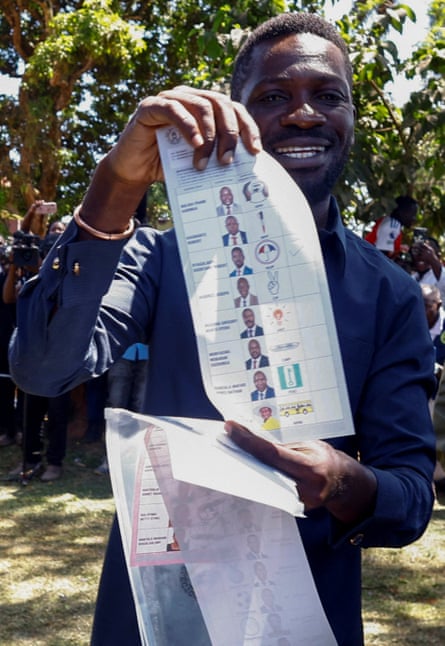
Bobi Wine casting his vote /Getty Images
After casting his vote, The military and police have surrounded the residence of Bobi Wine, effectively placing him and his wife under house arrest. Security officers have unlawfully jumped over the perimeter fence and are now erecting tents within his compound.
Why Uganda calls for urgent response
On January 14, the African union observation mission and the Eastern Africa Standby Force met with Bobi wine. Bobi Wine encouraged the officers not to be compromised by the state.
It remains crucial to stop a possible genocide and other forms of mass killings. Museveni’s son who is the military chief of staff tweeted about beheading Bobi Wine. Bobi Wine has repeatedly said “We have reliable information that the regime in Uganda is planning a massacre. They are planning to provoke people into an uprising so they can justify massacres of people to send a chill across the country. Several times, during the campaign Bobi appealed to the international community to take interest in the potential massacre in Uganda and prevent it. Ethnic and regional tensions are rising. Museveni has said every soldier will have 120 bullets to silence protesters .
Africa’s Great Lakes region (Uganda, Kenya, Tanzania, Rwanda, Burundi and the DR Congo) has experienced cycles of violence dating back to the 1980s. Museveni’s bush war (1980-1986) was followed by the 1994 Rwanda genocide. President Paul Kagame of Rwanda was the chief of military intelligence in Uganda. It was from Uganda that the Rwanda Patriotic Army (RPA) organized and invaded Rwanda (1990-1994). Thus, there is a strong connection between the two countries. In 1996, Uganda and Rwanda invaded the DR Congo, triggering a wave of violence that persists to date. The violence is heightened by Museveni’s militarisation of the DRC and, his and that of president Kagame’s support for militias, especially the March 23 Movement (M23).It is alleged that the M23 are in Uganda and are employed by the government.
The regime’s violence and human rights violations must be addressed. The violence that ensued in 2021 is a hint to what might happen during the post election period. Ugandans are worried that if the regime returned into power, political opponent and areas that have not voted for the president will experience increased repression. Perpetrators of violence and human rights violations must be prosecuted.
The Great Lakes Region is on fire and it is going to get more repressive, especially if Uganda experiences post election violence or if there will be no regime change . Uganda’s neighbours, Tanzania which has been the oasis of peace in the region, has experienced police, military and allegedly mercenaries assassination in the post election period . In 2007, Kenya experienced post election violence and the healing process is far from being achieved. Kenya’s young people continue to protests against government corruption and police brutality and have been met with violence and abductions.
The struggle for democracy and freedom led by Bobi is an example of how young people across Africa are longing for leaders to build democratic states in line with national, human, and resource potential. If Uganda succeeds, it will not only emancipate Ugandan, it will contribute to peace, security and development in Africa’s Great Lakes region. Uganda, Rwanda and Burundi have experienced violence like no other part of Africa. For the West, building democratic states in Africa is one way of stopping the influx of migration to their countries and to archive global developmental strategies such as the sustainable development goals, peace and security. Democracy has long been regarded as the political system that transformed the world. Today, we urgently need healthy democracies to resolve domestic and global issues, (e.g wars, poverty, food insecurity and climate change) and to realize the Sustainable development goals.
Possible interventions
Bobi Wine has continuously called and mobilized Ugandans to “fight’ for their rights and to “liberate” their country. Ugandans must know that they are the ones to spearhead their liberation.
The African Union and other international bodies must remain vigilant.
Judicial and financial penalties must be imposed on officials, leaders, military and police personnel who have violated peoples rights and plundered national resources.
Foreign forces must not provide the government with weapons and military personnel
Bobi Wine must be offered personalized protection by the African Union and/or the United Nations.
Amidst allegations of vote rigging and regime control of institutions including the judiciary, international laws must be followed to verify the election results and to demand accountability from the regime.
Written by Evelyn Mayanja, edited by Sienna Scullion.