By Will Brady
While it may still seem to some like futuristic technology, artificial intelligence (AI) is already having impacts on almost every facet of Canadian life in real time.
That was a central theme at Carleton University’s third annual Challenge Conference, where leaders in academia, business, government and the community gathered to explore how society is navigating the disruption and transformation spurred by rapid advances in AI.
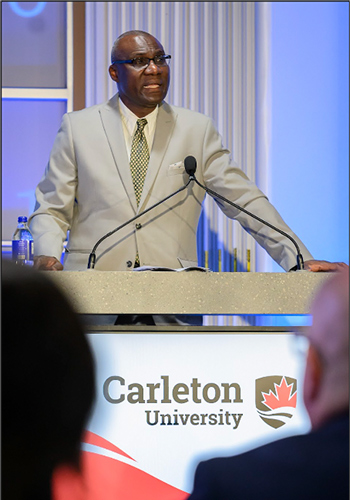
University President Wisdom Tettey opened the third annual Carleton Challenge Conference by highlighting both the “trepidation” many feel about the advances in artificial intelligence and the immense possibilities presented by the technology.
As if on cue, the conference was under way at the very moment when it was announced that Prime Minister Mark Carney — who was unveiling the new federal cabinet at Rideau Hall — had appointed the country’s first Minister of Artificial Intelligence and Digital Innovation, former CBC and CTV broadcaster Evan Solomon.
Meanwhile, at the front of a packed room in Carleton’s Richcraft Hall, University President Wisdom Tettey opened the conference —sponsored by the Ottawa-based Danbe Foundation and Ericsson, the Swedish-based technology company — by acknowledging that AI brings certain levels of risk, but also immense opportunity.
“When they hear the word AI, it just evokes in people different kinds of emotions,” said Tettey.
“And while there may be risk with that, the potentials are something that excites people about looking at the possibilities that attenuate the impact, that reduces the risks and allows us to work together in common purpose.”
This is the third annual Challenge Conference hosted by Carleton. The 2024 edition focused on climate change solutions and featured key leaders and experts from business, government and academia. The inaugural conference in 2023 offered informative and thought-provoking conversations about the world’s mental health crisis, a societal challenge brought into sharp focus as nations grappled with the COVID-19 pandemic.

Leveraging the power of AI
In his welcoming remarks, Tettey described several university initiatives that are already leveraging the power of AI for the greater good. He cited the work being done by Carleton Computer Science Professor Majid Komeili — a conference panelist — who has been engaged in a high-profile research project with the City of Ottawa on how to use machine learning to predict an individual’s risk of chronic homelessness. It’s a real-world application of AI aimed at helping local government support early and effective intervention in one of Canada’s most pressing social challenges.
Adegboyega Ojo, the conference’s keynote speaker, is a professor at Carleton’s School of Public Policy and Administration and the Canada Research Chair in Governance and Artificial Intelligence. Ojo described AI as a tool with “the power to fundamentally transform economic and social structures across a wide range of industries.” He equated the transformative power of AI to such historic technological innovations as the discovery of electricity, the invention of the steam engine and the rise of the Internet.
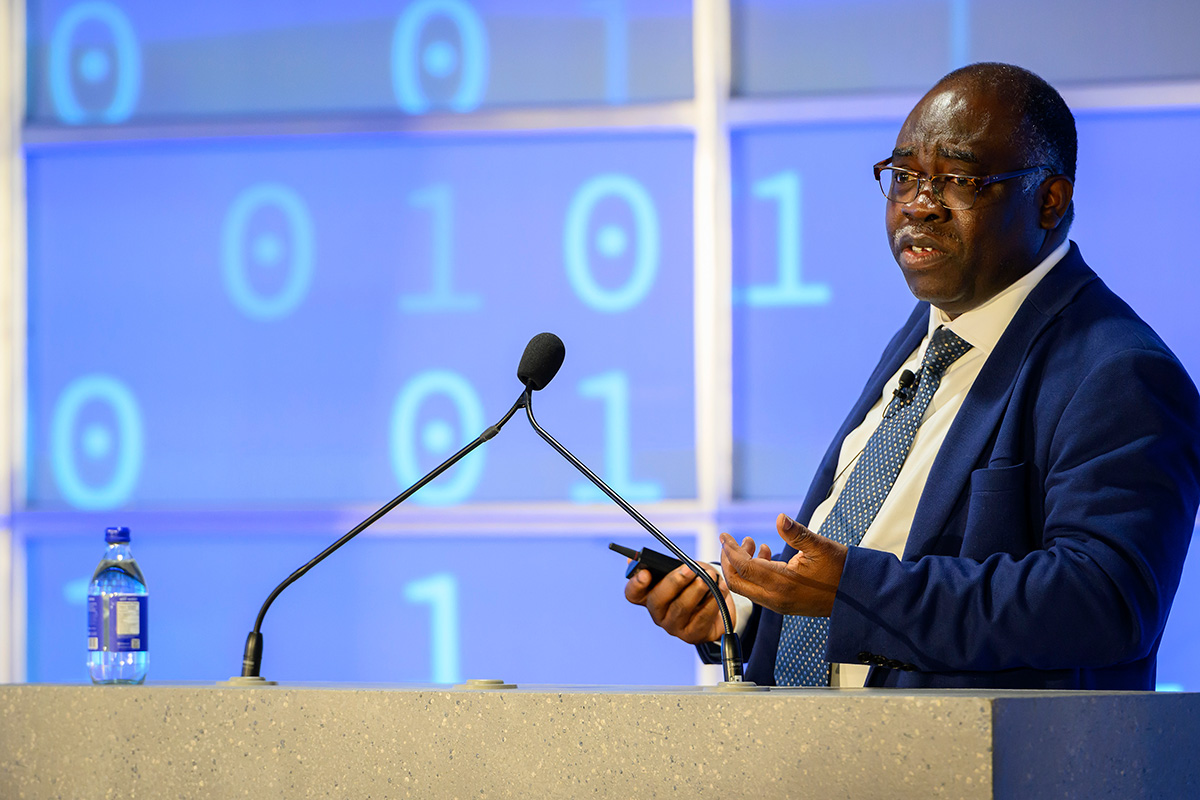
Carleton Professor Adegboyega Ojo, Challenge Conference keynote speaker and Canada Research Chair in Governance and AI, highlighted the “AI Paradox” facing Canada as it attempts to translate its strong research profile on AI into economic and social benefits.
Naturally, said Ojo, an instrument with that level of potential influence has governments scrambling to determine the best way to both harness and leverage AI’s power. He outlined the current global landscape around AI, noting that international organizations such as the Organization for Economic Co-operation and Development, European Union, United Nations and African Union have all established frameworks promoting responsible deployment of AI technology.
Even so, Ojo’s presentation included a warning: “Global efforts in responsible AI significantly lag behind rapid AI adoption, leaving critical gaps unaddressed in safeguarding human rights and protecting vulnerable groups.”
To highlight the risks, he pointed out that in just a two-day period this month — May 5 and May 6 — the OECD AI observatory flagged a host of potential safety and ethical concerns, including an official White House account posting an AI-generated image of U.S. President Donald Trump, a WhatsApp voice scam causing major financial losses, and a doctor prescribing the wrong drug dosage based on AI-generated advice.
Ojo also noted that there are clear regional leaders in AI development, with the United States charging ahead of Canada and other countries in AI readiness and model releases, and East Asia dominating research output.

The AI paradox facing Canada
This led to what he described as the “AI paradox” facing Canada. According to Ojo’s research across multiple AI indexes, Canada is a global leader in responsible AI and is home to a world-class research and innovation ecosystem. However, the country’s AI leadership has yet to meaningfully translate to social and economic impact at the rate expected.
He highlighted relatively low levels of private and public investment in artificial intelligence infrastructure in Canada compared to global AI leaders.
“The infrastructure gap is very clear,” said Ojo.
One of the reasons for this, he explained, appears to be low levels of public trust. Fewer than 50 per cent of respondents to a 2024 survey agreed with the statement that products and services using AI have more benefits than drawbacks.
Ojo said boosting levels of public trust in AI is an essential part of the task ahead for the Canadian government.
“If public trust is not developed, there is always going to be low demand,” said Ojo. “So even though we have very strong, responsible innovation framework, we must start to really integrate that trust.”
Overall, Ojo expressed approval of the Canadian government’s current AI plan, noting that it aims to address pressing issues such as low-scale AI investment, and the brain drain that results from a lack of dedicated initiatives to “retain domestic AI talent or attract back expatriates.”
He emphasized to those in attendance that now is the time to act, calling the need to responsibly seize upon the economic and social opportunities presented by artificial intelligence a “carpe diem” moment for Canada.
“It has to be now,” said Ojo. “We just have to do it.”