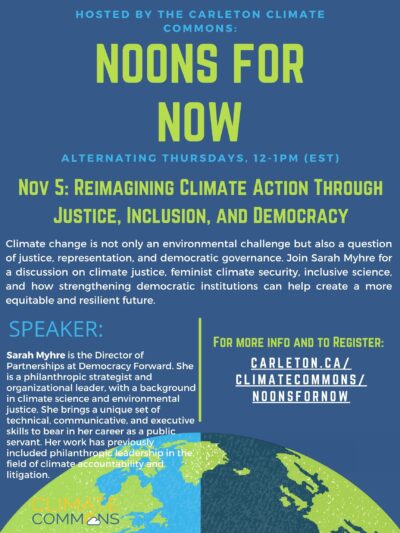
Climate change is not only an environmental challenge but also a question of justice, representation, and democratic governance. Join Sarah Myhre for a discussion on climate justice, feminist climate security, inclusive science, and how strengthening democratic institutions can help create a more equitable and resilient future.
Speaker: Sarah Myhre is the Director of Partnerships at Democracy Forward. She is a philanthropic strategist and organizational leader, with a background in climate science and environmental justice. She brings a unique set of technical, communicative, and executive skills to bear in her career as a public servant. Her work has previously included philanthropic leadership in the field of climate accountability and litigation. Dr. Myhre received a Ph.D. from the University of California at Davis and is a Kavli Fellow with the National Academy of Sciences. She has served on the board of directors of several organizations, including FutureWise Washington and ReclaimingSTEM Institute.
Actions
“Staying in the Work” (Sarah Myhre)
- Continue engaging with climate issues even when progress feels slow.
- Resist withdrawal, cynicism, or paralysis.
- Focus on sustained participation rather than perfection.
“Stay in Relationship” (Sarah Myhre)
- Maintain connections with people and communities.
- Deepen relationships with the more-than-human world.
- Build collective resilience through solidarity and care.
Broaden the Definition of Science
- Value multiple forms of knowledge, including:
- Indigenous knowledge
- Community expertise
- Lived experience
- Social sciences and humanities
- Recognize that scientific understanding is strengthened through diverse perspectives.
- “Science is deeply human” (Sarah Myhre)
“Sit with Uncertainty” (Sarah Myhre)
- Accept that climate solutions involve complexity and ambiguity.
- Avoid simplistic answers to difficult social and environmental challenges.
- Remain open to learning and adaptation.
Acknowledge That Nobody Is Disposable
- Center human dignity in climate policy and action.
- Consider who is most vulnerable to environmental harm.
- Advocate for equitable outcomes rather than sacrificing certain communities for the benefit of others.
Challenge Silo Thinking
- Connect environmental, social, economic, and democratic issues.
- Encourage collaboration across disciplines and sectors.
- Recognize that climate change is simultaneously a scientific, political, and justice issue.
Resource List
Organizations
- Democracy Forward
- https://democracyforward.org/
- Focuses on strengthening democratic institutions, advancing rights, and accountability through legal advocacy.
- Ecojustice
- https://ecojustice.ca/
- Canadian environmental law organization working on climate accountability, environmental protection, and public-interest litigation.
Books and Articles
- Facing Gaia: Eight Lectures on the New Climatic Regime
- Explores climate change as a political, social, and philosophical challenge rather than only a scientific one.
- Emphasizes humanity’s relationship with Earth as an interconnected system.
- “Bruno Latour, the Post-Truth Philosopher, Mounts a Defense of Science” (New York Times, 2018)
- Useful for understanding Latour’s views on science, expertise, democracy, and public trust.
- Roland Barthes: Mythologies
- Examines how cultural narratives become accepted as “natural” or unquestioned truths.
- Judith Butler: The Force of Nonviolence
- Argues that all lives are interconnected and that no person is disposable.