Members of the SENSE-APP research team participated in the AGE-WELL Annual Conference, held in Ottawa on November 3rd and 4th, 2026.
The conference brought together over 450 leaders across academia, healthcare, and industry under the theme “From Innovation to Impact: Powering Canada’s AgeTech Ecosystem” to showcase technology solutions designed to transform independent living and healthy aging.
Dr. Kathleen Van Benthem and Lindsay McCauley presented poster sessions highlighting recent findings on senior driver safety, vehicle automation, and age-inclusive digital design.
Senior Drivers’ Trust and Use of Advanced Driver Assistance Systems to Advance Safety
Authors: Kathleen Van Benthem, Lindsay McCauley, Alexia Bierlaire, Bruce Wallace, Jocelyn Keillor, and Chris M. Herdman
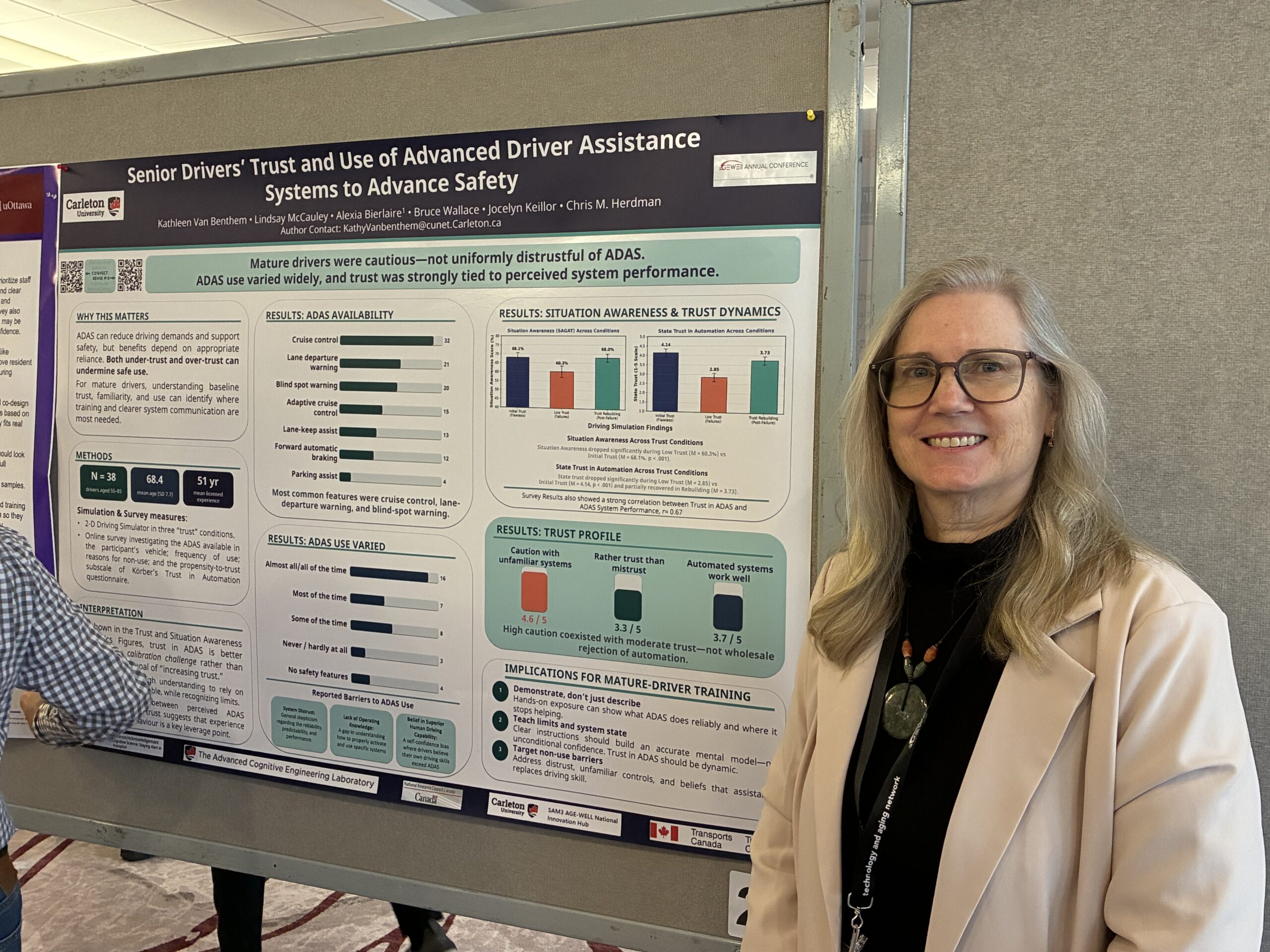
Dr. Kathleen Van Benthem presenting research on senior drivers’ trust and use of Advanced Driver Assistance Systems (ADAS) at the AGE-WELL 2026 Annual Conference.
What We Studied
Modern vehicles are increasingly equipped with Advanced Driver Assistance Systems (ADAS), which include features like cruise control, blind-spot monitoring, and lane-keeping assistance intended to reduce driving demands and enhance safety. However, whether drivers safely adopt these tools depends on their level of trust. This study evaluated how drivers aged 55 and older view and use ADAS, measuring baseline trust, familiarity, and perceived reliability to identify key areas for driver training.
Key Findings
- Older drivers showed a strong precautionary attitude toward unfamiliar car technologies while maintaining a moderate level of overall trust in automated systems.
- Trust was strongly tied to how well the system actually performed in real time rather than a fixed personal mindset.
- While basic features like cruise control were widely used, common barriers to adopting more advanced features included system distrust, a lack of operating knowledge, and a belief that human skill exceeds system capability.
Why It Matters
Effective driver support requires building an accurate mental model rather than simply encouraging unconditional trust. Clear instructions and practical, hands-on training can demonstrate what ADAS features do reliably and where their limits lie, helping mature drivers navigate safe transitions to automated vehicle technology.
Mature Drivers’ Perceptions of Telematics: Implications for Age-Inclusive Design
Authors: Lindsay McCauley, Kathleen Van Benthem, Bruce Wallace, Jocelyn Keillor, and Chris M. Herdman
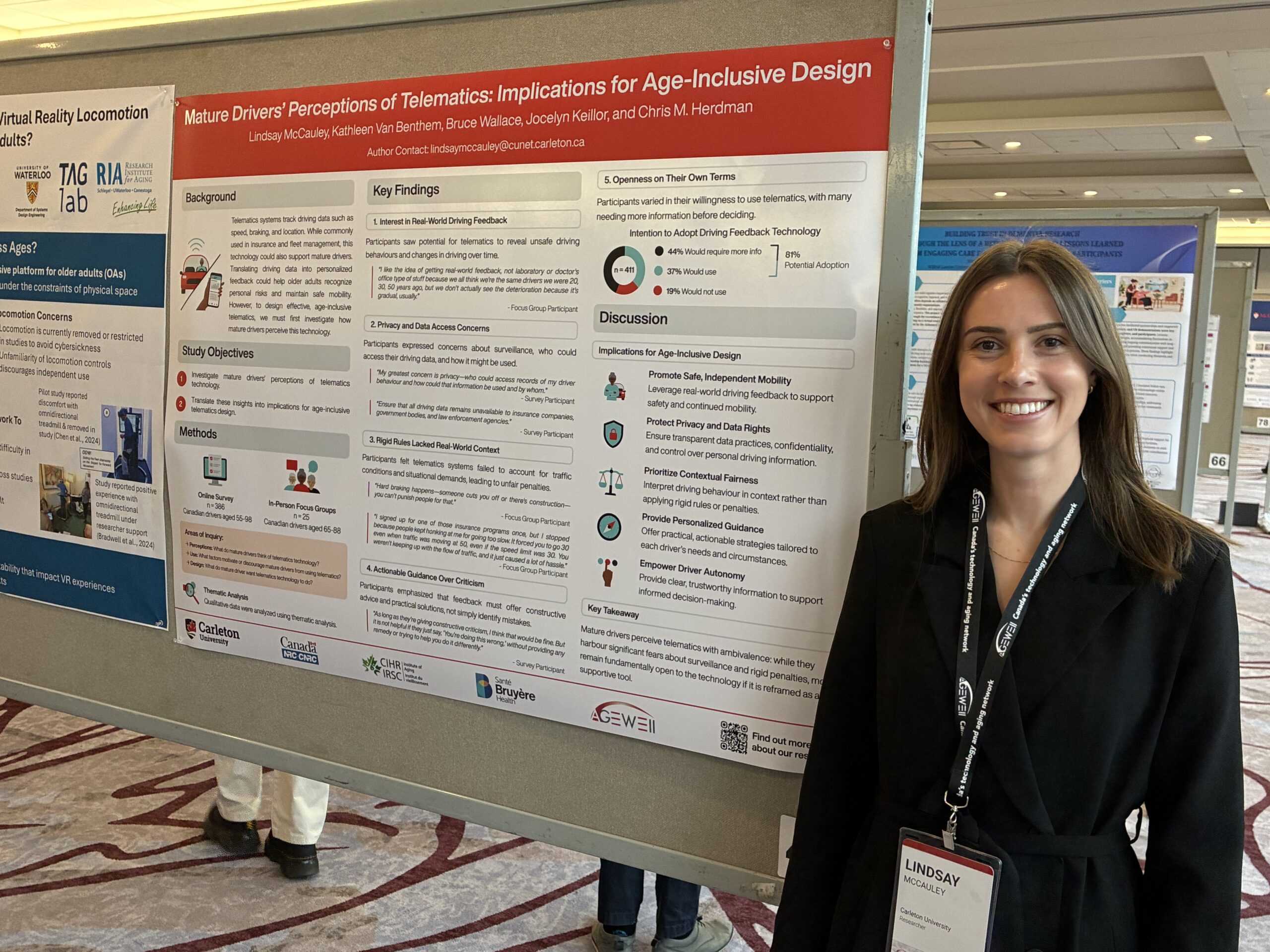
Lindsay McCauley presenting findings from our mixed-methods study on mature drivers’ perceptions of telematics at the AGE-WELL 2026 Annual Conference.
What We Studied
Vehicle telematics technology captures real-world driving data such as speed, braking, acceleration, and location. While typically used for insurance monitoring or fleet tracking, telematics offers significant potential in AgeTech to support safer, independent mobility by giving older drivers meaningful feedback on their habits over time. This mixed-methods study combined a national survey of Canadian drivers aged 55 and older (n = 386) with in-depth focus groups (n = 25) to investigate how mature drivers perceive telematics and how to design systems that truly support them.
Key Findings
- Participants frequently expressed low trust toward traditional tracking, fearing surveillance, loss of control, and data misuse by external entities.
- Participants felt rigid algorithms penalize drivers unfairly for necessary safety actions, such as hard braking to avoid a collision or keeping up with the flow of traffic.
- Despite initial hesitancy, over 80 percent of participants were open to adopting driving feedback technology if it was framed as a helpful coaching tool rather than a punitive monitoring system.
Why It Matters
Understanding mature drivers’ perceptions of telematics provides the foundation needed to build effective driving feedback tools. Directing design choices toward resolving concerns around privacy protection, rigid scoring, and contextual fairness enables the development of telematics tools that empower safe, independent, and continued mobility.
Learn More About Our Research
The SENSE-APP team’s work builds on the Advanced Cognitive Engineering (ACE) Laboratory’s broader research in driver behaviour, road safety, and human factors. Visit the Advanced Cognitive Engineering (ACE) Lab website to learn more about our driving research and ongoing projects.