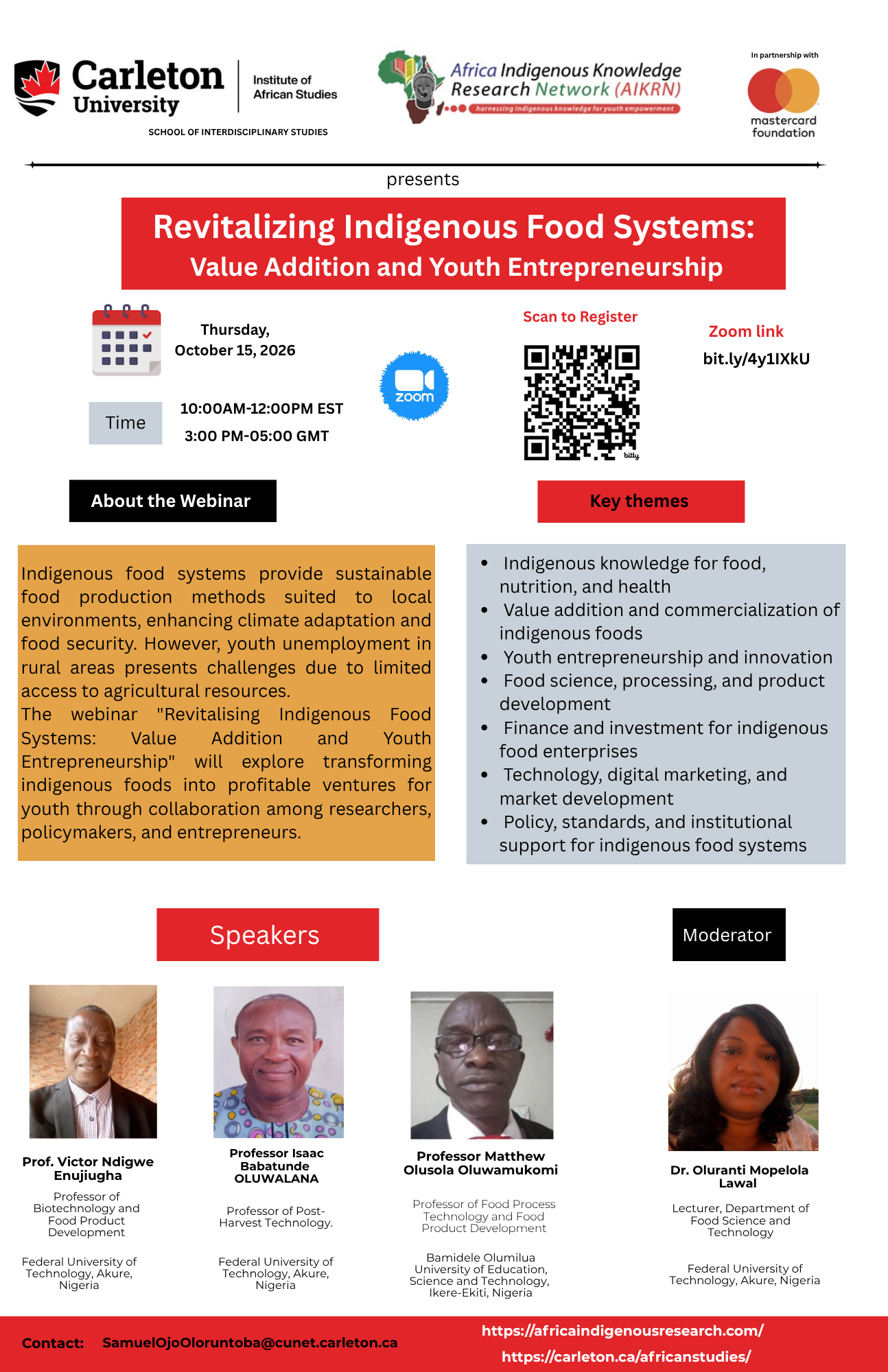
Revitalising Indigenous Food Systems: Value Addition and Youth Entrepreneurship
October 15, 2026 at 10:00 AM to 12:00 PM
| Location: | Zoom |
| Cost: | Free |
| Audience: | Alumni, Anyone, Carleton Community, Current Students, Media, Staff and Faculty |
| Contact Email: | AfricanStudies@cunet.carleton.ca |
As part of the AIKRN Webinar Series, the Africa Indigenous Knowledge Research Network (AIKRN) and the Institute of African Studies at Carleton University invite you to join us for:
Revitalising Indigenous Food Systems: Value Addition and Youth Entrepreneurship
Date: October 15, 2026
Time: 10:00 AM – 12:00 PM (ET)
Venue: Online via Zoom
About the Webinar
Indigenous food systems represent some of the world’s most resilient and sustainable approaches to food production, processing, distribution, and consumption. Many indigenous crops are well adapted to local environmental conditions and can withstand drought, heat, pests, and poor soils, making them important resources for climate adaptation, biodiversity conservation, food and nutrition security, and resilient food systems.
At the same time, youth unemployment remains a major challenge, particularly in rural communities. Agriculture and food enterprises offer significant opportunities for employment and income generation, yet many young people continue to face barriers such as limited access to finance, land, infrastructure, technology, markets, and viable business opportunities.
The webinar, “Revitalising Indigenous Food Systems: Value Addition and Youth Entrepreneurship,” will explore how indigenous foods and knowledge can be transformed into innovative, profitable, and sustainable enterprises for young people.
By bringing together researchers, policymakers, Indigenous knowledge holders, youth entrepreneurs, farmers, private-sector actors, investors, development partners, civil society organizations, and other stakeholders, the webinar will provide a platform for knowledge sharing, dialogue, networking, innovation, and collaboration.
Key Themes
The two-hour webinar will explore key areas including:
- Indigenous knowledge for food, nutrition, and health;
- Value addition and commercialization of indigenous foods;
- Youth entrepreneurship and innovation;
- Food science, processing, and product development;
- Sustainable economic development;
- Finance and investment for indigenous food enterprises;
- Technology, digital marketing, and market development;
- Policy, standards, and institutional support for indigenous food systems.
The webinar will also highlight opportunities for young entrepreneurs to engage in areas such as food production, seed multiplication, processing, packaging, branding, product development, e-commerce, digital marketing, agritourism, indigenous restaurants, nutrition enterprises, and export marketing.
Youth Innovation Showcase
A special Youth Innovation Showcase will provide selected young entrepreneurs with an opportunity to present indigenous-food businesses and innovations and receive feedback from technical experts, researchers, investors, and other stakeholders.
Interactive discussions will focus particularly on finance, technology and processing, and policy and standards, with the goal of identifying practical actions and potential partnerships.
Proposed Speakers and Panelists
Prof. S. O. Oloruntoba
Founder, Africa Indigenous Knowledge Research Network
Institute of African Studies, Carleton University, Canada
Prof. V. N. Enughuija
Professor of Biotechnology and Food Product Development
Federal University of Technology, Akure, Nigeria
Prof. Oluwamukomi
Professor of Food Process Technology and Food Product Development
Bamidele Olumilua University of Education, Science and Technology, Ikere-Ekiti, Nigeria
Prof. I. B. Oluwalana
Professor of Post-Harvest Technology
Federal University of Technology, Akure, Nigeria
Moderator
Dr. O. M. Lawal
Lecturer, Department of Food Science and Technology
Federal University of Technology, Akure, Nigeria
Expected Outcomes
The webinar seeks to strengthen indigenous food systems as pathways for youth entrepreneurship and employment, climate resilience, food and nutrition security, biodiversity conservation, sustainable livelihoods, innovation, and inclusive economic development.
By combining Indigenous knowledge, food science, modern processing technologies, entrepreneurship, investment, digital innovation, and market development, the webinar aims to demonstrate how indigenous food systems can become strategic assets for sustainable livelihoods and resilient communities.
The webinar will ultimately focus on transforming indigenous food resources and knowledge into viable, innovative, and sustainable enterprises, particularly for young people.