Funding/Research Supports
NSERC
Project Status
Complete
Project Overview
In cold regions like Canada, winter road maintenance plays a critical role in ensuring safe and reliable transportation. Deicing materials are widely used to mitigate ice formation on pavements; however, their efficiency and environmental impacts vary significantly. Conventional rock salt, although effective, has been associated with infrastructure corrosion and environmental concerns. Therefore, evaluating alternative deicing materials is essential for improving winter maintenance practices.
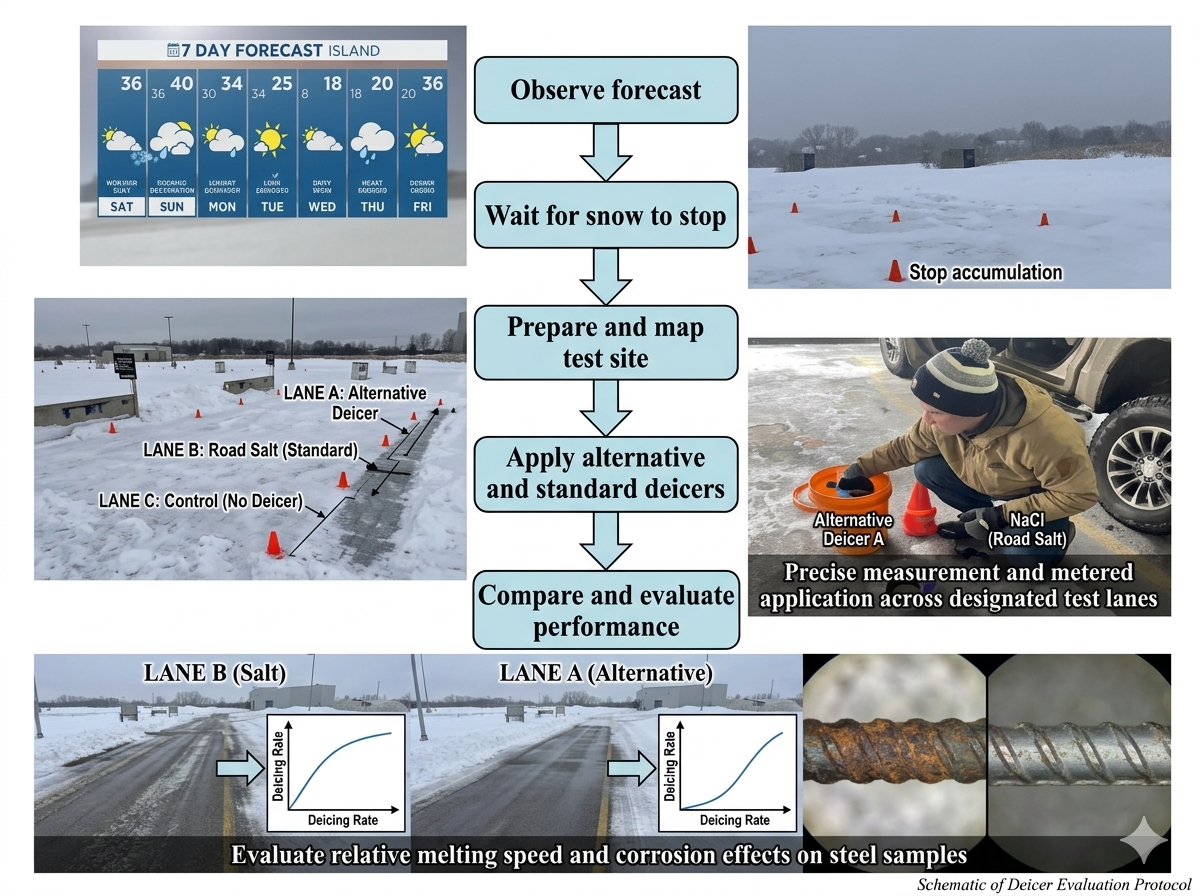
In this research, laboratory and field experiments will be conducted to assess the performance and environmental impact of various deicers. Seven alternative deicers, along with conventional rock salt, will be evaluated through a series of controlled laboratory tests, including ice melting capacity and ice penetration tests. These experiments will be performed under different temperatures and application rates to measure the melting efficiency and penetration capability of each deicer.
In addition, a corrosivity test will be carried out by exposing steel rebar samples to deicer solutions under repeated wet-dry cycles over a period of four weeks. This analysis will help determine the potential of each deicer to cause infrastructure corrosion. Furthermore, a field experiment will be conducted to evaluate the bare pavement regain efficiency of rock salt under extreme cold conditions at varying application rates.
The results obtained from this study are expected to provide valuable insights into the performance, durability, and environmental impacts of different deicing materials. The findings will support transportation agencies in selecting more effective and environmentally sustainable deicing strategies, ultimately contributing to safer winter roads, reduced infrastructure damage, and improved long-term maintenance practices.
Project Report
Link to Report: An investigation on the deicing potential of road salt and alternative deicers