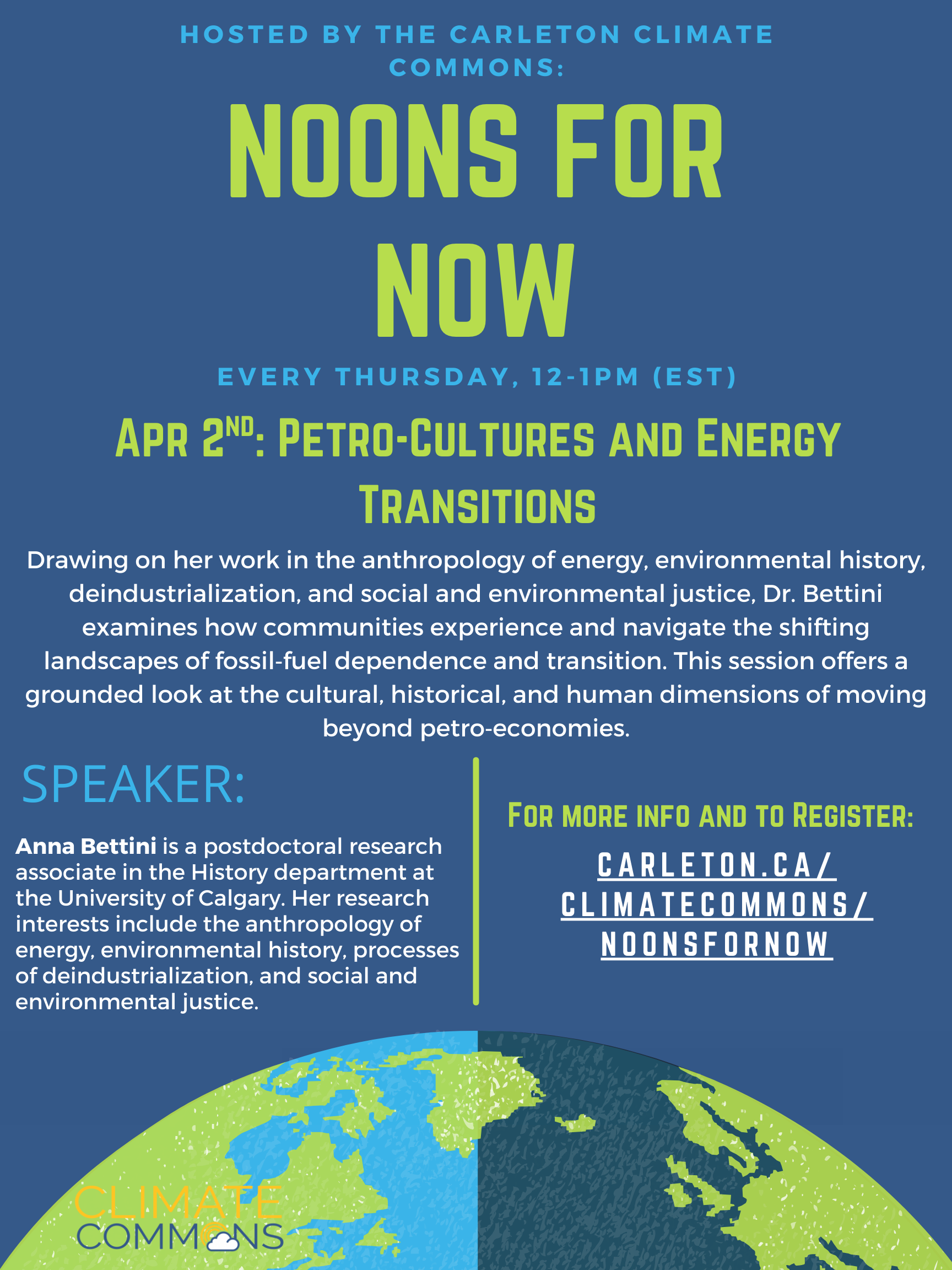
Drawing on her work in the anthropology of energy, environmental history, deindustrialization, and social and environmental justice, Dr. Bettini examines how communities experience and navigate the shifting landscapes of fossil‑fuel dependence and transition. This session offers a grounded look at the cultural, historical, and human dimensions of moving beyond petro‑economies.
Speaker: Anna Bettini postdoctoral research associate in the History department at the University of Calgary. Her research interests include the anthropology of energy, environmental history, processes of deindustrialization, and social and environmental justice.
Actions
- Learn About Your Local Energy History
- Look up how your city or region has been shaped by fossil‑fuel industries, infrastructure, or past industrial booms and declines.
- Identify whose stories are missing or underrepresented.
- Map Your Own Energy Use
- Track your daily energy consumption (transportation, heating, digital use).
- Reflect on how habits, convenience, and cultural norms shape your dependence on fossil fuels.
- Talk to Community Members Affected by Energy Transitions
- Reach out to workers, families, or neighborhoods impacted by plant closures, resource extraction, or new energy projects.
- Listen for themes of identity, loss, resilience, and adaptation.
- Support Local Just‑Transition Efforts
- Join or follow groups working on equitable energy transition, worker retraining, or community‑led climate planning.
- Attend town halls or public consultations on energy policy.
- Explore Energy Humanities Resources
- Read or watch materials that examine the cultural and human dimensions of energy (e.g., Petrocultures, Energy Humanities).
- Share a resource with someone else to spark conversation.
- Reflect on Your Own Petro‑Culture
- Identify ways fossil fuels shape your routines and sense of possibility.
- Consider one small shift you could make that aligns with a post‑carbon future.
- Amplify Voices of Environmental Justice
- Follow Indigenous, frontline, and marginalized communities advocating for fair energy transitions.
- Share their work or support campaigns that center justice.
- Engage in Policy Conversations
- Write to local representatives about the importance of just transition planning.
- Ask how they are addressing the social and cultural impacts of energy change.
Resource List
Anna Bettini:
- Anna Bettini’s Website
- Bettini, Anna. “We feel left behind:” Ethnographic Perspectives on Just Transition, Re-Training, and Future of Energy Among Oil & Gas Communities in Alberta, Canada
- Bettini, Anna. Review of Just Transitions: Social Justice in the shifts of a low carbon economy by Edouard Morena, Dunja Krause, Dimitris Stevis.
Energy:
- Dominic Boyer & Imre Szeman (eds.), Energy Humanities: An Anthology.
- Imre Szeman, On Petrocultures: Globalization, Culture, and Energy.
- Deborah Cowen, The Deadly Life of Logistics.
Environmental History & Fossil‑Fuel Transitions:
- Timothy Mitchell, Carbon Democracy: Political Power in the Age of Oil.
- Andreas Malm, Fossil Capital: The Rise of Steam Power and the Roots of Global Warming.
- Vaclav Smil, Energy and Civilization: A History.
Deindustrialization:
- Steven High, Industrial Sunset: The Making of North America’s Rust Belt.
- Sherry Lee Linkon, The Half-Life of Deindustrialization: Working-Class Writing About Economic Restructuring.
- Alice Mah, Industrial Ruination, Community, and Place