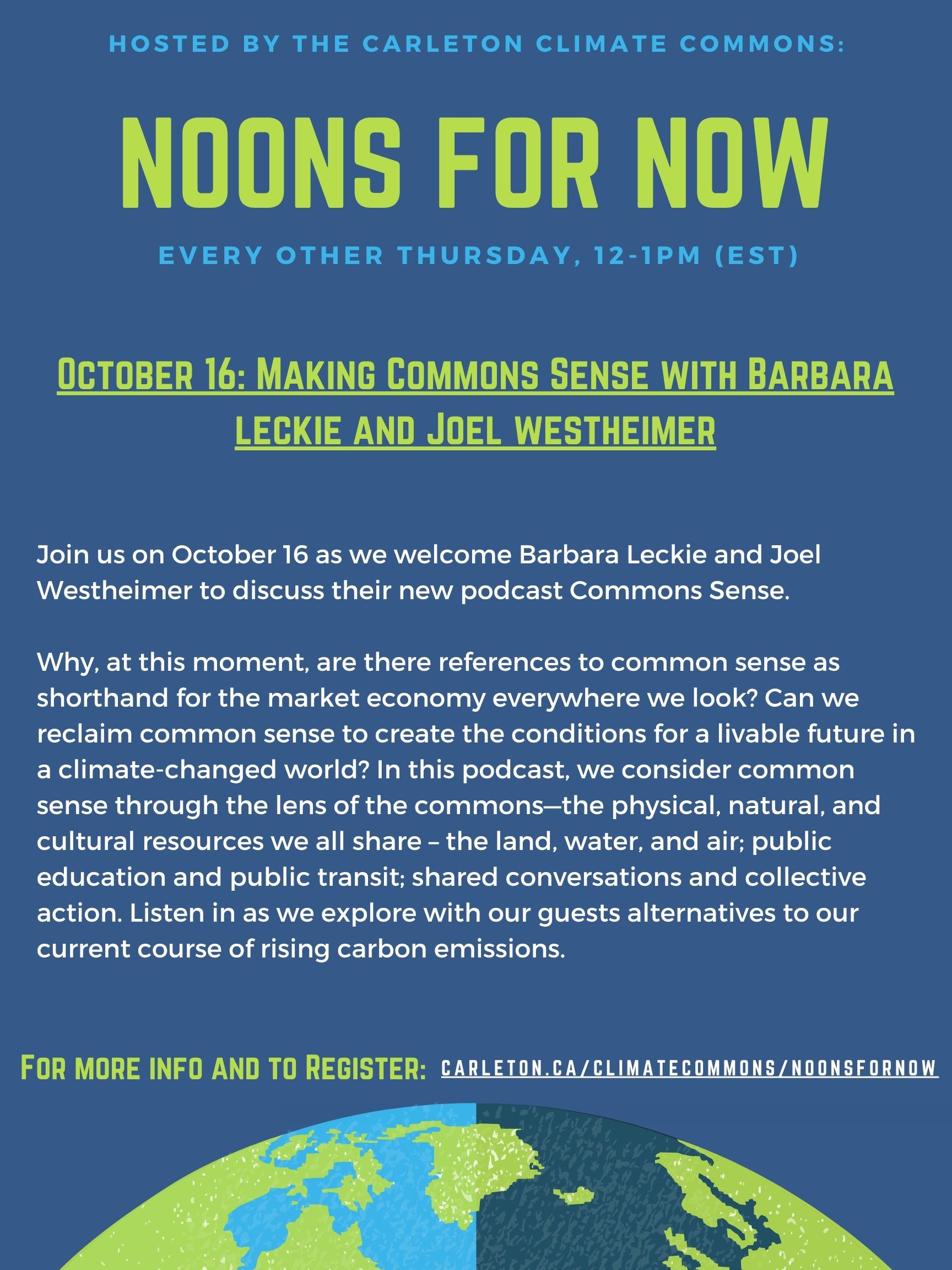
Join us on October 16 as we welcome Barbara Leckie and Joel Westheimer to discuss their new podcast Commons Sense.
Why, at this moment, are there references to common sense as shorthand for the market economy everywhere we look? Can we reclaim common sense to create the conditions for a livable future in a climate-changed world? In this podcast, we consider common sense through the lens of the commons—the physical, natural, and cultural resources we all share – the land, water, and air; public education and public transit; shared conversations and collective action. Listen in as we explore with our guests alternatives to our current course of rising carbon emissions.
Speakers:
- Barbara Leckie is a professor in the Department of English and the Institute for the Comparative Study of Literature, Art, and Culture at Carleton University, Ottawa. She is the author of Climate Change, Interrupted: Representation and the Remaking of Time (Stanford UP, 2022) and Open Houses: Poverty, the Architectural Idea, and the Novel in Nineteenth-Century Britain (U of Penn P, 2018) as well as several articles and edited collections. Her current work focuses on collectivity, collaboration, and co-writing in response to the climate crisis. She is also Academic Director of Re.Climate: Centre for Climate Communication and Public Engagement.
- Joel Westheimer is Professor of Democracy and Education at the University of Ottawa and an Education columnist for CBC Radio. His books include Among Schoolteachers: Autonomy and Ideology in Teachers’ Work; Pledging Allegiance: The Politics of Patriotism in American Schools (forward by Howard Zinn); and What Kind of Citizen? Educating our Children for the Common Good. His current work focuses on youth perceptions of democracy at a time of rising populist nationalism. He is a regular contributor to newspapers and magazines including The Washington Post, The Toronto Star, and The Globe and Mail.
Actions
- Listen to “Commons Sense”: Tune into the podcast to understand different perspectives on common sense and its relation to the commons.
- Host a Listening Group: Gather friends or neighbors to listen to the podcast together and share thoughts on its themes.
- Buy Locally: Purchase food and goods from local farmers’ markets or cooperatives to support local economies and reduce carbon footprints.
- Participate in Community Gardens: Get involved in or start a community garden to foster local food production and community ties.
- Join Local Environmental Groups: Collaborate with organizations that focus on climate action and community resource management.
- Practice Shared Resources: Encourage sharing practices, such as tool libraries or carpooling, within your community.
- Educate on Public Goods: Learn about the importance and care of public goods like public transit, parks, and education.
- Engage in Circular Economy: Support businesses that focus on recycling, reusing, and sustaining resources effectively.
Resource List
Podcasts:
- Commons Sense Podcast
- Amplify Podcast Network
- Conscient Podcast
- Conscient Podcast: Everyday Habits for Transforming Systems Episode
Articles:
- Arendt, Hannah. ‘Philosophy and Politics.’ Social Research 57.1 (1990): 73–103.
- Barthes, Roland. “Myth Today,” Mythologies. 1957.
- Crehan, Kate. Gramsci’s Common Sense: Inequality and Its Narratives. Duke University Press, 2016.
- Lesjak, Carolyn. The Afterlife of Enclosure: British Realism, Character, and the Commons. Stanford UP, 2021.
Books:
- Rosenfeld, Sophia. Common sense: A political history. Harvard University Press, 2011.
- Low, Setha M. Why public space matters. Oxford University Press, 2023.
- Marron, Catie. City Squares: Eighteen Writers on the Spirit and Significance of Squares Around the World. HarperCollins, 2016.
- Ruddick, Margie. Wild by Design: Strategies for Creating Life-Enhancing Landscapes. Island Press, 2016.
- Cohen, Mitchell. Rhythms of Change: reflection on the regent park revitalization. Page Two Books, Inc., 2024.
- Ostrom, Elinor. Governing the commons: The evolution of institutions for collective action. Cambridge university press, 1990.
- Ostrom, Elinor. “Tragedy of the commons.” The new palgrave dictionary of economics. Palgrave Macmillan, London, 2008. 1-5.
Other: