Spatial Determinants of Health Lab
Advancing spatial and social theory to understand and address health inequities in Canada.
Health is not distributed randomly. It is shaped by where people live, work, and age — and by the social and structural forces that make some places healthier than others. The Spatial Determinants of Health Lab at Carleton University studies these relationships through the lens of health geography, using spatial theory and quantitative methods to understand how place, inequality, and health intersect across Canada.

Our research is connected via a focus on quantitative methods and the development of novel measurement approaches, analytic tools, and new data sources. Recent methods development includes assessment of postal code geocoding error, development of a national population density surface, and a service-specific rural accessibility index. Research themes include: health inequalities and antifragility in rural communities; geography and mental health; environmental exposures and neurodevelopmental disorders; and multiple-cause-related mortality by income and geography. Across these projects, our team works with complex Statistics Canada microdata in the Carleton Research Data Centre, develops interactive geospatial visualizations, and promotes open science through open-access datasets and code libraries.
Research Themes
- Rural health and service accessibility: examining geographic barriers to health and social services, with particular attention to communities defined by remoteness and social marginalization.
- Geography and mental health: understanding spatial and social inequalities in mental health outcomes, focussing on the use of geographic methods in mental health research.
- Environmental exposures and neurodevelopment: investigating the spatial dimensions of environmental risk factors and their associations with developmental disorders.
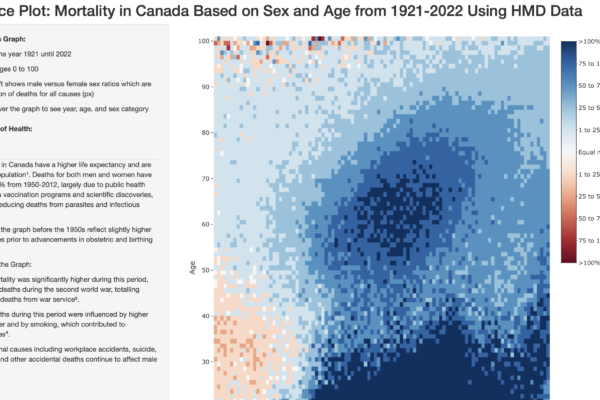
- Cause-related and multiple-cause mortality: analyzing income-based gradients in mortality across Canada using linked administrative and vital statistics data.
Open Data and the Rural Data Portal
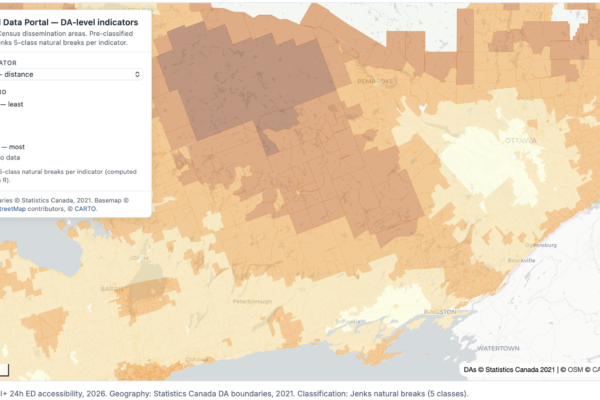
Alongside our peer-reviewed research, the lab develops and maintains open data resources for researchers, public health professionals, and community partners. Our Rural Data Portal supports an ongoing research program on rural health and the social determinants of health in Canada, built around the Canadian Accessibility and Remoteness Index (CARI+), a population-weighted measure of travel time and distance from every dissemination area in Canada to essential services including emergency departments, schools, and birth services.
| Explore the data at: https://rural-data.com.
Code Repositories and Replicable Tools
In keeping with Open Science principles, we have developed code repositories for recent papers examining geocoding misclassification error and development of small-area population density surfaces. Via GitHub, we have posted the code, tables and an R correction tool for a national validation of PCCF+ postal code geocoding against the National Address Register (12.4 million addresses).
We have developed a portable R-based tool that reports positional error and deprivation misclassification by delivery mode, and corrects MSDI-based rates and rate ratios for geocoding error.
| Explore the code at: https://doi.org/10.5281/zenodo.23564814
From Research to Practice
Our lab works with community and health system partners to translate spatial research into tools that support decision-making. This includes geospatial analytics partnerships with Ontario Health Teams, collaboration with industry partners, and presentations to public health audiences on place-based approaches to understanding health-seeking behaviour. We are committed to producing work that is legible beyond the academy — to policymakers, planners, and communities — without sacrificing theoretical or methodological rigour.
Training the Next Generation
The lab is home to a diverse community of scholars at every stage of their academic journey — from undergraduate interns and honours thesis students to Master’s and PhD researchers in Health Sciences and related programs. We are committed to training the next generation of scholars, with a particular emphasis on quantitative literacy, spatial reasoning, and engaged scholarship. We also collaborate with affiliated faculty across Carleton’s departments and faculties, particularly with Geography and Environmental Studies.