Andrew Gemmell
PhD candidate with the School for Indigenous and Canadian Studies, with a specialization at the Institute of Political Economy, theorizing the Canadian Crown. Undergrad at Wilfrid Laurier, double honours Religion and Culture, and Philosophy (undergraduate project: ‘Rastafari as Political Ideology: Afrocentric, Anticolonial, and Eschatological Historical Consciousness’). MA Philosophy at the New School for Social Research (thesis title: ‘Archaic Vulnerability: Ontological Dynamics of Wonder in Ancient Greece and Pity in Revolutionary France’). Recent publication: ‘Defending Indigenous Rights from the Just Society’ in 1968 in Canada: A Year and its Legacies (University of Ottawa Press, April 2021: https://press.uottawa.ca/1968-in-canada.html).
I live with my family on unceded Omàmiwinini territory.
 Breanna Kubat
Breanna Kubat is a PhD Student in the School of Canadian Studies. She holds a Master’s of Arts in Canadian Studies (2021) and an Honours Bachelor of Global and International Studies with a specialization in Global Law and Social Justice (2019) from Carleton University.
Breanna’s M.A research entitled “Pearsonian Nostalgia: A Critical Examination of the Utility of Nostalgia as a Political Discourse in the 2015 Rebranding of the Liberal Party of Canada” critically examined the relationship between internationalism and the Canadian imaginary and theorized its political mobilization and the related socio-political consequences.
Her doctoral research theorizes the role of student organizing in institutional change in relation to, and juxtaposition with, university branding and administration responses. Specifically, it employs an international comparative case study between a Canadian and British university to examine the role of student organizing and institutional reactions in relation to external and internal calls to address the institution’s relationship to colonization and imperialism.
Jamie McCullough
My name is Jamie McCullough and I am from a small community tucked away in the Laurentians in Quebec. I moved to Ottawa years ago and now call it home. I am a daughter, wife, mother of 4 and an aunt to many nieces and nephews.
I hold a Masters degree from the School of Canadian Studies at Carleton. My PhD research interests lie in cross cultural education, race and racism, treaty negotiations, pedagogy, and experiential learning. I am interested in researching how Indigenous studies has been taught over the last 50 years in Canada compared to contemporary teaching methods influenced by the calls to action from the Truth and Reconciliation Commission.
 Victoria Pelky
Victoria Pelky is a PhD student in the School of Canadian Studies and is concurrently pursuing a Graduate Diploma in Curatorial Studies. Victoria completed her Master’s in Indigenous and Canadian Studies at Carleton University and her BaH in History and French at Trent University.
Victoria’s M.A research explores the position of French-speaking minorities in Canada at the provincial level following Quebec’s move towards provincial nationalism and the implementation of the Official Languages Act into Canadian law. She investigates how the Constitutional division of power has impacted language laws and led to direct provincial restrictions on bilingualism and on separate French-language education in the provinces.
Focusing on provincial legislation that was produced as a response to language agitation following the Royal Commission on Bilingualism and Biculturalism and its effects on minority French-language communities, she shows that despite various efforts by the federal government to implement language laws in order to protect Francophone minorities and encourage the idea of bilingualism as a national narrative, the continual, historical, and calculated actions of assimilation at the provincial level reflects the dominant Anglo-Saxon narrative rooted deep within the nation, highlighting the lack of unity between political governance and the competing definitions of the national Canadian identity.
 Melissa Pole
Melissa is a filmmaker and visual artist. She combines her research with both visual and digital art mediums. Her current focus is on arts-based, critical and decolonial pedagogy, community based collaborative methods and methodology, and decolonial futures. She implements these interests on multiple fronts.
Aligning her work with Indigenous land-based and environmental politics, Melissa teaches textured printmaking as part of art therapy sessions for survivors of sexual violence with Muskoka Parry Sound Sexual Assault Services. Within these sessions, the outdoor environment is combined with various painting mediums to create environmentally based techniques for both artistic practice and healing.
As part of multiple different arts communities in her hometown Bracebridge, Ontario, on unceded Anishinaabe, Kanienʼkehá꞉ka, and Mississauga territories, she advocates for the implementation of the TRC recommendations for change. One of her projects includes a 2021 development proposal for collaborative Indigenous/settler arts infrastructure and outdoor/indoor arts installations with the Town of Bracebridge. Her proposal was recently passed through town council and reviewed by the downtown development working group.
Melissa aims to bring critical decolonial and arts-based pedagogical perspectives into her teaching and research practice through the integration of expressive arts therapy. More accessible and grounded within community, the expressive arts allow for new epistemological frames to emerge as teachings become embodied. Aware of how knowledge production processes intimately shape the kinds of knowledge produced, the expressive arts allow for grounded approaches to meaning making that break through colonial constructions of space/time as well as institutional and structural limitations on knowledge creation processes.
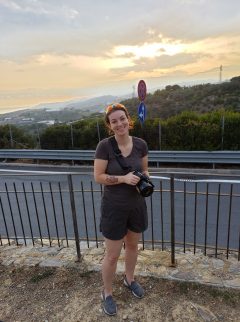
Samantha Stevens
Samantha Stevens specializes in international communications and relations, and humanitarian structural development and crisis aid. She holds a BA in English at Athabasca University, with a particular focus on British, Canadian, and post-colonial literature, ethics, and the psychological effects of mass media. She recently completed a Graduate Diploma in journalism and was awarded an MA in journalism upon the completion of her thesis: “Towards Reconciliation: The White Savior Trope in Canadian Newspaper coverage of Grassy Narrows First Nation between 1977 and 2019.”
Samantha’s research deals primarily with revealing a vestige of the antiquated colonial system, the white savior trope, in news media, policy, and Canadian society. She is particularly interested in how colonialism has embedded itself within the English language, and how such a perspective is then recreated through social and political reinforcement.
Her select publications include “Exporting the White Savior: The Colonial Textual Influence on Canadian/Indigenous relationships” and “Journalism Education and Call to Action 86: Exploring Conciliatory and Collaborative Methods of Research-Creation with Indigenous Communities,” which she coauthored.
Her current research explores the differing conceptualizations of jurisprudence between Indigenous legal orders and Aboriginal law (settler law applied to Indigenous peoples), and how those concepts intersect, relate, and conflict over time. Centered specifically on Anishinaabe law, governance, and constitution, this research is focused on the ongoing Restoule v. Canada (Attorney General) case in which representatives of the 21 Indigenous signees of the Robinson-Huron Treaty are suing the Ontario and Federal governments for failing to uphold their treaty obligations.