Housing First: Kaite Burkholder Harris Calls for Urgent Shift in Ottawa’s Housing Response
Ottawa, ON, March 24, 2026 — Addressing homelessness in Ottawa and across Ontario requires a fundamental shift in how systems are designed, coordinated, and resourced. This was a central message shared by Kaite Burkholder Harris, Executive Director of the Alliance to End Homelessness Ottawa, during her presentation at the Housing Affordability Symposium hosted by the Centre for Studies on Poverty and Social Citizenship (CSPSC) at Carleton University.

Drawing on recent data, Burkholder Harris outlined the scale and urgency of the homelessness crisis in Ontario. Homelessness continues to rise alongside increasing shelter capacity, expanding encampments, and widespread reliance on rent subsidies across municipalities. In Ottawa, thousands of individuals are currently in shelters or temporary accommodations, including hundreds of families with children, while hundreds more are living unsheltered.
She emphasized that homelessness is becoming increasingly complex. Changes in the drug supply, limited opportunities for community connection, and growing support needs are reshaping the landscape and placing additional pressure on service systems.
Burkholder Harris also highlighted critical limitations in current approaches. Systems that prioritize emergency response, while necessary, can unintentionally create “pipeline systems” that move individuals through shelters without addressing the underlying causes of housing instability. She noted that risk escalation within these systems often redirects resources away from prevention, reinforcing cycles of chronic homelessness.
To address these challenges, she called for a shift toward prevention, diversion, and coordinated system design. Prevention and diversion must serve as the foundation of an effective response, alongside housing and supports. She also emphasized the importance of real-time data systems, such as By-Name Lists and coordinated data platforms, to better understand patterns of homelessness and improve outcomes through informed decision-making.
A key focus of her presentation was the need to scale non-market housing. Burkholder Harris highlighted the growing gap between what households can afford and current market rents, noting that non-profit housing provides long-term affordability and becomes more cost-effective over time. Expanding this type of housing will require coordinated action across zoning, financing, land use, and partnerships.
She further emphasized the importance of designing systems that are flexible, coordinated, and responsive to people’s needs. This includes improving communication across agencies, aligning assessments, and ensuring that individuals are connected to both housing and the supports necessary for long-term stability.
Central to this vision is the role of lived expertise. Burkholder Harris underscored that meaningful system change must be informed by those with direct experience of homelessness, ensuring that solutions are practical, effective, and grounded in lived realities.
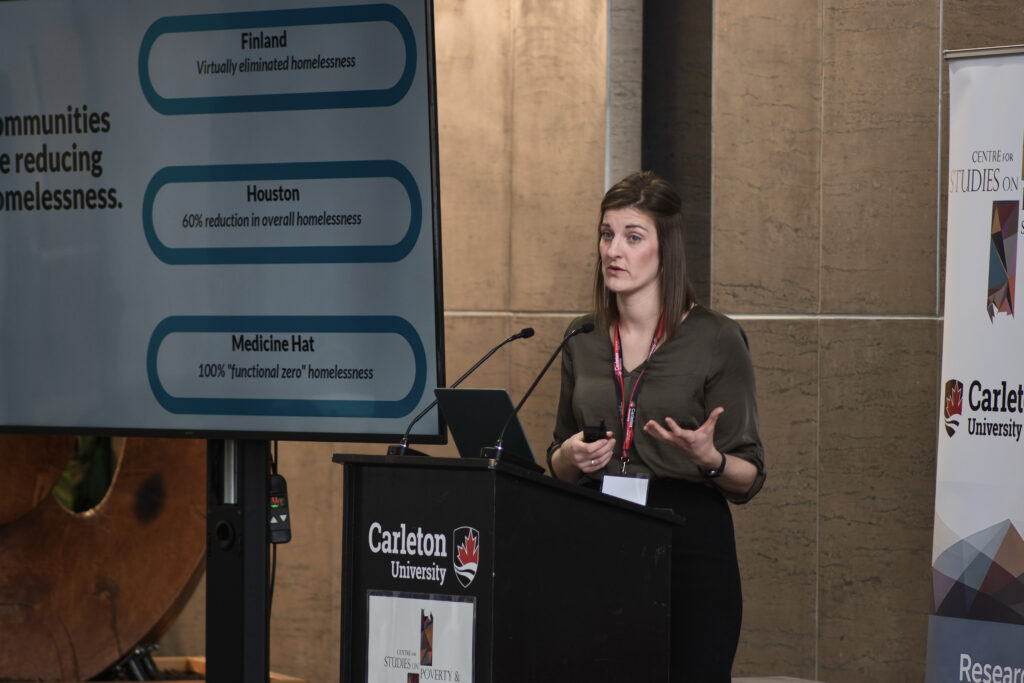
Her presentation concluded with a message of cautious optimism. Examples from other jurisdictions, such as Medicine Hat and Houston, demonstrate that homelessness can be significantly reduced through coordinated and well-resourced systems. However, achieving this outcome will require addressing political, bureaucratic, and structural barriers, as well as a willingness to rethink existing approaches.
The presentation reinforced a clear takeaway for attendees. Ending homelessness is possible, but it will require sustained, system-wide transformation.