Divided Power: How Federalism Undermines Reconciliation Talk
September 24, 2026 at 2:45 PM to 4:00 PM
| Location: | A602 Loeb Building |
| Key Contact: | Jonathan Malloy |
| Contact Email: | Jonathan.Malloy@carleton.ca |
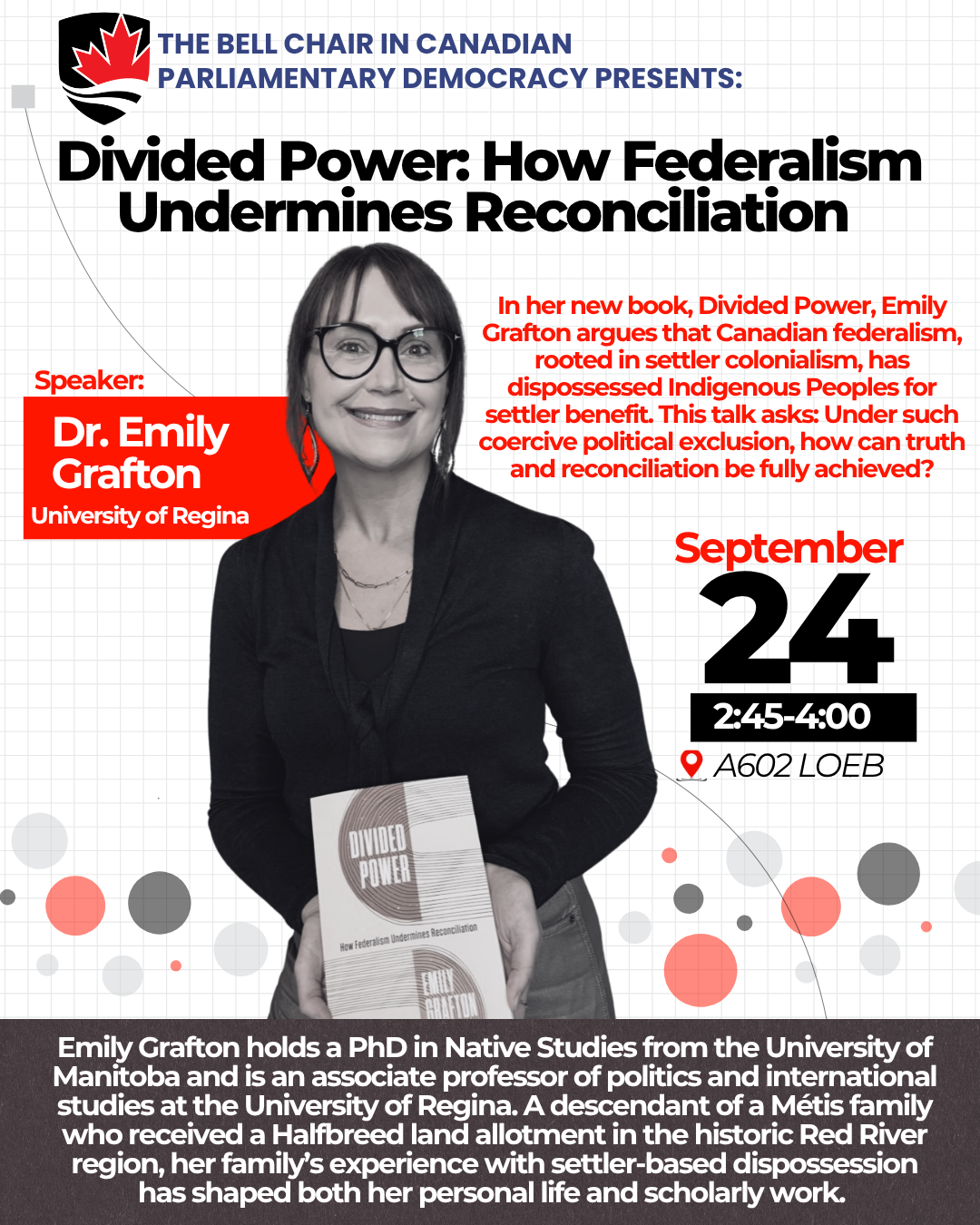
Abstract: Reconciliation, as set out by the Truth and Reconciliation Commission, is a process of understanding the Canadian state’s genocide against Indigenous Peoples and creating new relationships based on mutual respect and dignity. Given the racism and paternalism embedded in the Canadian state, building such a relationship is monumental and, in addition, there is a major structural roadblock in the way: federalism. Divided Power: How Federalism Undermines Reconciliation (Fernwood Publishing, 2025) argues that Canadian federalism, rooted in settler colonialism, has dispossessed Indigenous Peoples for settler benefit. This talk asks: Under such coercive political exclusion, how can truth and reconciliation be fully achieved?
Bio: Emily Grafton holds a PhD in Native Studies from the University of Manitoba (Winnipeg) and specializes in decolonial politics and research. A descendant of a Métis family who received a Halfbreed land allotment in the historic Red River region, her family’s experience with settler-based dispossession has shaped both her personal life and scholarly work. Grafton is currently an associate professor of politics and international studies at the University of Regina (Saskatchewan), where she teaches courses on Indigenous rights, reconciliation, feminism and gender politics, international relations, and Canadian government. Her research is community-driven and includes collaborations with local non-profits in Regina. She is the author of Divided Power: How Federalism Undermines Reconciliation (Fernwood Publishing, 2025) and co-editor of the book series On Colonialism in Canada (URPress, 2025; 2026). Grafton also serves on the Board and Reconciliation Committee of the Canadian Political Science Association.
Refreshments will be provided.