Waiting for Godot – Inuktitut
May 19, 2027 — May 29, 2027
| Location: | Azreili Studio - NAC 1 Elgin Street |
| Cost: | 15 |
| Audience: | Anyone |
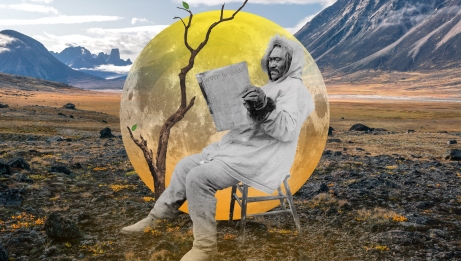
A 662 OVA (Nunavut) and Volcano (Toronto) creative collaboration. Produced in association with Great Canadian Theatre Company (Ottawa), NAC Indigenous Theatre, and the NAC’s National Creation Fund (Ottawa)
See the classic through an Inuit lens.
Vladimir and Estragon wait… endlessly… for someone named Godot, passing the time in the most widely spoken language of the North, Inuktitut. Hungry. Battered. Bored, (and deeply bound to one another) they share a kinship that is at once tender, grumpy, and enduring, relying on wit and companionship to make life bearable.
Their hilarious and haunting story reveals the absurdity of life, imbalances of power, and the quiet agony of waiting in a world that offers few answers.
Pull up a seat and join Vladimir and Estragon as they banter, bicker, and wait for Godot.
Performed primarily in Inuktitut, with surtitles and sections in English.
Developed with support from the National Arts Centre’s National Creation Fund.
The first-ever Inuktitut translation
Over the course of five years, translators Ruth Angutiqjuaq, Tatanniq Idlout, Carol Saqpinaq Kunnuk, Kaittaasi Peter, and Mary Petooloosie brought new life to Samuel Beckett’s text, creating not only the first-ever Inuktitut translation of Waiting for Godot, but one of the few contemporary world dramas translated into Inuktitut. Their work brings nuance, humour, and cultural specificity to a twentieth-century classic, offering a perspective that is grounded, incisive, and unmistakably Inuit.
* This visual was created with an historical photograph from an anonymous source. Despite archival research and community connections, we were unable to identify the individual or source definitively. The absence of attribution is a common issue in historical photographs of Inuit people, who were often unidentified or generically labeled (for example, as “Eskimo man”) in archival records. We include this note to acknowledge that erasure and to draw attention to the broader colonial practices that contributed to it.