Métis Spirit Art
| Email: | metisspiritart@gmail.com |
| Website: | Browse |
| Twitter: | Follow |
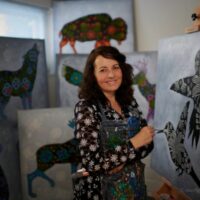
My name is Phyllis Poitras-Jarrett, a contemporary Métis artist living in Regina, Saskatchewan, Canada. Poitras is my mom’s maiden name; she was a proud Métis matriarch. Both my Kokum and Mooshum’s homelands are near the Red River. Jarrett is my loving father’s Scottish-English name, present with us in spirit. I graduated from the Saskatchewan Urban Natives Teaching program and retired after a rewarding 28-year teaching career. I’m a self taught artist and have developed some unique techniques in my art.
My artwork celebrates harmony and balance with all life sources. Animals, plants, insects, land, water, and air hold equal value on Earth. We must be mindful of our daily footprints by respecting and caring for Mother Earth. These elements are known as “All My Relations” by Indigenous peoples.
Nature is woven into our kinship systems, storytelling and ceremonial practices.
In my artwork the animals symbolize the qualities and values within each person. Embracing these values creates conditions for our lights to shine brightly on life’s journey. A mindful, kind, loving society generates energy and space to be present. This allows us to look beyond ourselves and recognize that Mother Nature has always provided abundant gifts of clean air, water, and food to sustain us. For our health and survival, caring for Mother Earth and her gifts is essential.
I celebrate nature’s diversity through animal motifs and colourful symmetrical Métis floral beadwork achieved with modelling paste. Each bead, flower, and animal is part of something greater. The 30 animals I painted during the pandemic have a grey background and spaced-out white beadwork flowers, which represent the greater universe. Hidden within each piece is a glass spirit bead, traditionally an off-colour or misplaced bead in Métis beadwork. This spirit bead symbolizes humanity’s imperfections, reminding us that each day offers an opportunity to improve ourselves for the betterment of “All of Our Relations.” When humankind recognizes its role as stewards of Mother Earth, we can restore health, harmony, and balance in our lives and the natural world.
Like most artists, my work is shaped by my past and present experiences, cultural background, and love for nature. I am self-taught and naturally creative since childhood. Raised on a Saskatchewan farm near Last Mountain Lake, I am one of six children. As farm children, we worked hard, but my escape was drawing by a small window upstairs, often frosted with beautiful winter designs. In summer, I would hike alone across the countryside for hours, seeking glimpses of animals, birds, insects, and wildflowers. One favourite discovery was the chrysalis, which I would take home to watch life’s stages before releasing the emerging butterflies and moths. I felt deeply connected to nature and the land, with my farm dogs keeping me safe on these ventures.
My Kokum, Celina Parisien-Poitras, inspired my work with her creativity and determination. She raised 11 children with her husband Grégoire Poitras in a two-room house on Jackrabbit Street in Lebret, Saskatchewan.
Kokum lived with us during the winter months, as her home lacked amenities. We all have fond memories of making long strands of colourful beads for her beautiful necklaces. We would earn a nickel per string, which often went full circle in an evening game of rummy. The next day our highly competitive beading circle would begin again.
I also honour the Seven Grandfather Teachings in 7 of my paintings. Today these value teachings are shared between many Indigenous Nations in Canada, originating with the Anishinaabe people. The values teach individuals to live balanced, healthy lives. The Anishinaabe people have traditional stories for each animal. Humility is represented by the wolf, courage by the bear, honesty by the raven or sabe, wisdom by the beaver, love by the eagle, and truth by the turtle.
When viewing my work, individuals may connect with their own values and qualities or recall the strength of loved ones, wisdom of leaders, or joy of children playing. Those who honour clan systems may feel cultural ties to specific animals. Others may connect to spirit animals that appear repeatedly in their lives. If you find a piece of yourself in my work, it has fulfilled its purpose. I create descriptions to represent or embody each animal’s natural ways of being, personifying them as guides. These meanings are only a starting point for the lovers of art and nature who have their own unique interpretations that celebrate their lived life.
Métis people are known as the “Flower Beadwork People,” a name given by First Nations. Beading was a time to socialize and share stories, with some designs tracing back to families. Our Kokum sewed intricate symmetrical designs, often by candlelight. Today, many Métis beadworkers reclaim this tradition. Métis women once took pride in embellishing clothing and accessories with vibrant floral beadwork. Many artifacts remain in museums, misattributed or anonymous. After the 1885 resistance, beading declined due to social pressures and bead scarcity. Thankfully, this cultural practice is resurging among our people. Our ancestors’ beautiful symmetrical designs live on in clothing, pouches, covers, and jewelry. Métis floral beadwork celebrates our Kokum’s and honours the plant world that provides food, medicine, and joy.
Art brings people together to celebrate unique cultures and deepen understanding of past and present realities. I sign my work P. Poitras-Jarrett, honouring both my Métis mother and Scottish-English father.
I dedicate this series to our Kokums and aunties, present-day Métis beaders reclaiming our beadwork, and Michif language teachers determined to revive our language. Most importantly, I dedicate it to all Indigenous ancestors who endured unimaginable injustices. Their resilience and will to survive live on in our children today, in strength and love.
Thank you for allowing me to share my work with you. I am deeply grateful for our ancestors’ creativity and knowledge, which inform and enrich my work.
Maarsii!