Carleton Opens Centre for Advanced Building Envelope Research
By
Jena Lynde-Smith
Photo Credit:
Brenna Mackay
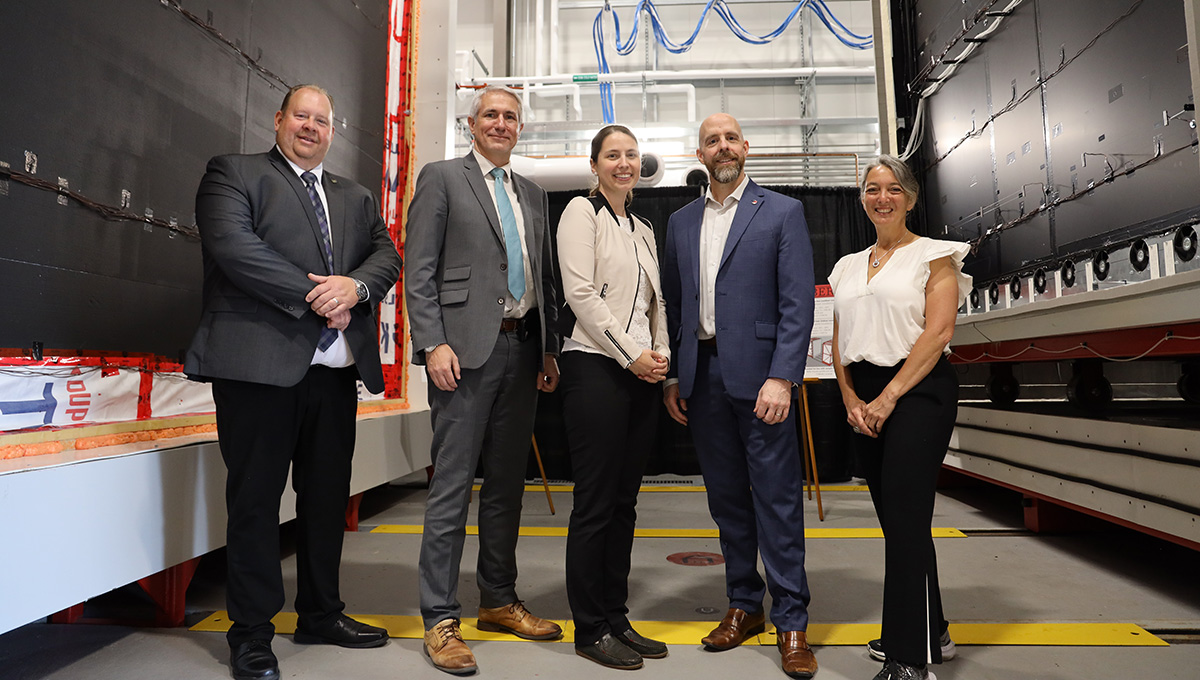
Carleton community members, government officials and industry representatives gathered today to mark the official opening of Carleton’s Centre for Advanced Building Envelope Research (CABER). The state-of-the-art facility will be used to investigate innovative materials and design strategies for completing retrofits and building new homes in ways that prioritize energy conservation and affordability.
“Carleton is committed to finding solutions to problems that affect all Canadians,” said Benoit-Antoine Bacon, Carleton president and vice-chancellor.
“The opening of this remarkable research facility focused on energy efficiency is another shining example of this commitment.”
Led by mechanical engineering researcher Cynthia Cruickshank, Carleton CABER researchers will investigate how heat, air and moisture move through materials and highly insulated wall systems, and how these elements contribute to occupant health, comfort and building science risks. They will use their findings to develop new approaches to constructing building envelopes that are thinner, cheaper, and new methods for renovating existing buildings with less cost and less disruption.
“The majority (70 to 90 per cent) of Canadian housing that will exist in 2050 already exists today, with over 70 per cent of the current building stock constructed prior to the development of a building energy code,” said Cruickshank.
“Solutions for existing buildings will play the biggest role in meeting Canada’s climate change goals. At CABER, we’re hoping to have a heavy hand in discovering these solutions.”
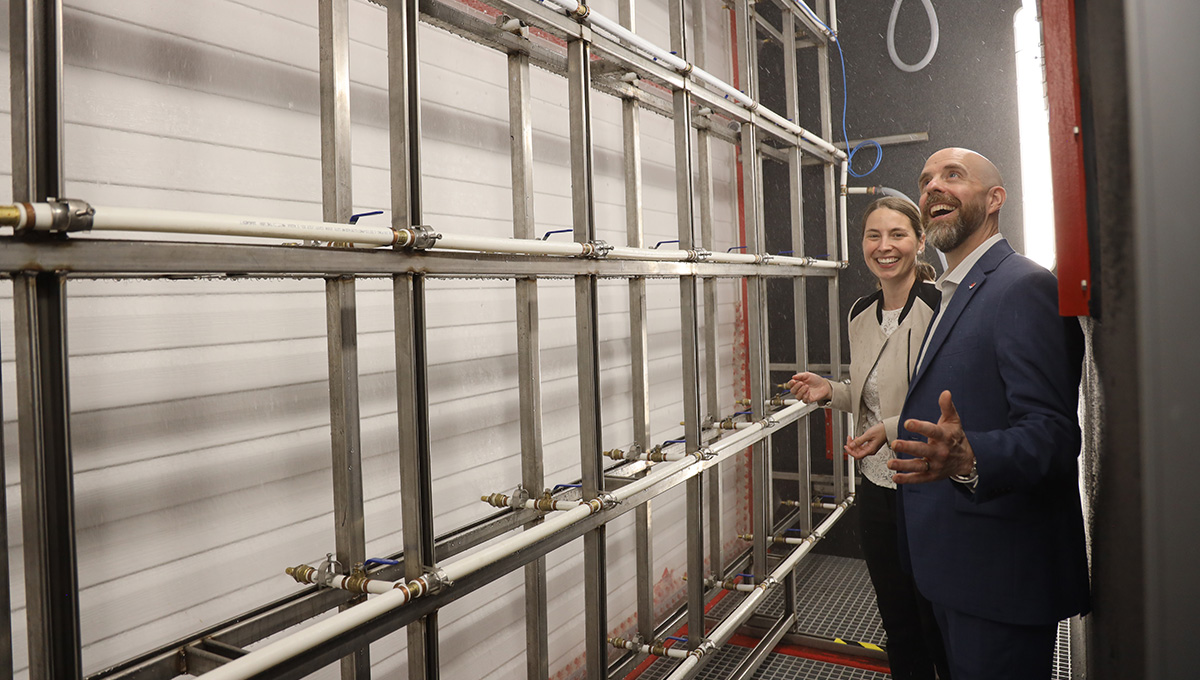
The 5,700-square-foot CABER facility is equipped with three state-of-the-art pieces of equipment: a two-storey guarded hot box to examine the thermal and moisture performance of retrofit wall assemblies, a two-storey pressurized spray rack to assess moisture resilience and in-situ wall openings to examine the interaction between outdoors and the built environment.
This innovative facility, located on the CanmetENERGY campus in Ottawa’s Bells Corners, is made possible through generous funding from Natural Resources Canada and the Ontario Research Fund.
“The Government of Canada is pleased to support Canadian innovation, including in the buildings sector. As we invest in building resilient and affordable housing while retrofitting our buildings stock, using the best technology is critical,” said Julie Dabrusin, Parliamentary Secretary to the federal Minister of Natural Resources and to the federal Minister of Environment and Climate Change.
“Working with Carleton University, we are developing cutting-edge technology that will help us to maximize energy efficiency, drive down emissions and costs, while advancing towards a low-carbon future. Congratulations to everyone at the CABER facility for their hard work.”
CABER will foster solutions to important building problems and will help mobilize knowledge by training the workforce to utilize these solutions. Through collaborations with industry, government and academia, Cruickshank is creating learning opportunities for workers, including construction trades, building designers, engineers, project managers and building science researchers.
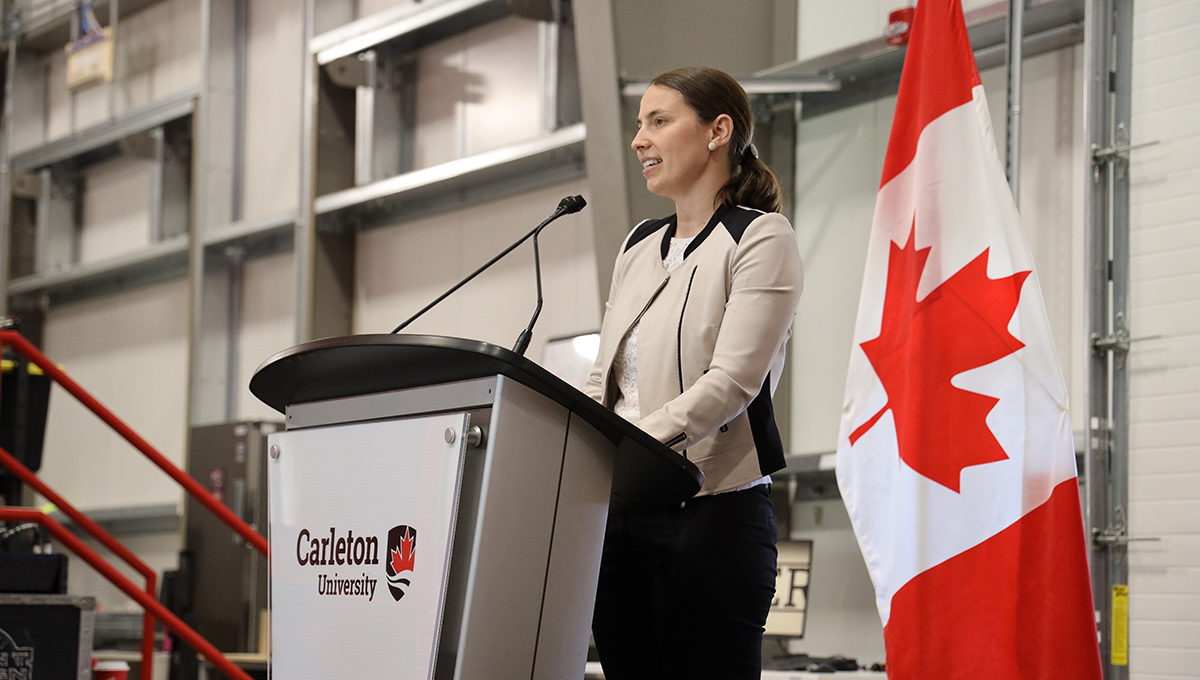
“Creating the opportunity for new testing and training capabilities could not be possible without collaboration,” said Cruickshank.
“Through CABER, we will help students and industry address the technology gap on building retrofit solutions, while providing students with high-quality training in experimental research.”
Carleton’s Strategic Integrated Plan highlights the university’s is commitment to enhancing its sustainability research. As part of Carleton’s Building Performance Research Centre, CABER is an important step towards this goal.
Related Stories

CKCU 93.1 FM: Community Radio at Carleton University
As Canada’s first campus-based community radio station, CKCU 93.1 FM has been a staple of Ottawa-Gatineau’s airwaves for 50 years, amplifying local voices, emerging artists…

Reimagining Responses to the Refugee Crisis
The geopolitical chaos of the past few years has made life even more precarious for millions of people around the world who have been forced…
Carleton University’s Top 10 Stories of 2025
As the 2025 season comes to a close, we reflect on the groundbreaking research, innovative leadership and inspiring community achievements that defined 2025 for Carleton…