Carleton Biology Building Renovations Boost Sustainability
By Joseph Mathieu
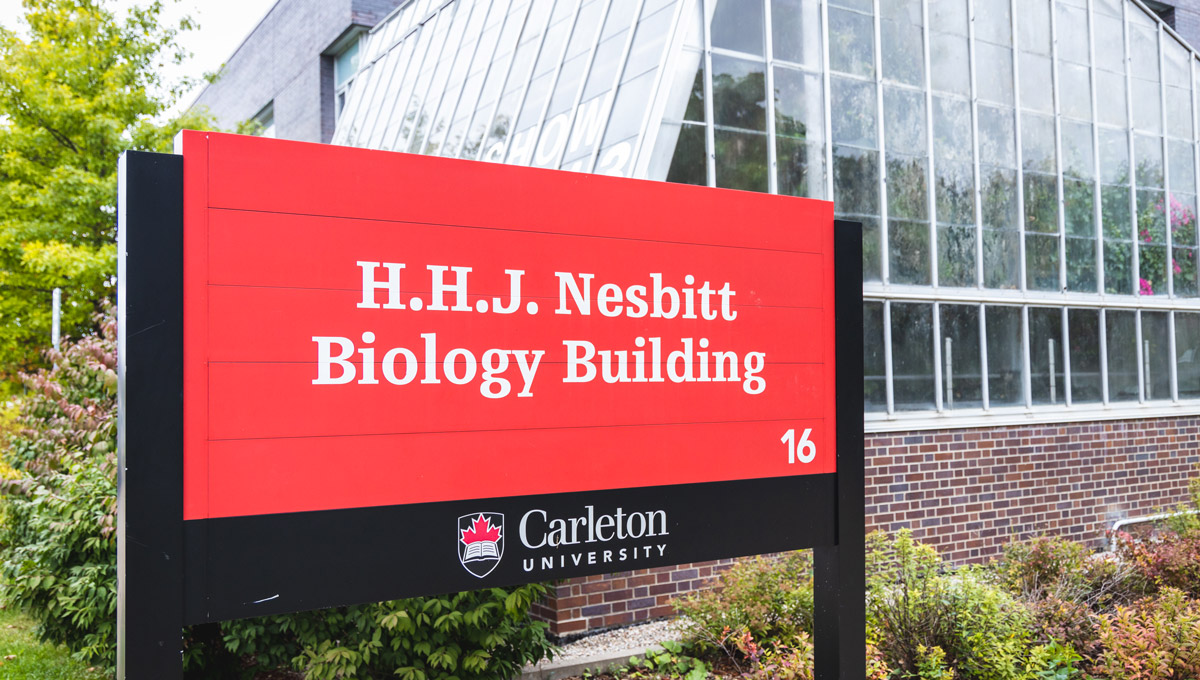
Extensive renovations at Carleton University’s Nesbitt Biology Building, due to end in the next few months, will allow the space to cut utility costs by a third.
And since early 2018 when the renovations began, research and lab work has been proceeding as usual.
“Nesbitt is one of the most active research buildings on campus,” says Prof. Owen Rowland, chair of the Department of Biology. “In addition to our own labs, we support more than 20 research programs through communal lab spaces.”
Nesbitt a Hub of Research Activity
Home to Carleton’s biology labs and research greenhouses, Nesbitt is open to researchers from other departments and graduate students working on their final-year projects.
The energy efficiency retrofit has been updating electrical and mechanical systems, offices, labs and 14 greenhouses. The 1969 greenhouse steam heating system was replaced with a more efficient glycol-based system. The research-focused greenhouses will also have a new remote-controlled shading system; the ability to increase or reduce sunlight with ease allows for more controlled experiments.
“All the workers were very respectful of the researchers,” said Rowland. “They made sure they weren’t accidentally impacting faculty or students.”
The process to keep Nesbitt in operation has been painstaking and time-consuming.
Two greenhouses shut down simultaneously while staff, faculty and Greenhouse Manager Ed Bruggink moved every plant, experiment and piece of equipment to neighbouring greenhouses. Once the new systems were installed, everything was moved back and the process repeated.
A Safer and More Energy-Efficient Facility
Nesbitt’s laboratories have been updated with more energy-efficient equipment and fixtures alongside new furniture and safety measures, such as eye-washing stations and safety showers. Storage space was transformed into a new state-of-the-art insect-rearing facility.
Most important, six containment labs (including micro-biology, biology and animal tissue culture) and the molecular bio-chemistry lab were improved to meet new federal standards.
It’s expected the renovations will be complete in December of January.
Related Stories

CKCU 93.1 FM: Community Radio at Carleton University
As Canada’s first campus-based community radio station, CKCU 93.1 FM has been a staple of Ottawa-Gatineau’s airwaves for 50 years, amplifying local voices, emerging artists…

Reimagining Responses to the Refugee Crisis
The geopolitical chaos of the past few years has made life even more precarious for millions of people around the world who have been forced…
Carleton University’s Top 10 Stories of 2025
As the 2025 season comes to a close, we reflect on the groundbreaking research, innovative leadership and inspiring community achievements that defined 2025 for Carleton…