But shouldn’t we protect children from fear and worry? In this uncertain time, some parents may feel concerned that COVID-19 is causing a loss of innocence.
As a researcher in critical childhood studies, I examine how the myth of childhood innocence informs social practices in the North American context. For some parents, talking with children about the realities of a pandemic may be a disturbing prospect, given the widespread belief that childhood should be carefree.
Combined with contemporary pressures to entertain, exercise and educate children into successful adults, many parents today may feel compelled to manufacture an innocent, even magical childhood by protecting them from sadness, grief, fear and even disappointment.
Exclusionary innocence
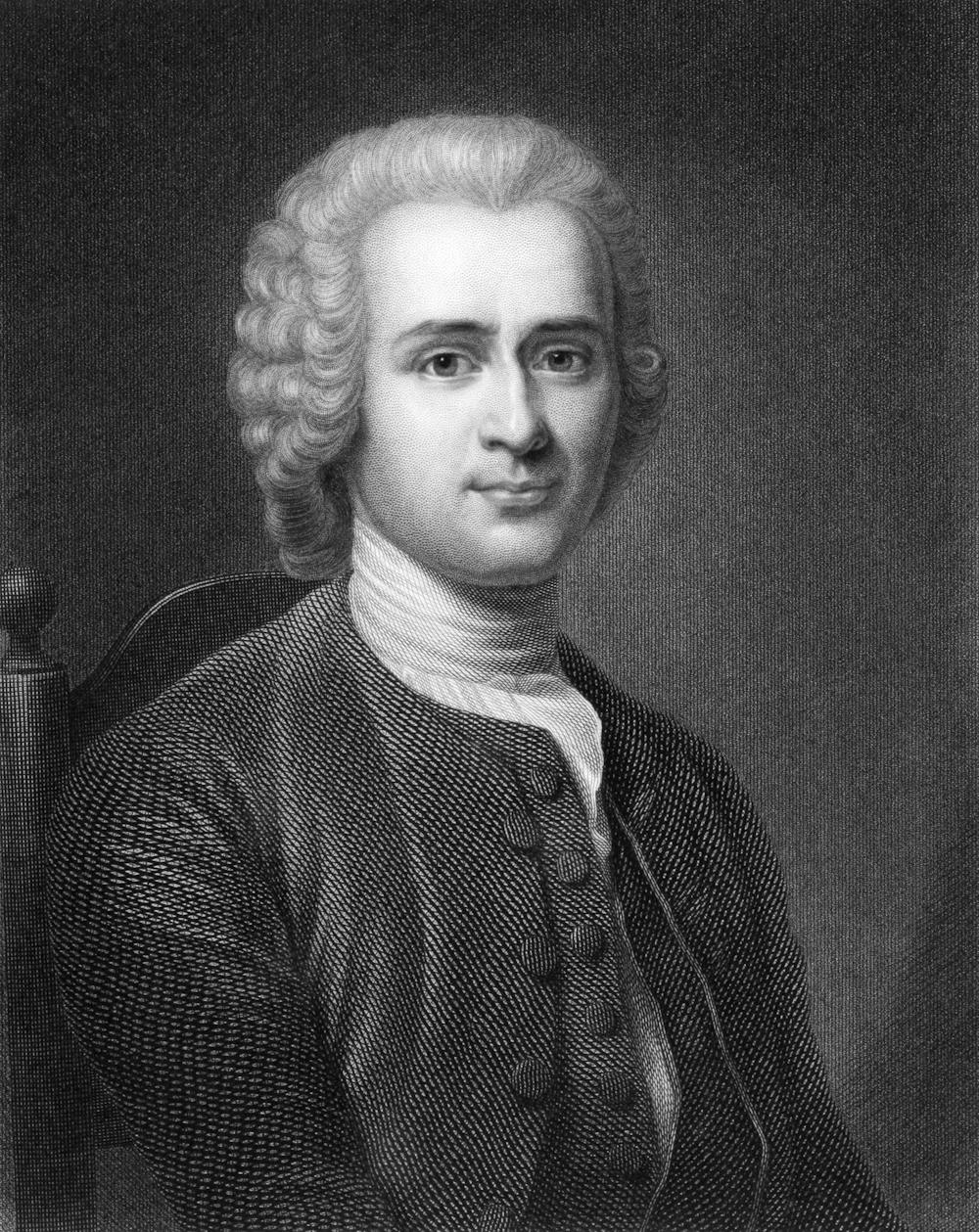
Jean-Jacques Rousseau portrait published in ‘The Gallery Of Portraits With Memoirs Encyclopedia,’ 1833. (Shutterstock)
Childhood innocence is a modern construction largely inspired by the work of early modern thinkers like Jean-Jacques Rousseau. His and others’ notions of childhood innocence was rooted in a white, middle-class, Euro-centric and hetero-patriarchal worldview that excluded the lived realities of all but the most privileged.
These 19th century ideas about childhood innocence also made difficult experiences — like those of historically marginalized children — seem abnormal, and made inexperience the marker of who could be a child and whose rights would be seen as most important.
The innocence myth
The reality is that childhood as a state of innocence — of not-knowing or inexperience — is a myth. All children experience sadness, grief, fear and disappointment, some earlier and in greater measure than others.
For many children, such as those who have experienced disease, natural disasters, poverty, homelessness, refugee dispossession or trauma — and for Black, racialized or Indigenous children who experience racism — the current pandemic isn’t the first time they’ve grappled with adversity. This is particularly true for those who face multiple or intersecting vulnerabilities and barriers.
Now, however, COVID-19 is forcing everyone, young and old, to confront the realities of social isolation, illness and death.
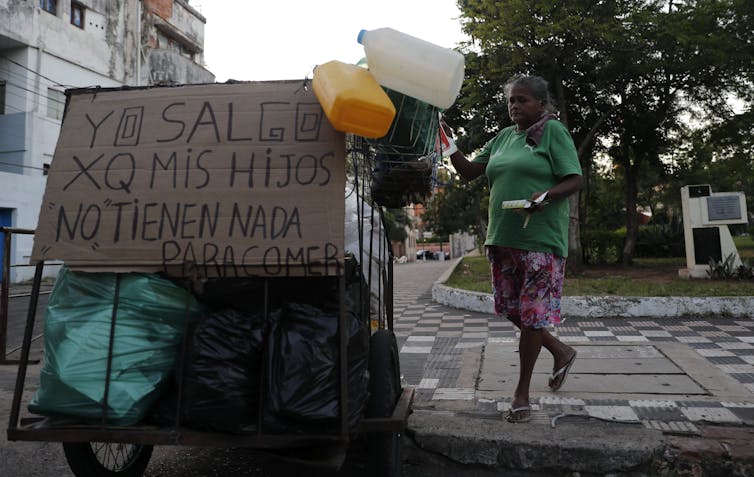
‘I go out because my children have nothing to eat,’ reads a sign carried by Digna Ojeda, in Asuncion, Paraguay, March 23, 2020, as she collects trash to recycle. Paraguay’s government has limited movement of people to prevent the spread of COVID-19. (AP Photo/Jorge Saenz)
Re-think beliefs
COVID-19 can be an opportunity to rethink pervasive and dominant western beliefs in innocence as a universal childhood ideal. We can create space for more open dialogue about children’s rights and capabilities.
The global pandemic is a compelling reminder that no child is exempt from difficult emotions and experiences, because no one is immune. Even parents with the most abundant financial, cultural and even political resources cannot entirely shield their children from COVID-19’s profound and widespread effects.
Yet the pandemic also reminds us that hardship discriminates. While social distancing inconveniences families who are able to work from home, the challenges are far more pronounced for those working on the front lines in essential services or facing layoffs, as well as those experiencing homelessness or living in shelters or social housing.
These inequalities are brought into sharper focus in light of the present crisis, but they aren’t new: children in Canada and across the world experience the discriminatory effects of inequality every day.
When we focus on protecting children’s innocence by sheltering them from adversity, we silence difficult emotions and experiences. What’s more, we may risk teaching them to ignore injustices.
Children have rights
In these uncertain times, it’s logical that we should be concerned about children’s well-being. But supporting their human rights today and every day means taking seriously their questions, concerns and capabilities.
Some world leaders have modelled this kind of respect, including Norwegian Prime Minister Erna Solberg, who held a kids-only press conference about COVID-19.
Norway’s PM Erna Solberg has held a special press conference, just for the children of Norway, answering their questions about #coronavirus
Strike on Afghan Hospital Shows the Laws of War May Document Atrocities — but Don’t Prevent Them
Pakistani jets recently bombed the Omid Addiction Treatment Hospital in Kabul, Afghanistan, a facility with 2,000 beds dedicated to helping patients recover from drug addiction.…
A Global Butterfly Index Could Advance Insect Conservation Worldwide
About 70 per cent of the species on Earth are insects. They are fundamental components of most ecosystems: they comprise half of the biomass on…
The West Has Long Characterized Iran’s Oil as a Prize To Be Claimed
With the recent outbreak of hostilities in the Persian Gulf, the focus of international attention has returned to one of the world’s most important energy…