Water Security
By Dan Rubinstein
Every 15 seconds, a child somewhere in the world dies from a preventable waterborne disease.
Globally, 1.1 billion people lack access to clean drinking water.
In Canada, rural and remote communities, especially in the North, frequently lack clean water and adequate wastewater treatment.
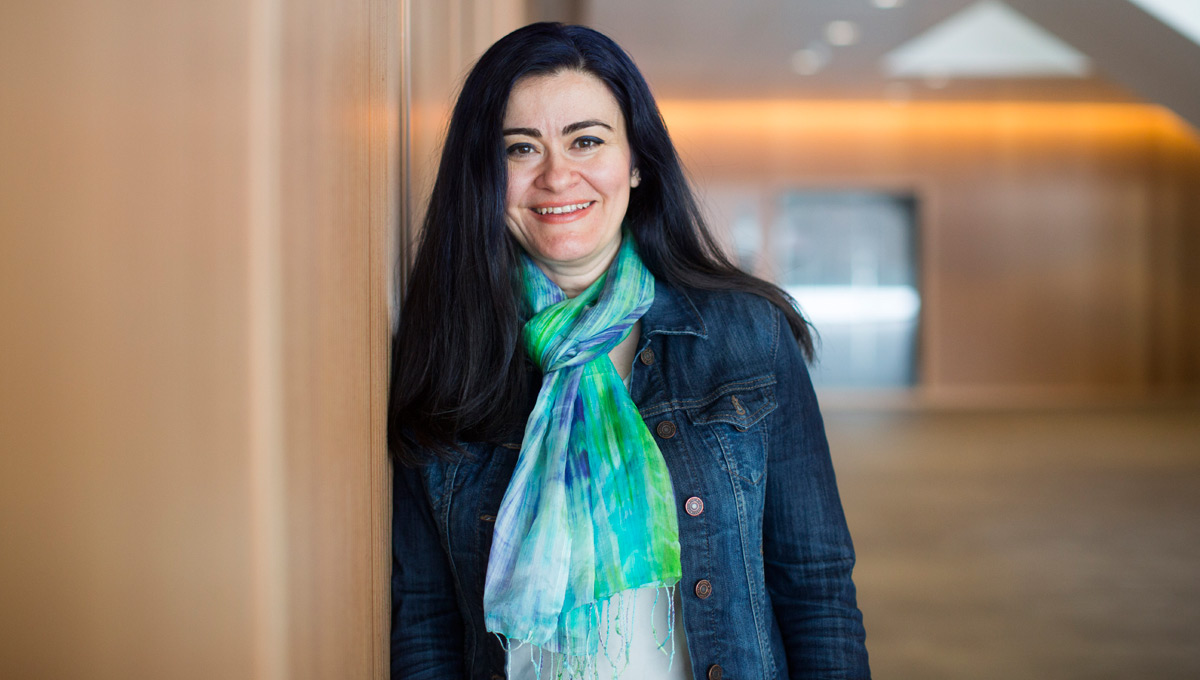
To help address these challenges at home and abroad, Carleton Prof. Banu Örmeci has been chosen to serve as the first Jarislowsky Foundation Chair in Water and Global Health.
“Water is essential — it is life,” says Örmeci, who leads an innovative and internationally recognized research program on wastewater and biosolids treatment in Carleton’s Civil and Environmental Engineering Department.
and the Canada Research Chair in Wastewater Treatment Engineering
Water security:
A major public health issue
“If you don’t treat wastewater properly, you start contaminating drinking water, and that can kill people. This is a major public health issue, and it’s very meaningful that the Jarislowsky Foundation has decided to support research in this area. It’s an important field — you can help save lives.”
The five-year endowed chair, launched with a $2-million contribution from the Montreal-based foundation, will allow Örmeci to focus on several ongoing and new projects, including novel clean technologies for recovering resources such as energy and nutrients from wastewater and sludge; low-energy and low-cost technologies for drinking water and wastewater treatment in rural and/or remote regions; pathogen disinfection in drinking water and wastewater; chemical and nanoparticle treatment; and several networking and community-building initiatives to bolster Carleton’s expanding role as an international leader in water research.
“Carleton has a distinguished track record in the field of groundwater research and developing multidisciplinary solutions to community and global issues,” says Foundation President Stephen Jarislowsky, CEO of one of Canada’s largest and most successful investment management firms. “Water is increasingly a critical health and environmental issue in Canada and around the world, and the foundation is pleased to partner with the university, its faculty and its students in tackling this critical challenge.”
[wide-image image=”4022″]
The value of fundamental
and applied research
After joining Carleton in 2005, Örmeci was appointed a Canada Research Chair (Tier 2) in Wastewater Treatment and Public Health Engineering in 2007. She is passionate about both fundamental and applied research, and is currently working on an NSERC-funded project with collaborators in France to develop real-time monitoring tools for sludge treatment.
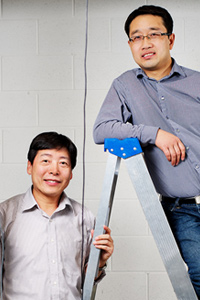
Örmeci is also active in China, partnering with a pair of Carleton engineering colleagues, Junjie Gu and Jie Liu, on a project supported by the Ontario-China Research and Innovation Fund to explore supercritical water oxidation as part of the process to treat wastewater and sludge.
She is working with Carleton’s Canada-India Centre for Excellence, looking to identify Canadian water and wastewater treatment technologies and companies that could be used in India.
And she is the chair of the International Water Association’s Sludge Management Group, a role that sends her to conferences around the world to help execute global initiatives that advance biosolids science, technology and management.
“The Jarislowsky Chair will propose innovative solutions to address a universal need,” says Rafik Goubran, dean of the research-intensive Faculty of Engineering and Design. “By considering the engineering, environmental, public policy and health implications of developing new processes and technology, Prof. Örmeci will ensure that we are serving the global community in the best possible manner.”
[wide-image image=”4025″]
From global to local
Örmeci is also engaged in the local community. She was part of the delegation that represented Carleton at the recent Ontario Universities’ Fair, serves on Carleton’s Board of Governors, is deeply involved in WISE (Women in Science and Engineering), does outreach programs with high school students and, amid her busy research schedule, remains dedicated to teaching and mentorship.
On the commercial front, Örmeci has several patents that have led to new treatment technologies, including an automated system to measure polymer concentrations in real time and optimize the “dewatering” process, which removes water from sludge before it is released into the environment.
This technique could also be applied to drinking water, because chemicals are used to aggregate solids and make them easier to remove from drinking water, but the concentration of these chemicals must be monitored and remain within safe parameters.
Örmeci is also the director of Carleton’s Water Research and Microbiology Lab, part of the university’s Front Door initiative, which is designed to provide access to the university’s research expertise and infrastructure to external partners.
“It’s import for us to help develop sustainable and appropriate solutions to the world’s water challenges,” says Örmeci, noting that, for example, some promising technologies aren’t effective in cold or remote communities. “We need to develop the right technology for the right location. Sometimes that means simplifying things.”
[wide-image image=”4023″]
Related Stories

Wildfires in Canada: Researchers Work to Protect Canadians from Wildfire Smoke
More than 6,000 wildfires burned across Canada in 2023, torching an area larger than England — the country’s most destructive fire season ever. In communities…

Protecting Canadians from Mosquito-Borne Diseases
It’s a sound Canadians know all too well: the high-pitch whine of a mosquito buzzing past your ear. Beyond annoyance and itchy bites, the emergence…

Reimagining Responses to the Refugee Crisis
The geopolitical chaos of the past few years has made life even more precarious for millions of people around the world who have been forced…