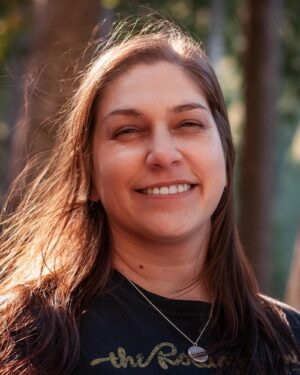
Jenel Shaw, Executive Director of Arts AccessAbility Network Manitoba.
Jenel Shaw is a self-taught visual artist and strong activist for the Deaf and disability community. She’s the Executive Director of Arts AccessAbility Network Manitoba (AANM), a disability-led, artist-run organization that supports and advocates for the Deaf and disability arts community. As part of PANL Perspectives‘ series, Making Canada Accessible, she spoke to us about why accessibility in the arts — and in all places — is vital for an entire community, not only Deaf/disability communities.
Question: How did you start at the organization?
Jenel Shaw: I finished Disability Studies at the University of Manitoba and had to take a couple years off to do my dissertation, which was an auto-ethnological study of how art can be empowering for people with mental illnesses in psych-ward settings. I wrote about my own experiences being in a psych ward, about not having any art work, not having anything to do all day. While there, I organized sessions with the other patients, because apparently, I can’t relax. It was a lot of fun and it taught me how powerful art was. When I graduated, Arts AccessAbility Network Manitoba (AANM) had core funding from the Canada Council for the Arts. When I first started back in 2018, I was the only staff. Now, five years later, we have one full-time and two part-time staff — and our programming and advocacy has exploded.
What work does the organization do with artists and exhibits?
 Jenel Shaw: We do a lot of one-on-one work. That’s a big part of my job. A lot of our artists need someone sitting beside them, especially emerging artists, to express thoughts for a CV, correspondence or for a grant, or to help them to prepare for an interview – or for anything that helps to advance their careers.
And we provide opportunities for exhibitions, professional exhibitions, where established and emerging artists get paid full fees, with 100% of proceeds going to the artist. We focus on visual arts, musical theatre, performance, comedy, poetry, any type of art form.
Question: How does the organization help arts venues increase accessibility?
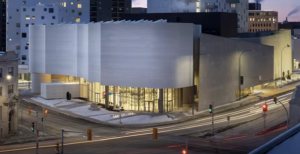
The Winnipeg Art Gallery is one of 45 venues that the Arts AccessAbility Network Manitoba (AANM) has audited in Winnipeg and Brandon. AANM posts the detailed audits online for free public access.
Jenel Shaw: During COVID, the Deaf and disability community in Manitoba created our own audit process for front of stage and backstage – the Accessibility Audit for Arts Venues. It was completely informed and created by the disability community, which strongly feels that the true experts of accessibility are those who live with disabilities every day. We found out what folks need the most: they need other organizations to be informed of their accessibility and they need information. For example, a lot of times, when you call a space, and you say, “Is your space accessible?” they say yes, but when you ask further, they don’t know how to explain it. AANM’s own Accessibility Information webpage is a good start about how to communicate details.
So, obviously, customer service was a big issue, and this insight led to a second kind of project: Anti-Ableism Workshop for the Arts.
The four-hour session teaches the history of how people with disabilities and deafness have been treated in Canada – the struggles for change and for rights. It also teaches protocols. A lot of people don’t know the protocols of interacting with Deaf and disabled artists — little things, like if someone’s in a wheelchair, you can’t move them unless you ask.
The session also teaches how to create accessible events. What can event organizers do that’s low cost and easy, but also what options are there that are even more accessible and require more resources? We try to cover a range, because some events have the financial means to do those things and some don’t.
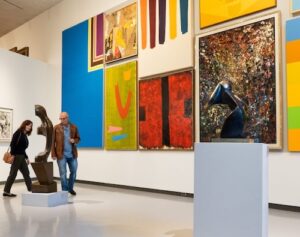 Overall, we push the idea of progress, of listening to your audience, of doing outreach to the communities you want to reach — and not necessarily throwing tons of money and doing everything at once. Intentions are great, but if you’re an organization that’s never provided American Sign Language before, and you decide to do that for a theatre production, and all you do is put “ASL provided” on a poster, you’re not going get anyone from the Deaf community. We work with theatres to explain how to do outreach, with the idea that it’s going take time and that trust has to be built. The Deaf community has been left out of so much for so long that it is harder to reach them, but it’s still worthwhile.
What’s involved in accessibility audits specifically?
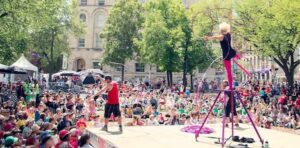
The Royal Manitoba Theatre Centre, in Winnipeg, offers a wide ramp with a gradual slope and non-skid surface and meets many other accessibility options on AANM’s checklist of 174 points. AANM’s Accessibility Audit Database helps the entire community, not only people who Deaf or disabled.
Jenel Shaw: We ask things so that all people can participate in the arts. We ask if there’s accessible parking outside and bus stops close by. In the space itself, is it wheelchair accessible? Are the doors wide enough for power wheelchairs? Do they provide ASL? Are the washrooms accessible? Do they provide assistive devices for the performance? Do they have braille? We have a checklist of 174 points.
We’ve heard from quite a few folks who have booked Handi-Transit Service to go to a concert for example, and they’ve called ahead of time and been told, “Yes, the space is accessible.” But they get there, and get through the front door, only to see stairs – and now they’re stranded, and it’s winter. Because Handi-Transit takes a few hours to book on the fly, they’re now facing a potentially dangerous situation in the cold.
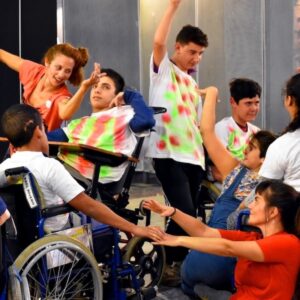
Read the other stories in PANL Perspectives’ “Making Canada Accessible” series, led by Daryl Rock and Calum Carmichael, in which charitable and nonprofit organizations outline their work in advocacy, barrier reduction and increased accessibility.
Our Accessibility Audit Database helps a lot of people, and we explain to organizations that the audit is about information that the entire community needs, not only the Deaf and disabled community. Anyone from the community, disabled or not, can look at a venue and see what access is available. For example, if you put a ramp onto a stage, an artist with physical disabilities can get up there and perform, but the ramp also makes it easier to move speakers and equipment. Supports affect many people. So, providing captions is great for the Deaf community, but they also help anyone whose first language isn’t English and folks with hearing aids. Accessibility doesn’t help only a few groups; it helps the entire community.
We’ve audited about 45 places here, in Winnipeg, and a couple in Brandon, our next biggest city. We’re a busy group.
Is your organization part of coalitions and advocacy in the private and public sectors?
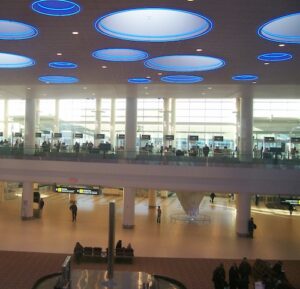
“The Winnipeg Airport reached out to us. We’re very lucky here, in Winnipeg, to have a lot of support with the disability community, the arts community, and the business community.” –Jenel Shaw
Jenel Shaw: Yes. I’m a co-Chair of the Manitoba Artist-Run Centres Coalition, and we partner with other organizations. We do a lot of advocacy, the whole point of which is to have conversations. We never want to admonish anyone. The conversations are about the exciting side of accessibility and the new ways it can present art and reach audiences.
We also have a lot of allies in businesses and elsewhere. The Winnipeg Airport has reached out to us. IG Wealth Management has reached out to us to do artists talks. We’re very lucky here, in Winnipeg, to have a lot of support with the disability community, the arts community, the business community. There’s always work to be done, but not all at once; it’s about relationship building, finding supports, creating conversations, partnering with different organizations.
Have you noticed a significant shift among Canadians in terms of neurodiversity and mental health issues?
Jenel Shaw: I’m in my forties, and when I was a kid, we never talked about those things. The only time we ever talked about mental illness or disability was when we talked about the kids in the “special class” at our school. I wasn’t diagnosed, until I was 16, with chronic depression, and I was always ashamed of it, because it wasn’t talked about in our community.
Today, because of the work done for inclusion and rights over the decades, you can see the changes in youth. I do a lot of talks with students. They toss around terms like “depression” and “neurodiversity,” and it’s lovely to see. I wish I’d had that openness in my youth — to address self-stigma. The stress of hiding, of trying not to tell people, was almost worse than the symptoms themselves. It makes me happy that a lot of the youth today don’t have to deal with that. The more we talk about things, the better things gets.
Do you have advice for nonprofits in general?
Jenel Shaw: You have to reach out to your community and to the disability community. We, in the disability community, understand better than doctors, architects and “experts” what we need in terms of accessibility – we, who use the services, know the nuances. But start by reaching out to people in your community, maybe friends or family, and ask about the barriers they face and how things could be better changed. Expand from there. Also, at AANM, we can introduce you to leaders in the Deaf and disability community. Having conversations and reaching out are the biggest things.
Photo of Jenel Shaw is courtesy of Felicia Byron. Photos are courtesy of Wiki Commons, including RFBailey.
Thursday, September 11, 2025 in Accessibility, News & Events
Share: Twitter, Facebook