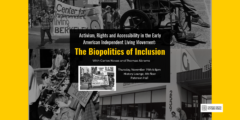
Thursday, November 19th 6-8pm
History Lounge, 4th floor Paterson Hall
Join the Carleton Centre for Public History for an evening of conversation about the history of disability activism. The evening is free and open to all – no registration is required. Please feel free to reach out to centreforpublichistory@cunet.carleton.ca with any questions or accessibility requests.
About the Talk:
Focussing on the early history of the Centre for Independent Living (CIL), we outline how in the 1970s disability activists and adjacent groups began to frame disability as a civil rights issue. Through an examination of archival and secondary sources we revisit the rights training undertaken by the CIL which aimed to teach disabled citizens and their allies how to wield their rights.
We draw out how the CIL employed a DIY approach to civil rights and to making America accessible following what was known as the Berkeley model. A key site of activist mobilization at this time focused on making civic infrastructure and public transit systems accessible. We draw on the collective memory of this activism, often considered pivotal in developing a civil rights framework to disability, to think through biopolitics, the government of spaces, and the administration of bodies.
Presenters:
Carlos Novas, Associate Professor, Sociology, Carleton University, carlos.novas@carleton.ca
Thomas Abrams, Associate Professor, Sociology, Queen’s University, thomas.abrams@queensu.ca