Design to Deployment: Small Modular Reactor’s Fundamentals Explained
Kris Devang Gandhi November 21, 2025
Photo: Johnson, J. N. (2025, September 25). NuScale Power: The SMR stock at the heart of the AI energy boom. MarketBeat. https://www.marketbeat.com/originals/nuscale-power-the-smr-stock-at-the-heart-of-the-ai-energy-boom/
By now, you may have noticed that distinguishing the various types of nuclear small modular reactors (SMRs) and understanding their ideal deployment scenarios is less straightforward than it initially appears. Thus, we will explore a simple guide through the fundamentals of SMR functionality that can alleviate the complexity, allowing you to easily navigate and draw the lines between the different SMRs that are currently under development or approaching first-of-a-kind (FOAK) deployment, with a more enriched understanding.
Engineers and regulators tend to group SMRs by coolant, moderator material and neutron spectrum, rather than by manufacturer. These design criteria often determine size, temperature, fuel form, target markets, and, most importantly, where they can be deployed. SMR vendors usually incorporate elements of these classifying characteristics into the naming convention for their SMRs.
SMRs carry out a physical process called nuclear fission. Nuclear fission is an exothermic reaction, meaning energy is generated in the form of heat. Coolant is circulated to absorb this heat and transfer it away from the reactor’s core, where it is converted to usable power, typically in the form of electricity (Spinrad & Marcum, 2025). In SMRs, the coolant selection is a strategic design decision because it synergizes with other associated elements such as neutronics, moderator material, thermal performance, safety systems, material selection, operating temperature/pressure, licensing path, and economics. All of these variables influence the SMR performance properties, affecting where and how these SMRs can be deployed.
The moderator used in SMRs plays a key role in shaping its performance. They also have a strong influence on neutron spectra in fission reactors (Garner, 2012). In addition, the moderator selection is correlated to the choice of coolant and conveniently enough, is often the same material (Garner, 2012). A moderator, as the name suggests, is used to moderate or slow down neutrons (Gupta, 2001). The purpose of reducing the (kinetic) energy levels of the fission-produced neutron to a state of thermal equilibrium with the environment in the reactor is to enable and promote fission (Gupta, 2001). For example, in a thermal-spectrum SMR, slowing down fast neutrons to thermal energy levels increases fission probability for fissile isotopes (e.g., U-235, Pu-239), resulting in higher reactivity and enabling compact cores. By contrast, SMR designs that avoid or limit moderation maintain a fast neutron spectrum, which promotes/supports breeding (U-238 → Pu-239), alternative fuel cycles, and different waste profiles; Fast-spectrum SMR demonstrates this strategy. In summary, the level of moderation implemented into the designs directly affects the neutron spectrum; this can be used to exploit different outcomes to support the SMR’s intended mission and deployment. (World Nuclear Association, May 2025)
To efficiently slow down fission neutrons, the moderator material atoms, found in the reactor core, should be light (low atomic mass) so each collision removes a large fraction of neutron energy and promotes thermalization (Gupta, 2001). It should also have a large scattering cross-section and a low neutron absorption cross-section (Gupta, 2001); this, combined with the large average energy loss per collision, yields a high moderating ratio. This metric signifies that the moderator slows neutrons efficiently without absorbing them, instead by just scattering them, improving neutron economy. (U.S. Department of Energy, 1993)
Materials composed of the most efficient moderating elements are among those with a low atomic number (Gupta, 2001). Hence why, the most common moderators are hydrogenous (e.g., light water, heavy water, and metal hydrides) (Ghosh, 2024). As mentioned previously, many designs combine coolant and moderator, which simplifies heat removal but also couples neutronics to thermal–hydraulic performance and influences materials selection. Ideally, the moderator simultaneously serves as a coolant as well, particularly if it possesses a high heat capacity to absorb reactor-generated heat effectively; again, water is an exemplary material in this regard (Ghosh, 2024).
Compatibility between structural materials and coolants is a critical factor in reactor design, impacting thermal properties/efficiency, safety, sustainability, longevity and economic viability. Coolant selection primarily focuses on desired thermal properties, including a low melting point, high heat transfer coefficients, and heat capacity, among others. It is generally expected that the structural and clad materials are compatible with the choice of coolant, whether it is water, liquid metals, or molten salts. Based on the coolant being used, the types of structural materials are selected with the most appropriate properties (e.g., strength, hardness, heat transfer, wall thickness) to best account for corrosion, chemical interactions, internal temperature, etc. (Ghosh, 2024)
The final component of the formula for distinguishing SMRs is the neutron spectrum, which represents the distribution of neutron flux over a specific neutron energy range (Science Direct, n.d.). In other words, it quantifies the fraction of neutrons present in the thermal (<~0.5 eV), epithermal (~0.5 eV–100 keV), and fast (>~100 keV) energy regions. The neutron spectrum is important because it influences the physical characteristics of the reactor core (Science Direct, n.d.). When a larger fraction of flux (meaning more neutron weight) occurs at higher energies (fast-leaning), these reactors are described as “hard” or fast reactors. In contrast, “soft” or “thermal” reactors have a larger fraction at low energies (thermal-leaning). The type of coolant used in an SMR is a useful indicator of the neutron spectrum and thus its hardness or softness. Based on the coolant, the flux fraction will predominantly lean toward one of the three regions, as seen in Figure 1. (U.S. Department of Energy, 1993, & International Atomic Energy Agency, 2023)
For deployment, the energy region matters because the target neutron spectrum achieved must align with the SMR’s mission objectives, since the spectrum drives fuel form/enrichment, control strategies, shielding needs, supply-chain fit, and ultimately schedule & cost (National Academy of Engineering; National Academies of Sciences, Engineering, and Medicine, 2023). The desired neutron spectrum is achieved by the choice and geometry of moderator/coolant, temperature, fuel, and (if needed) added absorber (National Academy of Engineering; National Academies of Sciences, Engineering, and Medicine, 2023). These levers shape the flux distribution and thus the deployment drivers mentioned above. In fast reactors, fast-spectrum cores can use localized metal-hydride moderator inserts to soften the neutron spectrum. For mixed-spectrum SMRs, incorporating strong absorbers such as boron (B), hafnium (Hf), gadolinium (Gd), and europium (Eu) can preferentially remove low-energy neutrons, thereby decreasing the thermal-to-fast neutron ratio and resulting in a harder spectrum (Garner, 2012). Practically, harder-spectrum designs often require liquid-metal coolants with specialized handling, storage, and transport protocols, whereas softer water-cooled SMRs have the lowest technological risk and leverage mature infrastructure—differences that can simplify licensing and shorten time-to-deploy. (World Nuclear Association, June 2025 & Science Direct, n.d.)
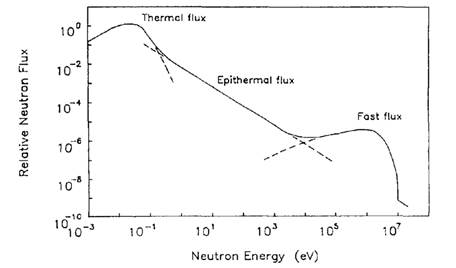
Figure 1: Example of a Neutron Spectrum from a nuclear fission reactor (Munita, Glascock, & Hazenfratz, 2019)
Now that we’ve outlined the key design criteria, the next article will break down the major SMR families, their technologies, capacity ranges, and use cases – from powering remote Indigenous communities to supplying military bases and industrial hubs.
References:
- Spinrad, B., & Marcum, W. (2025, October 2). Nuclear Reactor – Coolant Systems.
Encyclopaedia Britannica.https://www.britannica.com/technology/nuclear-reactor/Coolant-system
- Garner, F. (2012). Chapter 4.02 Radiation Damage in Austenitic Steels: 4.02.3 Differences in
Neutron Spectra. Comprehensive Nuclear Materials, Vol. 4: Radiation Effects in Structural and Functional Materials for Fission and Fusion Reactors, pp. 33–95. https://doi.org/10.1016/B978-0-08-056033-5.00065-3, https://www.sciencedirect.com/topics/earth-and-planetary-sciences/neutron-spectra#chapters-articles
- Gupta, C. K. (2001). Nuclear Reactor Materials: 3. Moderator, Reflector, and Blanket Materials.
Encyclopedia of Materials: Science and Technology (Second Edition), pp. 6339–6349. https://doi.org/10.1016/B0-08-043152-6/01123-2,https://www.sciencedirect.com/topics/materials-science/moderator-material
- Ghosh, S. (2024). Chapter 8.08 Material selection and processing in nuclear safety: 8.08.2.3
Moderator and coolant. Comprehensive Materials Processing: Second Edition, Vol. 8: Health, Safety and Environmental Issues, pp. 87–98. https://doi.org/10.1016/B978-0-323-96020-5.00167-9 https://www.sciencedirect.com/topics/materials-science/moderator-material
- World Nuclear Association. (2025, June). Small Nuclear Power Reactors.
- U.S. Department of Energy. (1993). Nuclear physics and reactor theory (DOE Fundamentals
Handbook, Vol. 1; DOE-HDBK-1019/1-93, pp. 1-142 https://www.navsea.navy.mil/Portals/103/Documents/NNPTC/Physics/doe_phys_nuc.pdf
- International Atomic Energy Agency. (2023). Neutron monitoring for radiation protection:
Safety Reports Series No. 115; STI/PUB/1987, pp. 1-254 https://www-pub.iaea.org/MTCD/Publications/PDF/PUB1987_web.pdf
- Science Direct. (n.d.). Neutron Spectra –In subject area: Earth and Planetary Sciences
https://www.sciencedirect.com/topics/earth-and-planetary-sciences/neutron-spectra
- Science Direct. (n.d.). Neutron Spectra –In subject area: Engineering
https://www.sciencedirect.com/topics/engineering/neutron-spectra
- National Academy of Engineering; National Academies of Sciences, Engineering,
and Medicine.(2023). Laying the Foundation for New and Advanced Nuclear Reactors in the United States, 1–238. https://doi.org/10.17226/26630 https://nap.nationalacademies.org/read/26630/chapter/4
11. Munita, C. S., Glascock, M. D., & Hazenfratz, R. (2019). Neutron Activation Analysis: An
Overview. 179–227. https://doi.org/10.2174/9781681085722119030007
12. World Nuclear Association. (2025, May) Physics of Uranium and Nuclear Energy .
Photo: Johnson, J. N. (2025, September 25). NuScale Power: The SMR stock at the heart of the AI energy boom. MarketBeat. https://www.marketbeat.com/originals/nuscale-power-the-smr-stock-at-the-heart-of-the-ai-energy-boom/