Is Going Nuclear Good for Critical Resource Extraction?
Erika Fernandez. November 21, 2025
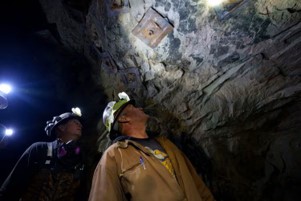
Anastasia Hufman. 2024. ‘As Utah’s Uranium Booms Again, Miners and Land Will Be Protected This Time, Industry Vows’. The Salt Lake Tribune. 2024. https://www.moabtimes.com/articles/as-utahs-uranium-booms-again-miners-and-land-will-be-protected-this-time-industry-vows/.
Is Going Nuclear Good for Critical Resource Extraction?
Natural Resources Canada argues that small modular reactors (SMRs) are a strategic asset for accessing resources and leveraging energy for economic, social, and geopolitical purposes,[1] but is this true? The answer is probably yes – however, there are considerations to explore. Nuclear energy is facing a global resurgence to meet increasing demands for a clean, reliable energy source that reduces carbon emissions and enhances infrastructure-security to remote and urban areas.[2] In particular, Canada is paying more attention to nuclear energy and its application to the extraction, exploration, of natural resources[i] and rare earth minerals.[3]
For example, the business case of SMRs could be applied to Ontario’s Ring of Fire – a significant untapped mineral resource area in northern Ontario spanning over 5,000 square kilometres.[4] The region is a source of chromite, cobalt, nickel, copper, and platinum which are important to Canada’s economy, national defence, and clean energy objectives.[5] At the provincial level, the Ontario government introduced a new law in 2025 intended to expedite access and infrastructure development.[6] In this scenario, an SMR could be a strategic asset for providing a power source to remote mining operations and offer greater efficiency and sustainability for long-term extraction projects.
Currently, crown corporations like SaskPower and Ontario Power Generation (OPG) are planning to build SMRs to meet demand to become a leader in the nuclear industry within Canada.[7] Besides Ontario, OPG and Capital Power are looking to deploy SMRs in Alberta, expanding the national SMR footprint to another province.[8]
Breaking Down SMRs in Detail
The reality is that SMRs are expensive, with an estimated project costing around between $50 million to $3 billion depending on the size: (microreactor <10 Mwe, small-scale reactors (10-50 Mwe), medium scale reactors (50-150 Mwe), and “Large-scale” SMR reactors (150-300 Mwe),[9] and an expected life span of 30 to 40 years. A related study done by the U.S. Department of Energy (DOE) highlights that nuclear energy is low maintenance and is 92.5 percent more reliable than natural or geothermal gas.[10]
Due to significant building and maintenance costs only a small portion of companies are likely to invest in SMRs. Regulatory challenges and questions also become more significant as companies outside the energy industry (mining companies) try to operate nuclear resources such as SMRs.
In addition to nuclear regulation, the Canadian government plays a heavy role in rare earth minerals mining, with different provinces controlling the development and management of resources. To enhance the adoption of SMRs, Canada through the department of Energy and Natural Resources provided $2.5 million towards SMR research to support the Enabling Small Modular Reactors Program.[11] The $2.5 million dollar research is divided into two projects: one is finding long-term disposal methods for nuclear waste, and researching how to incorporate 3D printing to create durable materials in SMRs.[12] Given the uncertain state of all government program funding beyond 2025, the future of additional SMR research remains unclear.[13]
The Business Case for Nuclear in Remote Mineral Rich Regions
Let’s consider mining in the Yukon territory for a business case in SMR versus conventional diesel generation. There are approximately 32 mines in the Yukon that generate all their power using diesel fuel.[14] These 32 mines are important, operating in mineral rich but infrastructure poor areas, representing a strategic opportunity for mining aided by SMR power generation. If these 32 mines were to hypothetically connect to B.C.’s power grid, it would cost an estimated $1.5 B – $2 B, equivalent to building a large SMR (~ 300Mw) without the accounted maintenance and building fees.[15]
However, not all mines will have the same business case due to scale and distance from the grid, so let’s consider a specific example of a mine running on diesel fuel.
Yukon’s largest mine, Newmont’s Coffee Gold project uses around 5 million litres of diesel annually, roughly equivalent to 19 million kilowatts of energy (1,300 homes).[16] Thus, if the average price of diesel in Yukon is $1.67/L to $2.10/L[17], the annual costs would be approximately $10 million yearly. Over a 40-year period this would equate to $400M in unadjusted dollars in fuel alone. When adding an estimated 20 percent in operating costs (equipment, people, maintenance) this equates to being under $500M in energy costs. For one mine.
This rough estimation presents a potential business case where a micro SMR can be cost-effective compared to diesel. A micro reactor can cost around $50 million to purchase, with annual operating overhead costs of $1M for a 40-year period equivalent to less than $100M, reflecting a potential 80% efficiency.
Conclusion
Mining companies are an example of the opportunity to build strategic autonomy by controlling their own energy supply. Currently, diesel is favoured due to its accessibility and overall ease of deployment. SMRs offer large potential savings over diesel, they also offer other additive benefits such as the ability to “cogenerate heat and power to remote communities”.[18] However, SMRs also have higher upfront costs and more perceived risks associated with their relative novelty, operational safety and regulation in addition to environmental hazards like soil and water contamination.
Therefore, diesel is the solution for operational simplicity and predictability, but it may come at a premium relative to the SMR options under development. This is not to say that diesel is the best choice — but that it is currently proven and available. The question posed becomes: how can we make SMRs a simple and predictable choice, if the economics appear to make sense? Could the answer be potentially opening doors to private-public partnership?
[1] Natural Resources Canada. ‘A Call to Action: A Canadian Roadmap for Small Modular Reactors’, 2018. https://publications.gc.ca/collections/collection_2018/rncan-nrcan/M134-55-2018-eng.pdf.
[2] Dave Culp. ‘Growing Nuclear Energy Interest Spurring New Investment in Nuclear Fuel Cycle’. NAC International, 2025. https://www.nacintl.com/insights/growing-nuclear-energy-interest-spurring-new-investment-in-nuclear-fuel-cycle#:~:text=It%20is%20clear%20nuclear%20energy,countries%20which%20already%20have%20nuclear.
[3] Natural Resources Canada. ‘Responsible Mining’. Government of Canada, 2025. https://natural-resources.canada.ca/minerals-mining/responsible-mining.
[4] Ontario Government. Ontario’s Ring of Fire. 2022. https://www.ontario.ca/page/ontarios-ring-fire).
[5] Ibid.
[6] Blair McBride. “Two Ring of Fire First Nations Oppose Ontario Law.” The Northern Miner, 2025. https://northernminer.com/news/two-ring-of-fire-first-nations-oppose-ontario-law/1003879662/?utm.
[7] David Dalton. ‘Go-Ahead For Project to Build Canada’s First Small Modular Reactor’. Independent Nuclear News, 2025. https://www.nucnet.org/news/go-ahead-for-project-to-build-canada-s-first-small-modular-reactors-5-4-2025.
[8] OPG. ‘Capital Power and OPG Partner to Advance New Nuclear in Alberta’. OPG, 2024. https://www.opg.com/releases/capital-power-and-opg-partner-to-advance-new-nuclear-in-alberta/.
[9] Zainab Gilani. ‘Will Small Modular Reactors Surpass Regulatory and Supply Chain Hurdles to Fill the Need for Stable, Baseload Power?’ Cleantech Group, 2023. https://www.cleantech.com/will-small-modular-reactors-surpass-regulatory-and-supply-chain-hurdles-to-fill-the-need-for-stable-baseload-power/#:~:text=Costs%20for%20SMRs%20vary%2C%20but%20estimates%20suggest,for%20microreactors%20to%20$3B%20for%20larger%20units.&text=Estimates%20suggest%20that%20CAPEX%20costs%20for%20these,cost%20of%20electricity%20(LCOE)%20ranging%20between%20$80%2D$90/MWh.
[10] U.S. Department of Energy. ‘Nuclear Power Is the Most Reliable Energy Source and It’s Not Even Close’. Office of Nuclear ENergy, 2021. https://www.energy.gov/ne/articles/nuclear-power-most-reliable-energy-source-and-its-not-even-close#:~:text=Nuclear%20Has%20The%20Highest%20Capacity,gigawatt%20coal%20or%20renewable%20plant.
[11] Natural Resources Canada. 2024. ‘Government of Canada Announces $11 Million to Advance Small Modular Reactor Research and Hydrogen Technologies to Support Clean Energy Development’. Government of Canada. https://www.canada.ca/en/natural-resources-canada/news/2024/07/government-of-canada-announces-11-million-to-advance-small-modular-reactor-research-and-hydrogen-technologies-to-support-clean-energy-development.html?utm_source=chatgpt.com.
[12] Ibid.
[13] Canadian Union of Public Employees. 2025. ‘Carney’s Cuts Threaten Services and Jobs That Help Our Communities Thrive’. CUPE. https://cupe.ca/carneys-cuts-threaten-services-and-jobs-help-our-communities-thrive?utm_source=chatgpt.com.
[14] SMR Roadmap and Technology working group. ‘Canadian SMR Roadmap’, 2018. https://smrroadmap.ca/wp-content/uploads/2018/12/Technology-WG.pdf?.
[15] Keith Halliday. ‘A Nuclear Option?’ UpHere, n.d. https://www.uphere.ca/articles/nuclear-option?
[16] Julien Gignac. ‘Will Mining Be the Sleeping Giant of Yukon Greenhouse Gas Emissions?’ The Narwhal, 2020. https://thenarwhal.ca/yukon-mining-greenhouse-gas-emissions-climate-change/.
[17] Statistics Canada. ‘Whitehorse, YT Average Retail Price for Diesel Fuel at Self Service Filling Stations’. YCharts, 2025. https://ycharts.com/indicators/whitehorse_yt_average_retail_price_for_diesel_fuel_at_self_service_filling_stations#:~:text=Basic%20Info-,Whitehorse%2C%20YT%20Average%20Retail%20Price%20for%20Diesel%20Fuel%20at%20Self,15.91%25%20from%20one%20year%20ago.
[18] Government of Canada. ‘Small Modular Reactors (SMRs) for Mining’. Government of Canada, 2025. https://natural-resources.canada.ca/energy-sources/nuclear-energy-uranium/small-modular-reactors-smrs-mining.
[i] For instance, Natural Resources Canada is implementing “a two-year extension of the 15 per cent Mineral Exploration Tax Credit (METC)” which delivers $110 million for exploration investments including finding and developing new mining sites.[i] This tax credit does not include covering capital expenses such as energy and power investments, rather the program targets exploration like drilling, sampling, etc.