Dead-End Pathways
A practical tool for identifying decarbonization options that cannot plausibly deliver net zero.
Time, money, political capital, and institutional attention are limited. Investing in pathways that cannot reach a net-zero end state delays meaningful progress and diverts resources from viable solutions. This framework helps decision-makers identify and avoid those dead ends.
What is a dead-end pathway?
A potentially promising options for decarbonization that upon closer scrutiny cannot effectively address the climate challenge and if nevertheless pursued would waste scarce societal resources.
The three diagnostic tests
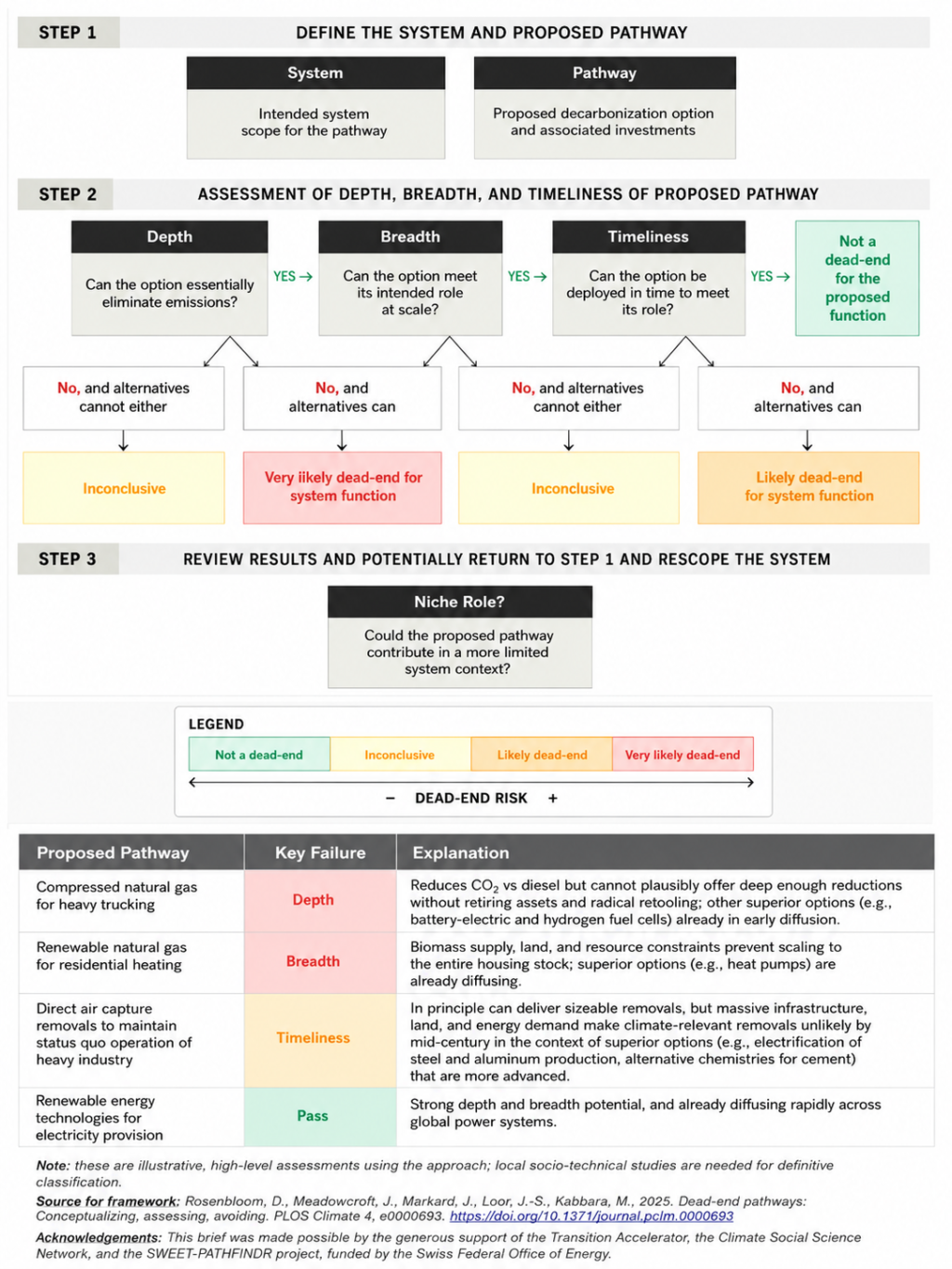
The framework assesses pathways sequentially across three dimensions.
1. Depth – Can the pathway ultimately eliminate emissions in the system of interest?
If not, it is very likely a dead end.
2. Breadth – Can it scale to perform its intended function across the relevant system?
If not, it is very likely a dead end for that system.
3. Timeliness – Can it be deployed quickly enough to help meet climate commitments?
A pathway that might work someday may still be a dead end if superior alternatives can deliver on the required timeline.
Examples
The following are illustrative assessments using the approach. Local socio-technical studies are needed for definitive classification.
| Proposed Pathway | Assessment | Key Diagnostic |
|---|---|---|
| Compressed natural gas for heavy trucking | Very likely dead-end pathway | Depth |
| Renewable natural gas for residential heating | Very likely dead-end pathway | Breadth |
| Direct air capture removals to maintain status quo operation of heavy industry | Likely dead-end pathway | Timeliness |
| Renewable energy technologies for electricity provision | Not a dead-end pathway | Passes all three tests |