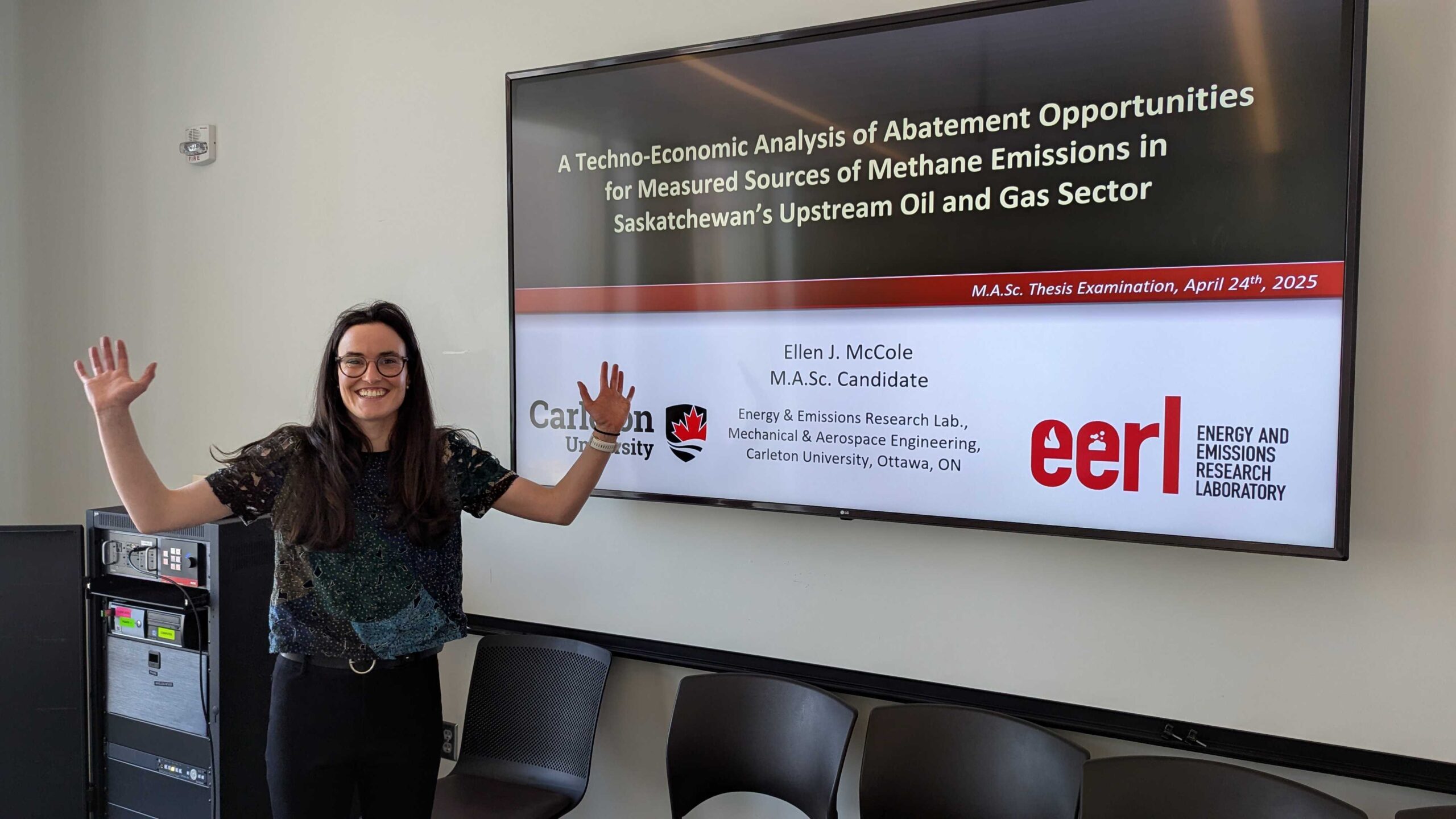
Congratulations to Ellen Josephine McCole on successfully defending her master’s thesis titled “A Techno-Economic Analysis of Abatement Opportunities for Measured Sources of Methane Emissions in Saskatchewan’s Upstream Oil and Gas Sector” .
Ellen’s thesis project is an important piece in EERL’s techno-economic work exploring cost-effective mitigation technologies to reduce methane emissions. The Government of Canada has been developing new oil and gas sector methane regulations which are necessarily underpinned by a regulatory impact assessment that considers costs to achieve a given level of mitigation. Three recent techno-economic analyses – ICF International (2016), Tyner & Johnson (2018), and Dunsky (2023) – have evaluated the marginal abatement cost of methane mitigation in Canada’s upstream oil and gas sector. However, these analyses are limited in that they either considered source breakdowns and magnitudes as outlined in available federal methane emission inventories, or these same breakdowns scaled to match aggregate measured totals. By contrast, recent field studies to create measurement-based inventories (Tyner & Johnson, 2021; Johnson et al., 2023; Conrad et al. 2023) have shown that actual source breakdowns can be significantly different than suggested in official inventories, with aggregate totals that are approximately 1.4—1.8 times federal estimates.
Leveraging actual measured source distributions obtained from a comprehensive measurement-based inventory, developed by EERL, this study outlines results of a techno-economic analysis of selected methane mitigation technologies for oil and gas production sites in the province of Saskatchewan, Canada. Beginning with an exhaustive review of grey and peer-reviewed literature, cost models for mitigation technologies were derived to identify potential cost-effective solutions. Abatement cost models were then produced using a 2021 measurement-based, source-resolved methane emissions inventory for Saskatchewan (Conrad et al. 2023) to evaluate abatement costs under two scenarios: (1) mitigation of all emissions on each site, and (2) mitigation of emissions only when cost effective relative to a selected cost threshold. Abatement costs were separately estimated on a site-by-site basis prior to deriving total abatement costs for the province.
The preliminary results, as part of Ellen’s thesis, have been shared at 2023 AGU in San Francisco and at 2024 & 2025 CanCH4 Symposium in Ottawa. The study findings are being further developed and refined by EERL Team, as they have important implications for ongoing regulatory development as well as longer-term goals of net-zero emissions.