Where Experience Meets the Classroom: Inside Sprott’s Professional MBA
For Danielle Rolling, pursuing an MBA wasn’t about stepping away from her career. It was about figuring out how to keep moving forward.
As a Financial Policy and Systems Analyst at Health Canada, Rolling already held a Bachelor of Commerce and had built considerable experience working in finance. With that foundation, she saw a Master of Business Administration (MBA) as a way to further develop her skills and open new possibilities for where her career could go next. But with an established career already underway, returning to school meant finding a program that could fit into her professional life — not put it on pause.
Carleton University’s Professional MBA (PMBA) offered a solution to that challenge.
With full-day, in-person classes every second Friday and Saturday, the 16-month program gave Rolling a way to pursue an MBA without stepping away from her career.

“I was really excited to find an in-person program that allowed me to continue working at the same time,” she says. “I’ve always found that I get a lot more out of learning in person than I do online.”
Rolling’s experience reflects the idea behind the PMBA itself. When Carleton’s Sprott School of Business launched the program in 2019, it was designed specifically for experienced professionals who wanted to keep progressing in their careers while developing the broader management and leadership skills to take the next step.
Seven years later, Luciara Nardon, Sprott’s Associate Dean, Professional Graduate Programs, says that original idea has grown into something larger.
“The PMBA has evolved from a new offering designed for working professionals into one of the School’s signature graduate programs,” says Nardon.
“It has grown into a learning network that attracts professionals from diverse industries, backgrounds, and stages of leadership.”
That evolution reached Kanata in January 2026, when Sprott welcomed the first PMBA cohort to CU@Kanata — bringing a program built around meeting professionals where they are into the heart of Canada’s largest technology park.
Drawing from Experience
By design, PMBA students arrive with something that can’t be taught from a textbook: years of professional experience. That expertise doesn’t stay at the classroom door, with students bringing the challenges, decisions and perspectives from their current roles into discussions with faculty and classmates.
“Students aren’t discussing theoretical business challenges — they’re working through real leadership and organizational issues drawn from their own careers,” says Nardon.
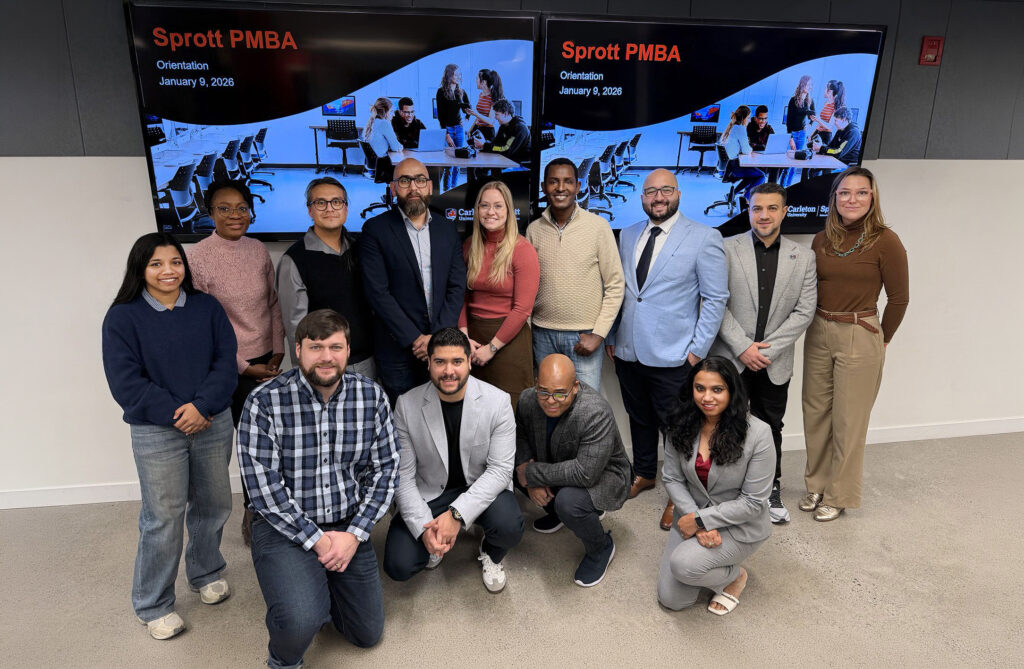
With professionals from technology, public service, health care, finance, defence, entrepreneurship and the non-profit sector learning alongside one another, conversations about leadership or organizational change draw on perspectives shaped by very different industries and workplaces.
The result is a learning environment where expertise flows in more than one direction.
For Rolling, those relationships have become an important part of the experience, connecting her with classmates who share opportunities, exchange ideas and encourage one another in their professional goals.
Meeting Professionals Where They Are
The same philosophy that shaped the PMBA — creating a graduate program that works alongside an established career — also made Kanata a natural place for its expansion.
“Launching the Kanata cohort allows us to bring graduate business education directly into an innovation ecosystem where professionals are actively shaping the future of technology, business and entrepreneurship,” says Nardon.
“It also makes the program more accessible to professionals balancing graduate education with busy careers and personal commitments.”
That expansion also provides professionals another entry point into the program. While Sprott’s main-campus PMBA cohort begins in September, the CU@Kanata cohort begins in January, with both following the same 16-month format.

For Rolling, the Kanata location has become part of what makes the in-person experience work. She points to practical benefits such as free parking, breakout rooms and shared spaces that give students opportunities to work together and connect between classes.
“I’ve genuinely enjoyed the Kanata location,” she says. “It’s a really nice setup for us.”
Those interactions matter in an intensive cohort-based program. A classroom discussion can continue over lunch, a group can work through a problem together between sessions, and professional relationships can grow beyond the course material.
Learning That Moves with a Career
Through case studies, applied projects and real-world organizational challenges, students can bring questions and experiences from their careers into the classroom — and take new ideas back to the workplace.
“Students don’t have to wait until graduation to see the impact of what they’re learning,” says Nardon.
“They can apply new ideas in their real-world roles from the first course and continue building on them throughout the program.”
The program has also expanded its focus on individualized professional development, with opportunities including career coaching and skill development in areas such as AI literacy, communication and innovation.
For Rolling, that flexibility matters in a cohort where students may be at various stages of their careers.
“Each of us gets to develop skills that are meaningful to us and tailored to our individual goals,” she says.
The experience has also broadened her sense of where her future could lead.
“It’s definitely expanded my perspective on the opportunities available to me and where my career could go,” says Rolling.
That sense of possibility speaks to what Sprott set out to create in 2019: a program shaped around professionals already established in their careers, and strengthened by the experience, perspectives and ambitions they bring with them.