Takeaways From the Fieldwork in Chile and Colombia
by Constanza Lobos, Stephanie López Villamil
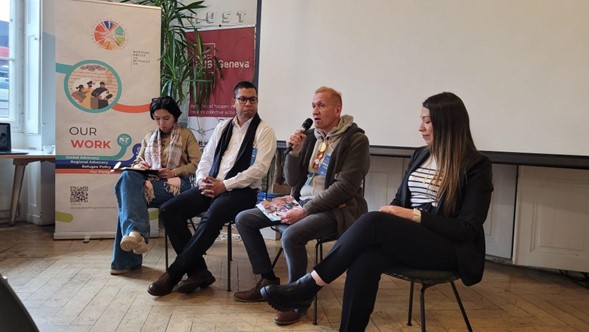
Panel: “Venezuelan refugees in Latin America: protection gaps” during the Global Refugee Forum 2023. In the photo: Fernanda Bedoya (El Derecho a No Obedecer), Roberto Blanco (Alianza VenCR), Robert Tigrera (Asociación Lluvia de Arcoiris), Lublanc Prieto (Refugees United)
As part of the project “The Politics and Process of Refugee Leadership: A Comparative Analysis of Factors Conditioning Refugee Leadership in Global South” our team of researchers from Colombia and Chile conducted fieldwork in both countries to understand the conditions that enable or constrain refugees to demonstrate leadership in navigating local, national and regional power structures to influence the development and implementation of policies and programs aimed at affecting their daily lives.
During the first semester of 2024, we approached Venezuelan and Haitian leaders in both countries to learn about their trajectories and experiences. We discussed their needs and expectations and the obstacles they have encountered in their paths for the meaningful participation of their communities and in carrying out advocacy processes. Methodologically, this involved approaching refugee and migrant leaders considering research ethics and the challenges to approach the different actors, including organizations, and associated institutions. In this blog, we will reflect on the main implications of doing research with refugee and migrant leaders from the global south.
Methodology design and first approaches to the field
One of the team’s first tasks was to approach refugee and migrant communities, leaders, and relevant actors by attending different events related to migration and refugees. We also collected secondary data that was very useful to build a contextual overview of the migration and refugee situations in Colombia and Chile. All of the above made it possible to do a mapping of actors that was key to understanding the realities of both countries and to select possible participants for the research.
A disadvantage in the Chilean case was that there were no official records of migrant and refugee organizations, so the mapping had to be built based on the knowledge of the research assistants in Chile and their involvement in different events through participant observation. In Colombia, both researchers leveraged their networks and previous collaborations with RLOs to recruit participants.
Another important challenge we faced in the case of Chile was the recent modifications of the political-legal context, with the enactment of a new migration law that modified the requirements and procedures for obtaining refugee status, as well as the presentation of different bills in Congress in a short period. This had an impact on the public political discourse in Chilean society, reinforcing a scenario of criminalization of migratory flows. We addressed this issue by developing various strategies to ensure respectful relationships with the participants and creating spaces of trust and security for both; us and them. Also, the collection of background information on the legal and political context allowed the team members to be aware of the situations that were occurring in Chile and to be informed when conducting interviews and focus groups.
While designing the data collection instruments for the fieldwork, a positive aspect was the collaborative creation of interview and focus group questions within the team. We considered relevant items for both the Chilean and Colombian cases. This allowed us to gain a broader perspective on the subject under investigation by contrasting elements of the context in each country and seeking commonalities and unique aspects of the experiences of migrant and refugee leaders.
Field data collection: obstacles, challenges, and achievements
Fieldwork was carried out between May and June 2024 in three cities: Bogotá, Riohacha, and Santiago. We conducted semi-structured interviews and focus group discussions (FGD) with Venezuelan and Haitian leaders, representatives of institutions related to migration and refugee issues, representatives of international organizations, and experts.
One of the main challenges in recruiting people at the beginning of the fieldwork was the distrust and lack of interest in the participation of community leaders in the regions of Chile, especially from the Haitian community. Some leaders expressed their concerns about “academic extractivism” and the risk of disregarding their voices when disseminating research results. To address this issue, we primarily relied on the established trust with researchers and established new platforms for open dialogue and collaboration to further strengthen this trust. Additionally, we informed the participants about the opportunity to engage in discussions about the findings and to be involved in the dissemination process, which piqued the interest of some participants.
The main challenge we encountered was the difficulty in getting leaders in Chile to participate in interviews or FGDs due to their busy schedules. Most of them have full-time jobs and work simultaneously in their organizations, leaving them with little time for extra activities. Additionally, the fieldwork in Chile coincided with the end of the first semester of the work/student year and the vacations of some interviewees and their children, leading to limited availability and the need to reschedule appointments. We sought to accommodate their availability of time and locations and be flexible with the proposed times. We agreed to conduct interviews and the focus group discussion after 6 p.m. so that they could participate.
In the case of Colombia, the main challenge was to elicit responses from state institutions and international organizations for the interviews. The solution was to seek out alternative individuals or organizations.
We encountered various challenges during our fieldwork in both countries, prompting us to consider new approaches for involving migrant and refugee leaders in the co-design and co-development of our research. We aimed to gather their perspectives on the situation and to build trust between researchers and participants or organizations. We believe that involving leaders in other stages of the research process could help us recruit more people, particularly from the Haitian community and among Haitian women, who were initially hesitant to participate.
Takeaways from our fieldwork in Chile and Colombia
The fieldwork in South America provided valuable lessons for both the team and the participants. These are our key takeaways:
- Establishing strong and trusting relationships with communities, organizations, and authorities is essential for effectively involving them in the co-design process from the outset of the research. This will help ensure that the research objectives and outcomes have a meaningful and beneficial impact on the communities involved.
- Building trust with the participants and developing collaborative proposals for future work. Leaders expressed their interest in continued involvement in the research, such as writing articles or academic blogs, and other forms of collaboration beyond the initial interview.
- Gaining a deeper understanding of the dynamics within the communities we intend to investigate, such as gender and age relations, and power structures. This understanding could help us establish stronger connections and determine effective ways to engage with different communities, such as the Haitian community.
- Collaborating continuously with leaders to discuss the research results and involve them in various dissemination activities. Many leaders appreciated being asked about their needs, which is a significant outcome of the research, especially in contexts where information on this topic is scarce or non-existent.
- Listening to migrant and refugee leaders is crucial for any research, integrating their voices into debates, disseminating the results, and creating opportunities for dialogue with authorities and experts.