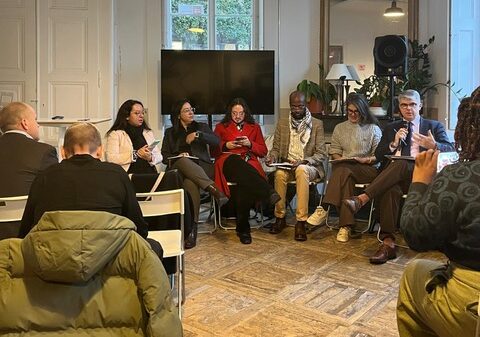
Dr. Stéphanie López-Villamil, Ana María Díez, Alejandro Gómez, Abdullahi Mire, María Guevara, and James Milner participate in the panel discussion at R-Space in Geneva. Building Bridges Across Regions: Refugee-Led Dialogue Between East Africa and Latin America. 15 December 2025.
On 15 December 2025, LERRN and R-SEAT co-hosted a panel discussion at R-Space in Geneva on the theme “Building Bridges Across Regions: Refugee-Led Dialogue Between East Africa and Latin America”.
Timed to coincide with the Global Refugee Forum Progress Review meeting, the event was a critical opportunity to highlight the shared challenges and opportunities to levering the expertise of refugee leaders in developing and implementing more efficient, effective and accountable responses to displacement. With the room at full capacity and with many key partners in attendance, the event highlighted the critical role that enhanced and meaningful refugee participation can play in ensuring that collective action to respond to the needs of refugees can be mobilized at a time of financial collapse for the humanitarian response sector and growing political skepticism around both multilateralism and upholding core refugee and human rights protection principles.
The event centered around the global launch of LERRN’s synthesis of its work on refugee-led organizations in East Africa and the Middle East and its more recent work, supported by the Gerda Henkel Foundation, on refugee leadership in East Africa and South America. Presented by the author, Dr. Stéphanie López-Villamil, the synthesis highlights the crucial role of refugee-led responses across regions, in areas as diverse as service delivery, advocacy, and policy development. By outlining the various ways that refugee leaders navigate shifting political opportunity structures, López-Villamil detailed the use of multi-level advocacy used across contexts to address power inequalities and enhance access and impact. The lessons of this analysis are particularly relevant given the moment currently faced by the global refugee regime.
The event then featured responses and perspectives from refugee leaders working in diverse contexts. In her intervention, María Guevara, Latin America Lead for R-SEAT, highlighted how the synthesis report captured the strategies employed by refugee-led organizations across Latin America and how the expertise of refugees is increasingly being recognized in national processes and regional efforts, such as the Cartagena +40 process. Abdullahi Mire, winner of the 2023 Nansen Refugee Award and founder of the Refugee Youth Education Hub, highlighted how the strategies outlined in the report are being used by leaders in places like the Dadaab refugee camps in Kenya to navigate the profound consequences of collapse of funding to UNHCR in 2025. Alejandro Gómez, with Fundación Refugiados Unidos in Colombia, noted that while there has been an increased recognition of the substantive value of refugee participation, it is important to highlight that disproportionate barriers remain for many, especially leaders from the LGBTQI+ community. Ana María Díez, President of Coalición por Venezuela, noted that while refugee leadership had contributed to critical policy changes at the national and regional level, such as the regularization of status for some 2 million Venezuelans in Colombia, more work is needed to change the perception of refugees from a burden to a state to understanding refugees as individuals with skills and abilities to contribute to their host community.
The panel discussion was followed by a lively discussion with a highly engaged audience that illustrated the relevance of the results presented in the synthesis report to situations well beyond the contexts included in the report, along with the increased relevance of these issues in advance of the anticipated election of Dr. Barham Salih as High Commissioner for Refugees by the UN General Assembly later in the week.
The panel highlighted how the challenges and opportunities faced by refugee leaders are remarkably similar across regions. While challenges persist around issues of funding, access and capacity, refugee-led initiatives have responded by drawing on the strength of coalitions, engaging with regional processes, leveraging the combined significance of their unique access to displaced communities and their moral and expert authority, and their ability to mobilize through alternate forms of media, such as social media and virtual networks. Ultimately, the event underscored the key lessons from the research on refugee leadership and refugee-led organizations: At a time of profound need and collapsing support from traditional partners, refugee-led responses bring the combination of moral authority, proven efficiency, technical expertise, and trust-based relationships with affected communities that are urgently needed to reimagine responses to forced migration in a rapidly evolving political reality.