Past Event! Note: this event has already taken place.
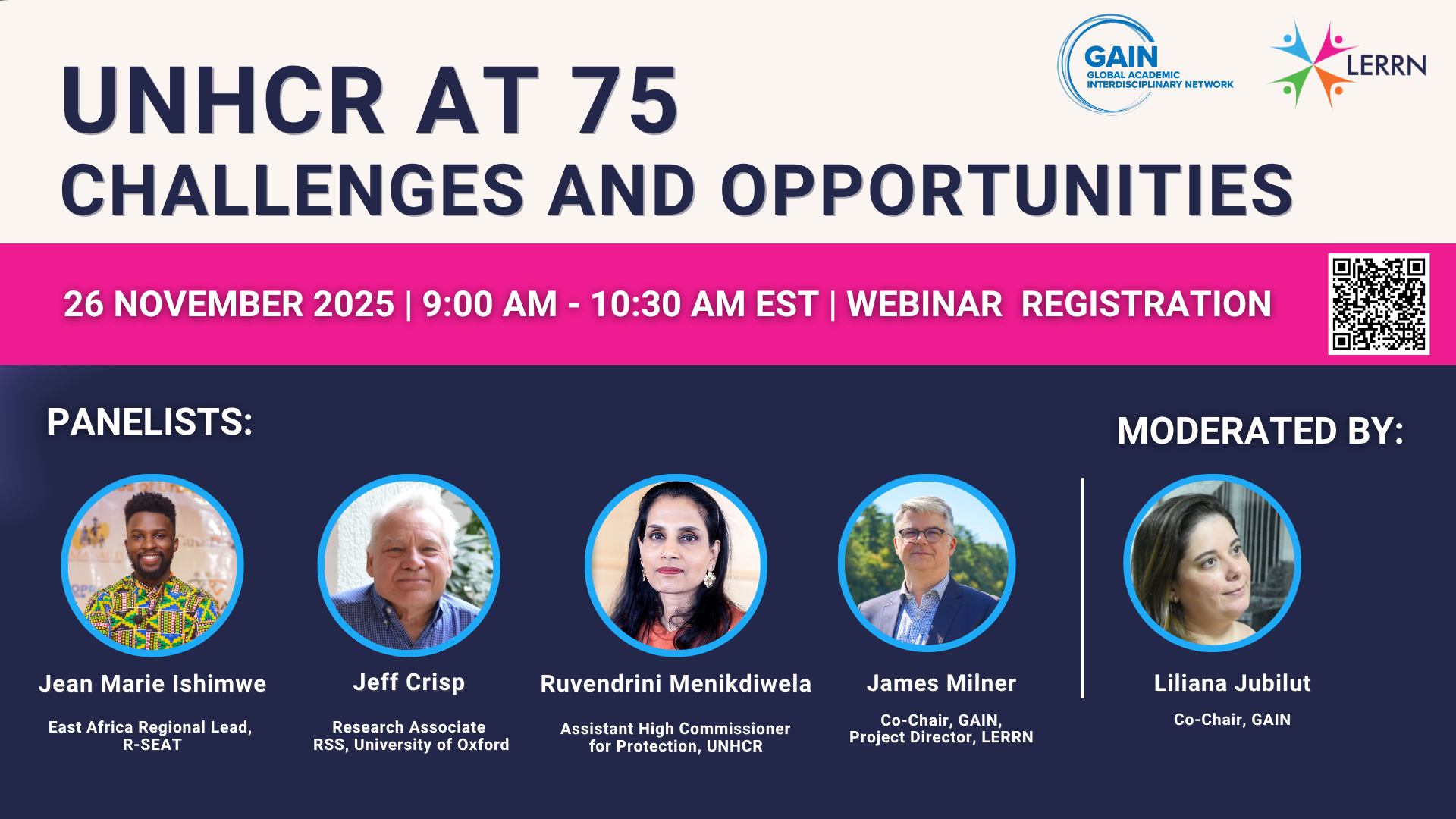
Webinar “UNHCR at 75: Challenges and Opportunities”
November 26, 2025 at 9:00 AM to 10:30 AM
| Location: | Zoom |
| Cost: | Free |
Time: 9:00 AM – 10:30 AM EST (Timezone Converter)
Supported by Wordly (text translation)
Event Description
The Office of the United Nations High Commissioner for Refugees (UNHCR) was created by the UN General Assembly on 14 December 1950. Its founding mandate was to ensure international protection for refugees and to facilitate the cooperation necessary to find durable solutions. UNHCR’s history has been one of both continuity and change, with the organization’s core mandate enduring over the decades and the scope of the organization’s work evolving considerably. As UNHCR prepares to turn 75 this December, the organization and the global refugee regime itself face profound challenges stemming from dramatic funding cuts and growing political opposition to the core principles UNHCR was created to defend. At the same time, however, UNHCR’s mandate is as critical as ever as global forced migration dynamics continue to grow in scale and complexity.
As UNHCR prepares to turn 75 in mid-December and ahead of the Global Refugee Forum Progress Review meeting in Geneva, please join a distinguished panel as we discuss: What are the challenges and opportunities facing UNHCR? How can our understanding of UNHCR’s role within the global refugee regime help navigate current challenges and ensure the organization’s mandate is realized in an increasingly turbulent world?
This webinar is co-hosted by the Global Academic Interdisciplinary Network (GAIN) and the Local Engagement Refugee Research Network (LERRN). GAIN was established by Paragraph 43 of the Global Compact on Refugees (GCR) to mobilize the academic research community to help advance the objectives of the GCR. With the support of a Partnership Grant from the Social Sciences and Humanities Research Council of Canada (SSHRC), LERRN is working to ensure that the knowledge and expertise of those most affected by displacement more reliably shapes forced migration studies, policy and practice, contributing to a global forced migration response system that is more effective, legitimate and accountable for and to those most affected by displacement.