Banting Fellow Supports Ethiopia
By Sue Bowness
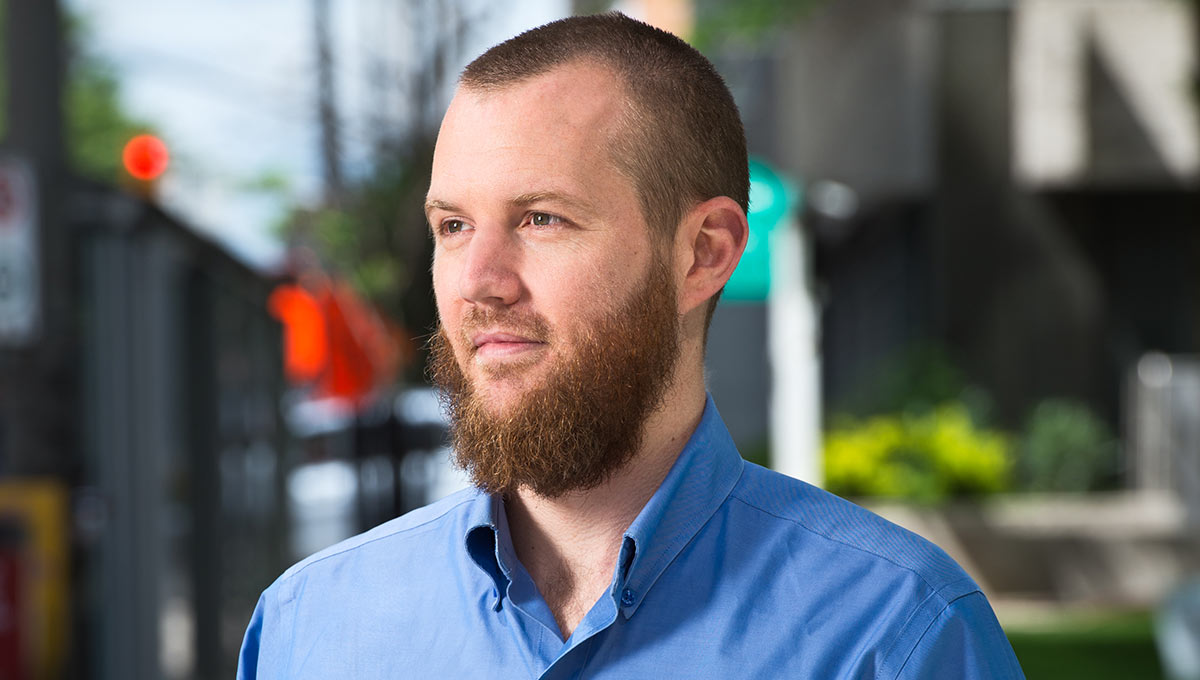
Ask Logan Cochrane what keeps drawing him back to Ethiopia and he’ll say it’s a mixture of personal connections and depth of experience. While Carleton’s newest Banting Postdoctoral Fellow has worked in other African countries such as Uganda, Burundi, Tanzania and DR Congo, Cochrane consistently returns the nation where he first started his career as a development worker.
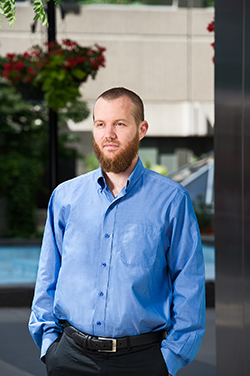
“It was the first place that I moved, and I spent my early years there, so I learned to speak their national language. That gave me a much stronger connection. Now, if I go to work for a project, I’m building on a legacy of experiences from a range of different sectors. I think that adds a lot of value,” he says.
In 2012, Cochrane took his commitment a step further by becoming a permanent resident of Ethiopia.
With research funding amounting to $70,000 a year for two years, Cochrane is set to put the value he brings to further good use. His postdoctoral project, undertaken for Carleton’s Faculty of Public Affairs, will investigate how citizens engage their fellow citizens and government to make positive change in policies and institutions.
He’ll also consider how specific factors contribute to change, including social capital factors (religion, linguistic, age, gender) and access to information. Finally, he’ll consider the effect government responsiveness has on the stability of the government and country (Ethiopia’s two previous governments were overthrown by coups d’etat).

Ethiopia: A Nation in Crisis
That Ethiopia is a nation in crisis is clear from the numbers: in 2015 and 2016, there were more than 500 protests where at least 650 unarmed protestors were killed by the military and 20,000 were arrested.
A state of emergency was declared in fall 2016.
Being embedded for many years gives Cochrane an understanding that goes beyond the headlines, a depth that is evident in both his research and development work history. Growing up in British Columbia, Cochrane moved to Ethiopia after completing a Bachelor of Arts in Anthropology at the University of Victoria. There, he started working with organizations such as UNICEF, UNAIDS, and Save the Children, several of which he continues to consult for today.
Research for his master’s degree in sustainable development at Staffordshire University in the United Kingdom focused on climate change adaptation in Ethiopia, and his doctoral research at the University of British Columbia focused on improving policies and programs around Ethiopia’s food security.
Community Collaboration
Cochrane says that his new home base in Ottawa is an ideal location for his continued research due to its proximity to funding agencies (he’s currently working for the International Development Research Centre) and African embassies. He adds that the strength of the university’s graduate and undergraduate programs in international development, as well as its Institute for African Studies (the only such institute in Canada) makes Carleton the best home base.
“Carleton has this really unique opportunity of being connected with all of the African diplomats. A number of African nations have very strong relationships with Carleton,” he says.
Cochrane adds that he’s drawn to continue his work in academia for its potential to provide a basis for evidence-based decision making. He’s quick to emphasize the collaborative nature of the work he does, soliciting input from community members on everything from devising research questions to collecting and analyzing data.
It’s this mix of outside objectivity and community involvement that helps to produce more functional research, says Cochrane. “Because government programs can be political, outside researchers consulting with community members can help determine whether programs are meeting the needs of the community. In some ways research can be an intermediary between national decision makers and community members.”
Yet his ongoing passion for development work is rooted in a strong sense of social justice. “A legacy of injustice needs to be addressed, and that includes forms of contemporary capitalism; it includes all sorts of things where certain people are marginalized and suffer for the benefit of others, and that includes us,” he says.

Related Stories

CKCU 93.1 FM: Community Radio at Carleton University
As Canada’s first campus-based community radio station, CKCU 93.1 FM has been a staple of Ottawa-Gatineau’s airwaves for 50 years, amplifying local voices, emerging artists…
Reimagining Responses to the Refugee Crisis
The geopolitical chaos of the past few years has made life even more precarious for millions of people around the world who have been forced…
Carleton University’s Top 10 Stories of 2025
As the 2025 season comes to a close, we reflect on the groundbreaking research, innovative leadership and inspiring community achievements that defined 2025 for Carleton…