Brexit Event Explores Future of the European Union
By
Joseph Mathieu
Photo Credit:
Chris Roussakis
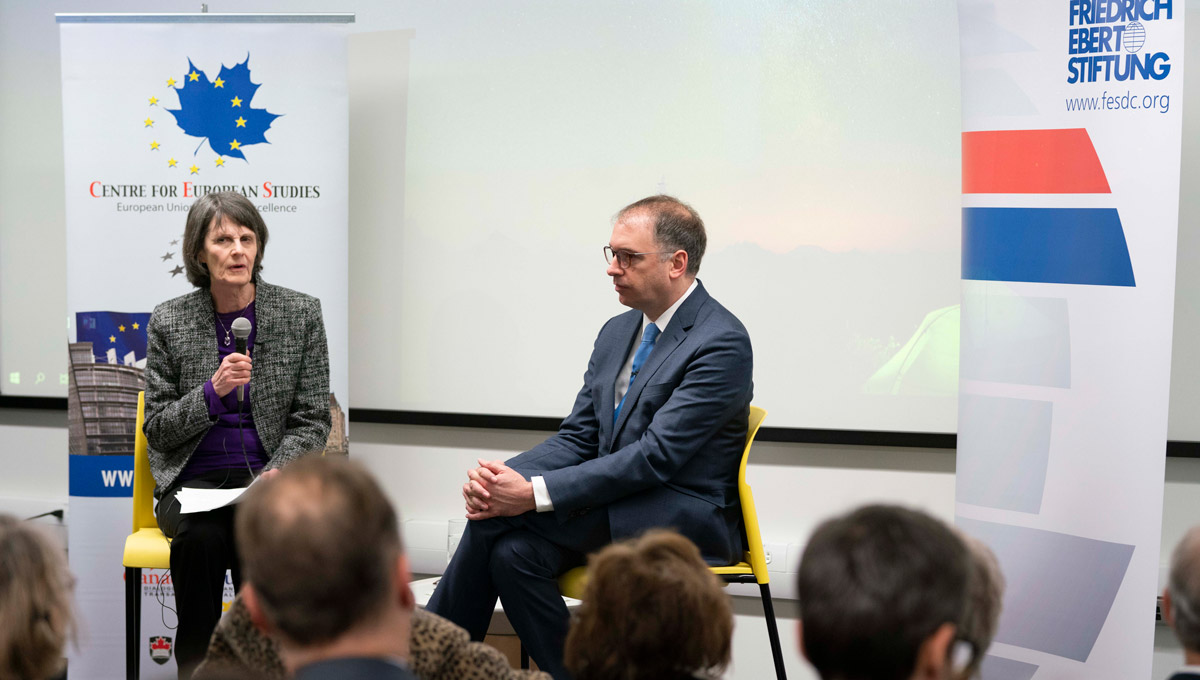
A special event hosted by Carleton’s Centre for European Studies (CES) and the Friedrich Ebert Foundation was held in MacOdrum Library’s Discovery Centre on Jan. 9, 2019.
Political Science Prof. Joan DeBardeleben put questions to Niels Annen, minister of state in the German Foreign Ministry about challenges facing the European Union (EU) in the coming months and years.
The event, titled Beyond Brexit: The Future of the European Union, allowed the pair to discuss EU sanctions on Russia, the rise of populist parties and the response to undemocratic tendencies in Poland and Hungary.
With European elections set for late May, DeBardeleben asked Annen if the wave of populism posed an existential threat to the EU. He argued that right-wing parties that constantly mention migration, refugees and crime had nothing much to offer.
“They win if you are afraid,” said Annen.
Does Brexit Weaken the EU’s Effect on the World Stage?
The best counter to divisive politics is multilateral co-operation, he said. He echoed the sentiment when DeBardeleben asked him if he saw Brexit as significantly weakening the EU’s effect on the world stage.
Although Germany regrets the choice made by the British people, it accepts the Brexit decision. Annen didn’t speculate on what might happen with the final Brexit agreement between British Prime Minister Theresa May and the EU.
“I am very optimistic that despite all the difficulties, the United Kingdom and the European Union have a very solid base to continue co-operation.”
DeBardeleben wondered if there was a planned exit to the escalation between Russia and Germany. After Russia’s 2014 annexation of the Crimean peninsula, the EU and United States imposed economic and diplomatic sanctions on Russian citizens and corporations, many of which are still in place.
“Unfortunately, sometimes in diplomacy your own language is not sufficient to make a point,” said Annen. “Sanctions are in a way another instrument of communication.”
He posited that stability in Europe is only possible through a pragmatic relationship with Russia, and that Germany wanted to find a political way to get rid of sanctions. The minister echoed German Chancellor Angela Merkel’s message that for this to happen Russia would need to co-operate.

Questions About a Rules-Based World Order
Before a brief question and answer session with the audience, DeBardeleben asked if the U.S. withdrawal from various international initiatives was threatening the rules-based world order.
“The concerning aspect is that the rule of law, democracy, the respect for human rights —which has always been under threat — is now also slowly disappearing from the agenda of western powers,” said Annen.
In his opening remarks, Annen mentioned that the relationship with Germany’s most important ally, the U.S., had been easier before Donald Trump became president.
“[But] we are not giving up on America,” he said. “Why should we? We still see a lot of support and encouragement, also from the United States.”
Annen said a positive agenda that can strengthen international co-operation can be built with the U.S. Congress, state governors, business associations, trade unions and civil society organizations.
“It’s important to invest even more in the relationship with your friends,” said Annen.
Click here for more stories from the Carleton Newsroom.
Related Stories
Protecting People from Earthquakes
Earthquakes are among the most destructive natural disasters on the planet. They typically happen when the tectonic plates that form the Earth’s outer shell, which…

Carleton University’s Top 10 Stories of 2025
As the 2025 season comes to a close, we reflect on the groundbreaking research, innovative leadership and inspiring community achievements that defined 2025 for Carleton…
Carleton’s Research Excellence Recognized with Four New Canada Research Chairs
Carleton University researchers Kelly Fritsch, Mohamed Al Guindy, Sriram Subramanian and Jaisie Sin have been announced as the university’s newest Canada Research Chairs (CRC). Their…