Gold Medal Research: Inaugural Graduate Studies Celebration at Carleton
By
Tyrone Burke
Photo Credit:
Chris Roussakis
The Gold Medal winner files across the stage, accepts recognition of the exceptional achievement, then – without a word – disappears into a sea of mortarboards.
Or at least that’s the way it’s been for 145 years.
The Governor General’s Academic Medal recognizes Canada’s finest scholars, and winners of the Gold Medal have broken new ground in their fields, but they haven’t been given a platform to share it, until now.
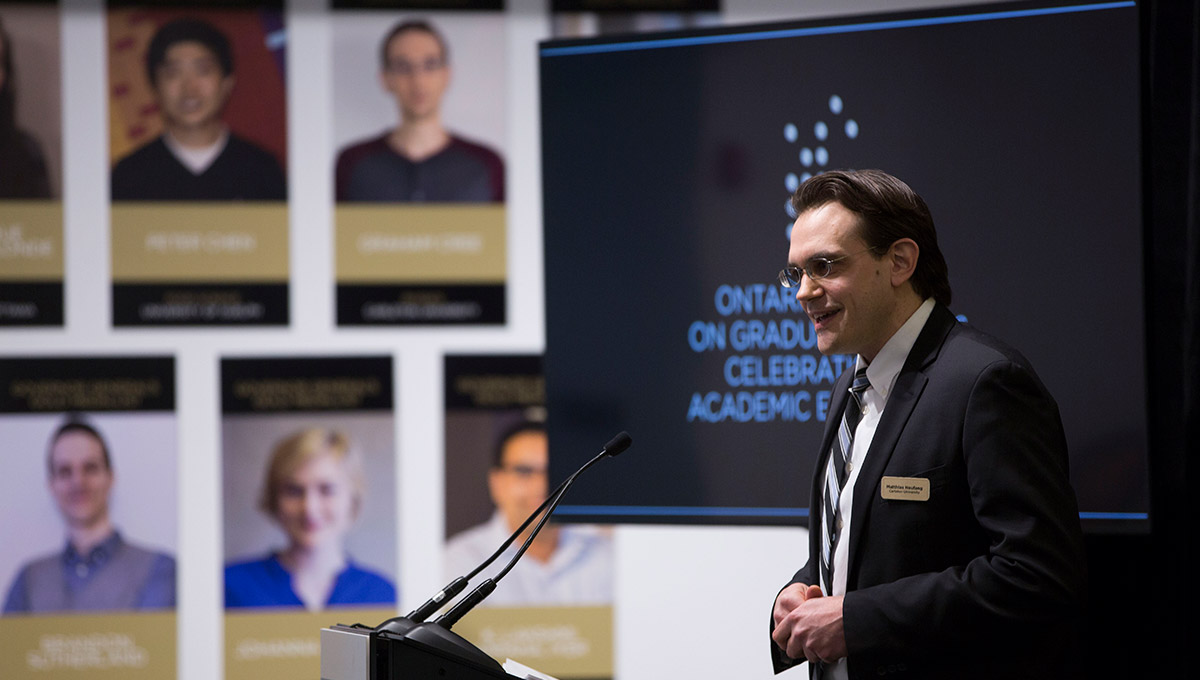
“Year after year, I would be on a podium and would congratulate people,” says Matthias Neufang, Carleton University’s dean of Graduate and Postdoctoral Affairs.
“But all I could do was read their thesis title – and no one would really know what the groundbreaking research was. The Gold Medal honours the best graduate work in a given year, but all the audience knows is that this must be truly outstanding.”
Honouring Winners from Across Ontario
Neufang conceived an event to honour winners from across Ontario and give each a chance to deliver a five-minute presentation on their work. On April 6, the inaugural Ontario Graduate Studies Celebration of Academic Excellence brought together eight Gold Medal winners at the Royal Canadian Geographical Society on Sussex Drive, with another three joining via video, as they pursue post-graduate opportunities.
Graham Cree, working with Carleton’s ATLAS research group – which uses data from the ATLAS particle detector of the Large Hadron Collider at Switzerland’s CERN, the European Organization for Nuclear Research – developed a way to more accurately measure the Higgs boson particle’s mass, natural width and interaction rate.
The Higgs boson – which gives other particles their mass – is the final piece of the standard model of particle physics. It’s been predicted to exist since the 1960s, but was only discovered in 2012.
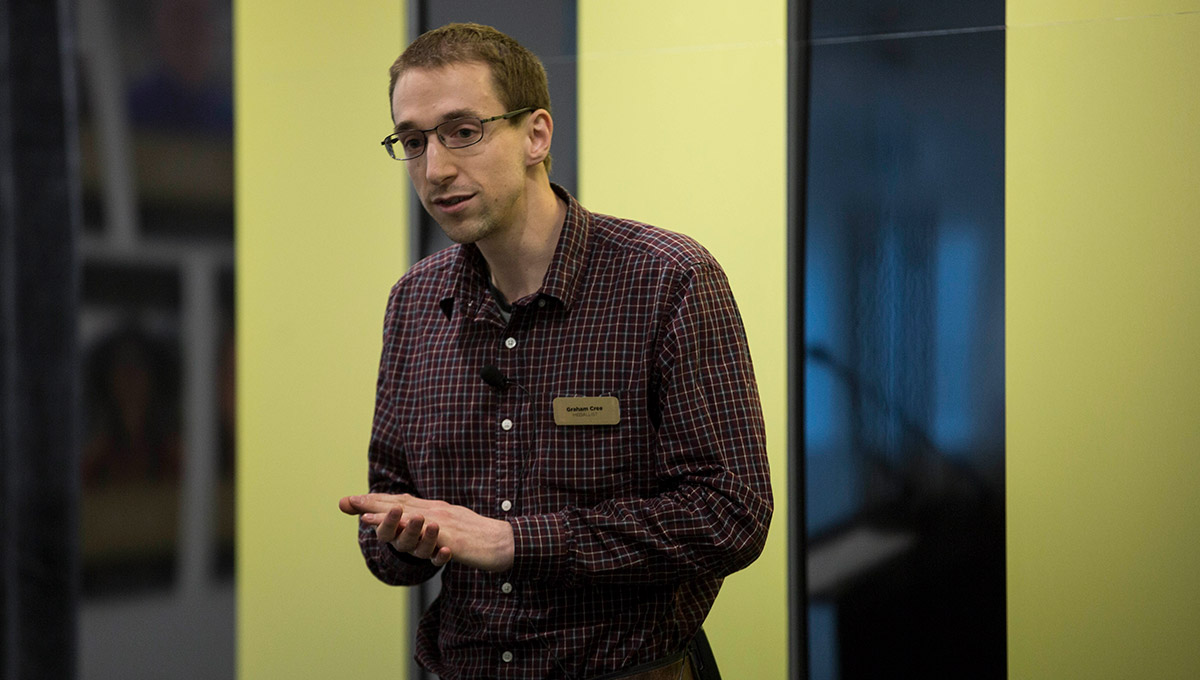
CERN’s Large Hadron Collider accelerates protons to 99.79 per cent of the speed of light, controlling locations of collisions so they occur within detectors. Particles produced pass through layers of specialized electronics that detect particles, but not all equipment is created equally.
“The detector has five million different readouts, and all of these components have a different level of precision,” Cree says. “With only 100 events, you haven’t really converged to the average yet. It isn’t a large number. Some are good events; they go through our best detectors, and some are bad events that go through equipment thrown in as an afterthought.
“My thesis was a technique that took all this into account. Not only do we have a very precise measurement, we have one that’s very honest. We have good events and bad events, and can statistically account for them.”
Showcasing a Breadth of Research
Cree contributed to our understanding of the world on the most fundamental level, but not all Gold Medal-winning research is as mind-bendingly theoretical as particle physics can be:
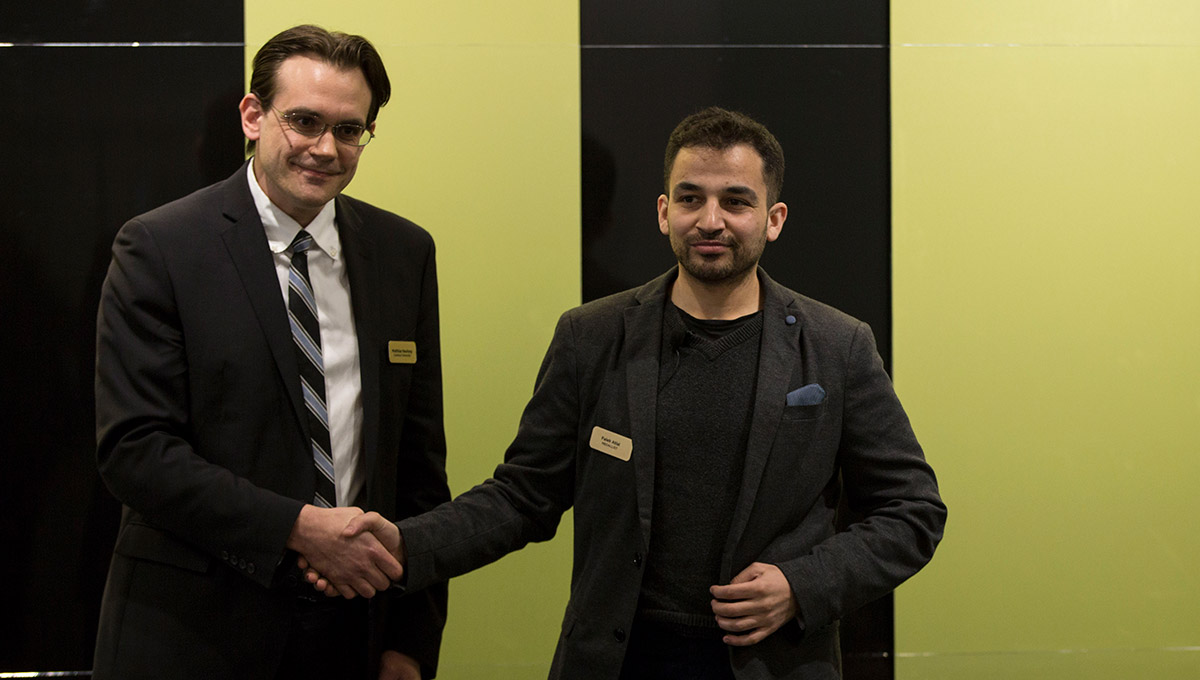
- Faleh Altal of Queen’s discovered ways of enhancing the electrical conductivity of polymers using salts, which can help extend battery life.
- Kristof Avramsson of the University of Ottawa problematized gender through a queer lens with an interrogation of men knitting.
- Véronique Bouche-Lalonde, also at the University of Ottawa, statistically correlated species distribution and climate, linking vertebrate diversity to temperature and rainfall.
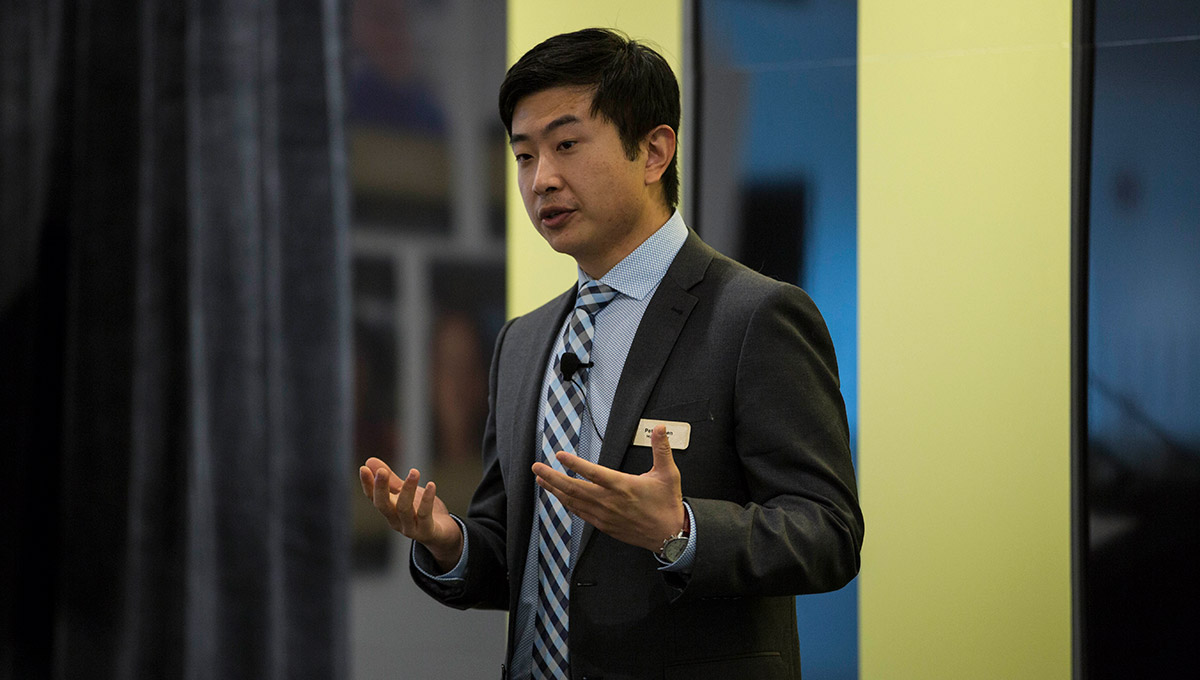
- Peter Chen at Guelph University revealed anti-oxidants in cranberry bean, and studied their correlation with bean darkening.
- Lindsay Cline of Brock University demonstrated the correlation between women’s body image, the social impression they made and their ability to accept compliments.
- University of Windsor’s K. Lakshmi Varaha Iyer found ways to improve vehicle charging while using a vehicle’s existing components
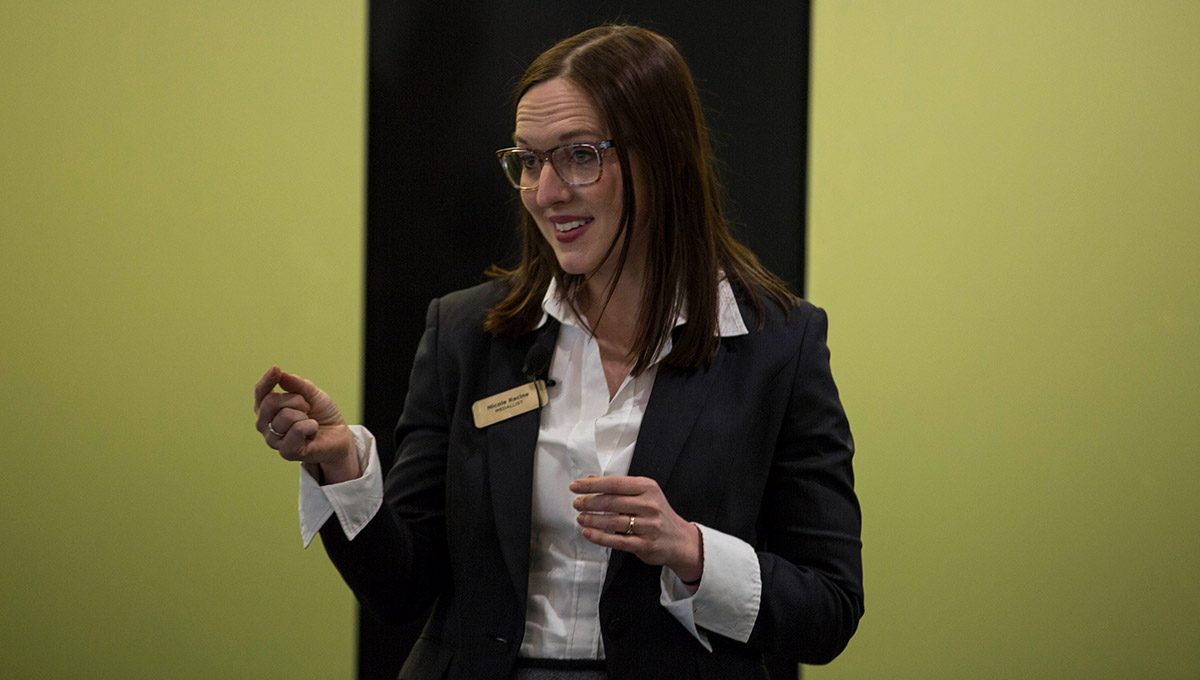
- York University’s Nicole Racine researched infant pain and parent behaviour to help parents and practitioners better calm children who fear needles.
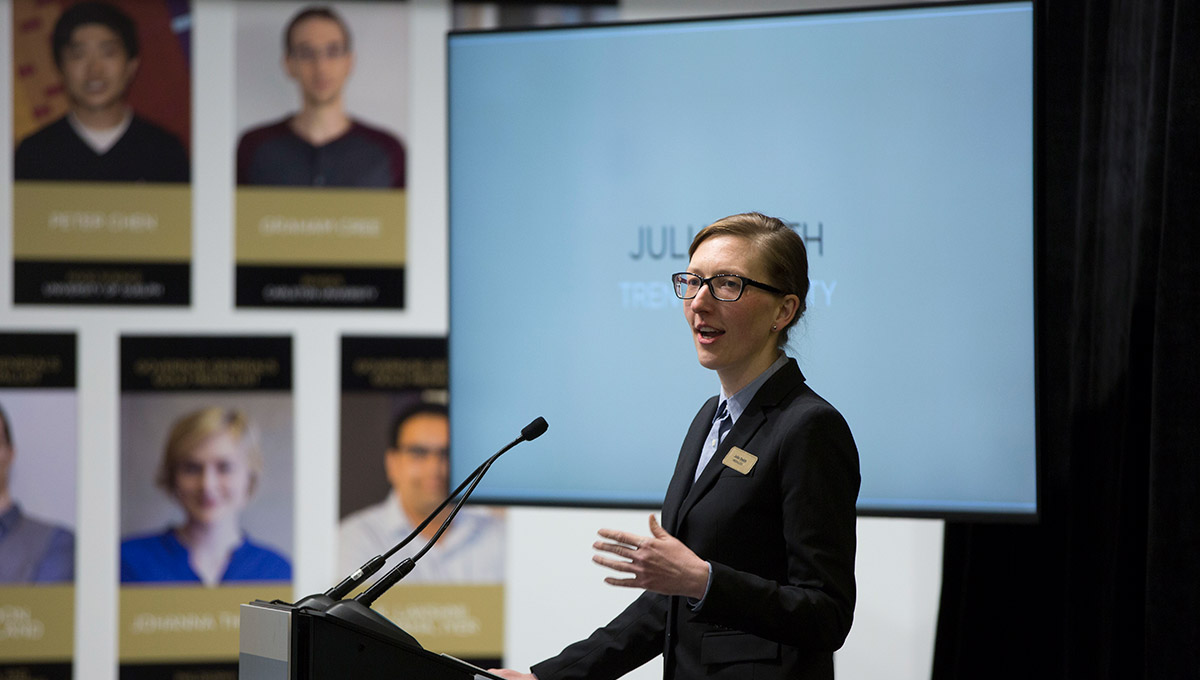
- Trent’s Julia Smith showed that contrary to assumptions that low unionization rates among bank employees arose from disinterest, repeated attempts at unionization have been thwarted.
- The University of Toronto’s Brandon Sutherland designed and built printable photonic devices which could lead to cheaper solar cells, LEDs, sensors and lasers.
- Johanna Thoma argued against orthodox rational choice theory, positing that personal preferences needn’t be consistent over time to be rational.
“There’s almost no theme in society that’s not at least somewhat represented,” says Neufang, “from psychology to food sciences, to electric cars, to philosophy. What I found particularly amazing is that it’s not only research geared to direct applications like electric vehicles, but also the Higgs boson, which is really explaining the universe. That has no direct application, but it’s something that mankind has wondered about for thousands of years. It shows the breadth of what universities do.”
Sharing the Work of Universities with the Public
The Celebration of Excellence – planned to become an annual affair – isn’t only an academic showcase. It’s a way for universities to share their work with the public.
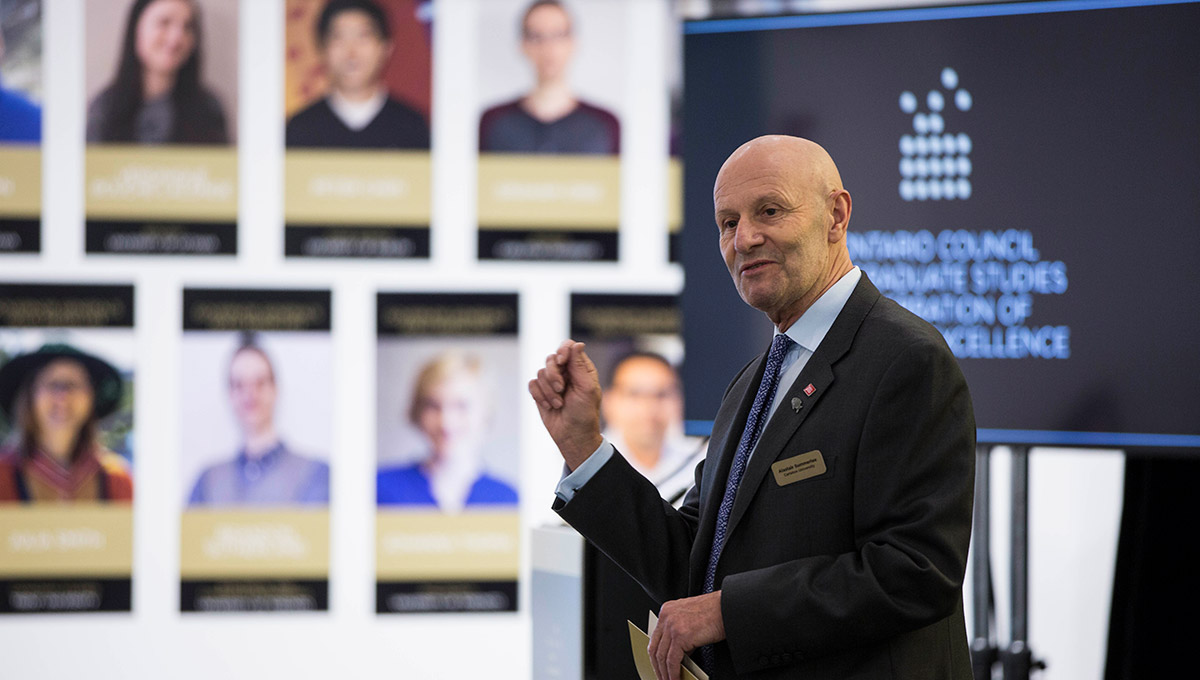
“The Council of Ontario Universities did a survey asking people what would help them understand what goes on at universities,” says Alastair Summerlee, Carleton’s interim president.
“Almost to a person, the message was to tell stories about what you do and where it fits in our short-, medium- and long- term thinking about society. This was a beautiful way of telling the stories that people have said they need to hear. That should translate into seeing universities as a critical part of the fabric of Ontario society. This is a great start. It’s something we need to think very seriously about how to replicate. For me, it illustrated what universities are about in an elegant, beautiful way, with some really, really inspiring people and stories.”