Carleton Report Highlights Shared Concerns of LGBTQ2+ Workers and Older Adults
Researchers in Carleton University’s School of Social Work released a report on March 11, 2021 that demonstrates for the first time that LGBTQ2+ older adults, and the workers who care for them, have the same concern for safety in public spaces.
The report, “It’s Got to Be About Safety: Public Services that Work for LGBTQ2+ Older Adults and LGBTQ2+ Workers in Canada,” is the product of a collaboration between Social Work Associate Prof. Susan Braedley, doctoral student Christine Streeter, the Canadian Union of Public Employees and Egale Canada.
The group is collaborating on an international seven-year Social Science and Humanities Research Council partnership grant entitled “Age-Friendly Communities in Communities: International Promising Practices.”
“As we conducted our research, LGBTQ2+ older adults and workers in a number of communities emphasized to us that we needed to pay attention to how unsafe services were,” says Braedley, associate director of the SSHRC project.
“Feeling safe or not safe was something both older adults and workers talked about a lot.”
The researchers focused on public services used frequently by older adults, including seniors’ drop-in programs, community health centres, buses, parks, libraries, social housing, hospitals, residential long-term care and home care.
“Older adults told of having to go back to the closet in their own homes in order to feel safe accessing home care,” or being physically assaulted in washrooms,” said Braedley.
Workers reported dealing with managers who suggested that being “too gay” or working on LGBTQ2+ initiatives might negatively affect their career tracks. LGBTQ2+ older adults.
Experiences of both groups included physical violence, harassment and outright denial of services and employment.
Among many issues identified in the report:
- The concerns of service users and workers overlap in many ways, and so do the solutions. Where LGBTQ2+ workers are safer, LGBTQ2+ older adults are safer, and vice versa.
- LGBTQ2+ older adults and workers face stereotypes, exclusion, discrimination, harassment and violence.
- Racialized, Black, trans, Indigenous, persons with disabilities and low-income LGBTQ2+ people face the worst conditions and their perspectives get erased.
- Responsibility for making public services safer and accessible has fallen disproportionately on workers, letting managers, owners, boards of directors, governments and accreditation agencies off the hook.
- Great work is happening, but it is often isolated and small scale.
- More change is needed at the systems level.
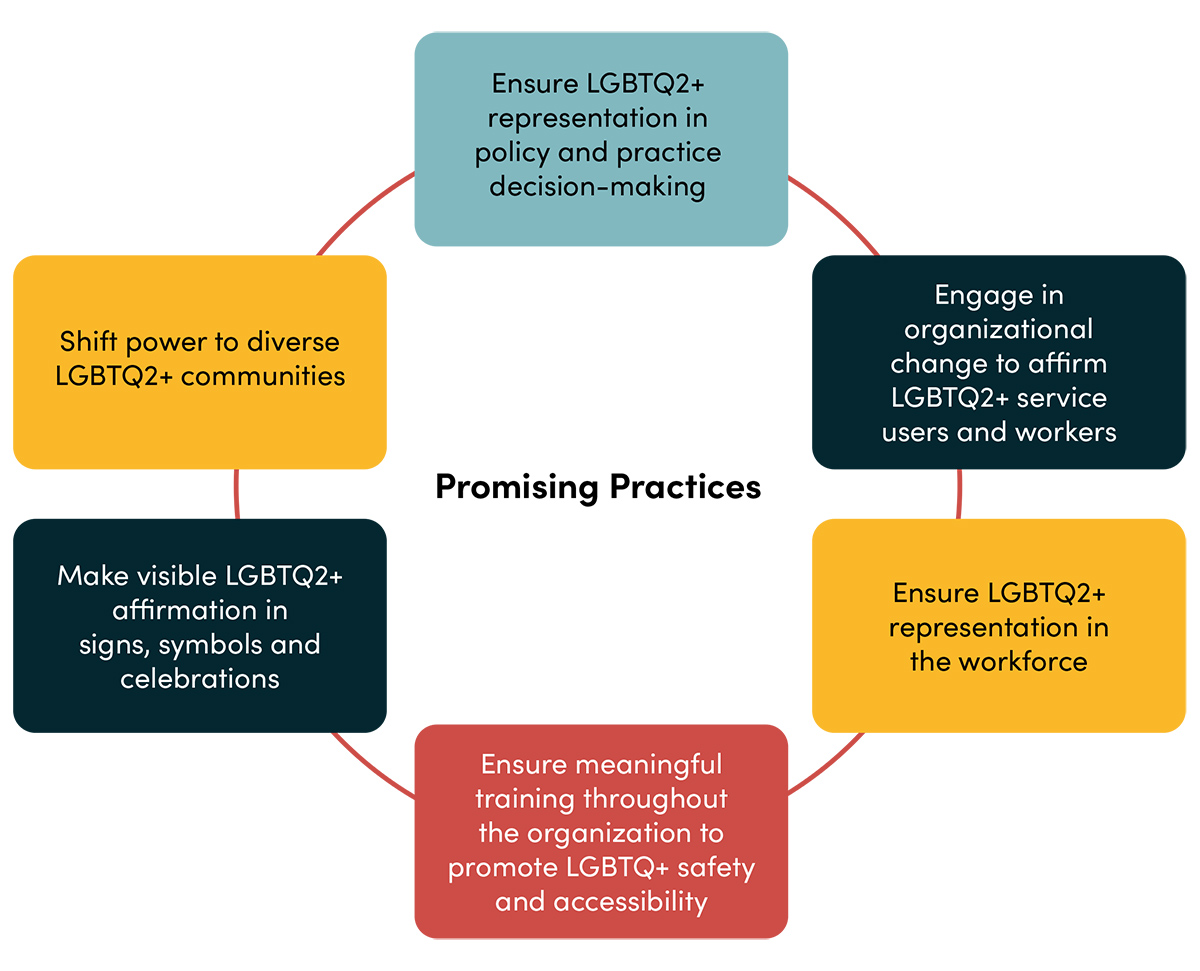
The report also shares promising practices that the researchers say will improve safety and accessibility in public services for LGBTQ2+ communities:
- Ensure LGBTQ2+ representation in policy and practice decision-making.
- Engage in organizational change to affirm LGBTQ2+ service users and workers.
- Shift power to diverse LGBTQ2+ communities.
- Make visible LGBTQ2+ affirmation in signs, symbols and celebrations.
- Ensure LGBTQ2+ representation in the workforce.
- Ensure meaningful training throughout the organization to promote LGBTQ2+ safety and accessibility.
“Public services have a responsibility to provide service delivery and working conditions that are healthy, safe and respectful for everyone, including LGBTQ2+ workers and older adults from all social locations,” states the report.
However, “there has not been sufficient political will to ensure dedicated, stable funding to pay for much needed system changes.”
Braedley points out that funding agencies also have a role to play by requiring accountability measures that address these concerns.
“But there isn’t one magic bullet that will address this problem,” says Braedley.
“It’s really a loop of things that are all connected, and we need to work on all of them.”

Related Stories
Wildfires in Canada: Researchers Work to Protect Canadians from Wildfire Smoke
More than 6,000 wildfires burned across Canada in 2023, torching an area larger than England — the country’s most destructive fire season ever. In communities…

A Clearer Picture for Prostate Cancer Diagnosis
Every single day, an average of 14 men in Canada die of prostate cancer. This startling number has driven researchers to do something about it.…

Protecting Canadians from Mosquito-Borne Diseases
It’s a sound Canadians know all too well: the high-pitch whine of a mosquito buzzing past your ear. Beyond annoyance and itchy bites, the emergence…