 By Richard Belzile, Executive Director of the Canadian Association of the Deaf | Association des Sourds du Canada, part of the PANL Perspectives series, “Making Canada Accessible“.
For more than 80 years, CAD-ASC has strived to dismantle the barriers that prevent Deaf Canadians from full inclusion in society. We provide research, consultation and information on Deaf needs to government policymakers, businesses, educators and provincial and territorial Deaf organizations and agencies nationwide, and we pilot innovative programs and share best practices in accessibility, helping to model solutions that others can adopt. Our Board is comprised solely of people who identify from the Deaf, Deaf-Blind and Hard-of-Hearing community and sign in ASL and LSQ. In addition, all our staff identify from the Deaf, Deaf-Blind, Hard-of-Hearing or DeafPlus (DDBHHD+) community as well. We feel we’re providing Canada and the world with a leadership model comprised solely of people with lived experience and with a passion to dismantle barriers and build bridges to inclusion and accessibility.
Of course, dismantling barriers hasn’t been easy
Read the other stories in PANL Perspectives’ “Making Canada Accessible” series, led by Daryl Rock and Calum Carmichael, in which charitable and nonprofit organizations outline their work in advocacy, barrier reduction and increased accessibility.
Over the decades, we’ve encountered many obstacles – from entrenched attitudes to systemic policy gaps. One recurring challenge is the tendency to exclude Deaf people from decisions that affect them. As observed by our former Executive Director, Jim Roots, people without the lived experience of a disability often build technologies they think we need, but “they are often wrong, because they haven’t bothered to ask us what we want.” Overcoming this attitude requires constant advocacy and education to remind decision-makers that by listening to the voices of Deaf Canadians, they can avoid costly mistakes.
We’ve also faced structural barriers like lack of legal protections and funding. CAD-ASC has tackled these by turning obstacles into opportunities for action.
For many years, Deaf Canadians were denied sign language interpretation in public services such as healthcare — a life-threatening barrier. CAD-ASC supported Deaf community members in the legal battle that led to the 1997 Eldridge Supreme Court decision requiring that all government services and programs be accessible to Deaf people.
As another example, when research in the 1990s revealed an appalling rate of Deaf underemployment, the federal government initially showed little interest. CAD-ASC refused to wait on the sidelines. At the time, we secured independent funding to create new jobs and training for over 100 Deaf Canadians per year for five years. By being persistent and solutions-focused, we turned a policy failure into a ground-breaking pilot program driven by the Deaf community itself.
Progress in accessibility doesn’t come only from overcoming barriers.
 Progress comes from recognizing and seizing opportunities to turn possibilities into tangible improvements. CAD-ASC has learned to act swiftly when an opening appears – whether through a legislative reform, a technology trend, or a partnership offer. For example, when the federal government began crafting the Accessible Canada Act (ACA) in 2017, we partnered with 31 organizations to consult the community and submitted 24 recommendations. Many of our ideas were adopted in the final law, including a historic recognition of the primary languages for Deaf communication in Canada: American Sign Language (ASL); la langue des signes québécoise (LSQ); and Indigenous sign languages. This acknowledgement in the ACA was the first time our sign languages were explicitly named in federal law.
In addition, when Marshall Wick, a past president of CAD-ASC, noticed the lack of captioned media, he saw an opening to prove its value. In the 1970s, he spearheaded a “Captioned Films for the Deaf” program, screening movies with captions across Canada to demonstrate public demand. This grass-roots initiative directly led to the introduction of captioned television programming in Canada by 1981.
 Internationally, CAD-ASC anchors its advocacy in the UN Convention on the Rights of Persons with Disabilities (CRPD), which Canada ratified in 2010 and joined the Optional Protocol in 2018. This gave Deaf Canadians the right to bring complaints to the UN committee if domestic remedies fail. Article 21 of the CRPD obliges states to “accept and facilitate the use of sign languages … and all other accessible means, modes and formats of communication,” a clause we cite whenever we press for more interpreters, captioning and formal recognition of ASL, LSQ and Indigenous sign languages. CAD-ASC has contributed to civil-society “shadow” reports that track Canada’s compliance, ensuring Deaf perspectives shape the UN’s periodic reviews of Canada’s progress. Tying domestic campaigns to this global treaty, we convert international human-rights norms into concrete obligations that drive accessibility reforms here at home.
Our experiences taught us lessons other organizations can draw on
 Involving the community affected by a barrier isn’t an option; it’s the key to lasting success. When Deaf and disabled people are included at every stage, solutions are far more likely to hit the mark. This principle holds whether it’s a new technology being developed or public service being planned.
Use the power of persistence and creativity. Change often takes years of sustained effort, so celebrate small wins and keep the pressure on. If one strategy stalls, switch tactics; blend advocacy, public education, pilot projects and litigation. A landmark example was former CAD-ASC president Henry Vlug’s 2000 Canadian Human Rights Tribunal victory over CBC/Radio-Canada; his complaint established the world’s first requirement that a national broadcaster caption 100 percent of its programming, from sign-on to sign-off.
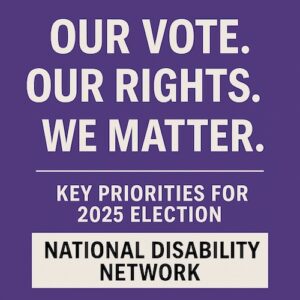 Collaborate. No single group can eliminate barriers alone. To amplify our impact, we’re among the 40+ member organizations of the National Disability Network, and have sought opportunities to joined forces with universities, disability allies and forward-thinking businesses.
Back advocacy with solid data. Research into Deaf Canadians’ literacy and employment rates gave us credible evidence to demand new programs and lent weight to our proposals for policy reforms.
Ensure that your leadership reflects the community it serves. Organizations that place persons with disabilities in decision-making roles gain insights no outside “expert” can replicate. CAD-ASC is Deaf-led at every level: membership is open only to Deaf, signing, or Deaf-run organizations and individuals; every staff member self-identifies as part of the Deaf, Deaf-Blind, Hard-of-Hearing or DeafPlus (DDBHHD+) community. Our Board, comprising Deaf directors, conducts its meetings entirely in ASL and LSQ. This Deaf-centered leadership model builds trust within the community and keeps our mission laser-focused on authentic Deaf priorities.
Advice for allies without disabilities
 The journey toward a barrier-free society is a collective effort. From the halls of Parliament to the everyday spaces of work, learning and community life, we all have a part to play. Across your workplace, track how many staff, managers, board members and program beneficiaries identify as Deaf, DeafBlind, hard of hearing, or as members of other disability or equity-seeking groups. Where gaps appear, embed those findings in a concrete Diversity Equity Inclusion and Accessibility (DEIA) plan that prioritizes hiring, promotion and mentorship for people with lived experience. Build permanent budget lines for accommodations, such as sign-language interpretation, so Deaf professionals can participate fully in decision-making rooms. Finally, replace guesswork with consultation: ask Deaf people directly, collaborate with organizations and engage Indigenous disability advocates. Representation at every level of an organization consistently leads to more inclusive policies, programs and services.
When organizing an event or meeting, plan for accessibility from the outset; reserve a qualified sign language interpreter or have real-time captioning available. Don’t wait until someone requests it. It’s always easier and cost-effective to cancel, than to try and book at the last minute. This applies to online meetings as well. Video, supported by professional interpreters, lets Deaf participants sign naturally, participate in side discussions and build rapport in real time. Securing interpreters takes advance planning, approvals and dedicated budget lines, yet those costs aren’t for “just one Deaf person.” Every hearing participant benefits from the clearer turn-taking, slower pace and sharper focus that interpreted meetings demand. Interpreters enhance comprehension for the entire room, reduce miscommunication and model respectful inclusion, turning a line item into a productivity gain for all.
 More broadly, be attentive. Each of us has the ability to look around, recognize a barrier – maybe it’s an uncaptioned announcement, an alarm with no visual signal, or simply a meeting where no one thought to provide interpretation – and then take action to fix it. In doing so, we honor the principle that accessibility is a shared responsibility. Be mindful that barriers might be attitudinal. Challenge any assumption that a person with a disability is less capable or welcome. Listen to the experiences of people with disabilities and value their expertise about what needs to change. If you’re unsure what barriers exist in your workplace or community, ask – then work with them to remove those barriers and prevent new ones.
More specifically, educate yourself about Deaf culture and the rich diversity within the Deaf and hard-of-hearing community. Even learning a few basic signs or the correct terminology (e.g., understanding the distinction between “Deaf,” “deafened,” and “hard of hearing”) shows respect and can help bridge communication gaps.
At CAD-ASC, our hope is that others will take these lessons to heart. By adopting inclusive practices, pushing for change when you see injustice and approaching accessibility as a fundamental human right, you will help to ensure that Deaf Canadians – and all Canadians – can participate fully and thrive. Together, we can remove the remaining barriers and create a Canada that truly hears every voice.
CAD-ASC is on Facebook. Richard Belzile is on LinkedIn. Photos are courtesy of CAD-ASC, Louis Belleau, Thiago Barletta and Mark Paton.
Monday, August 18, 2025 in Accessibility, For homepage, News & Events
Share: Twitter, Facebook