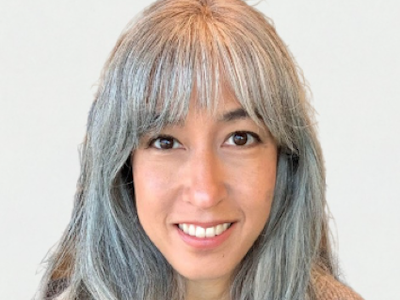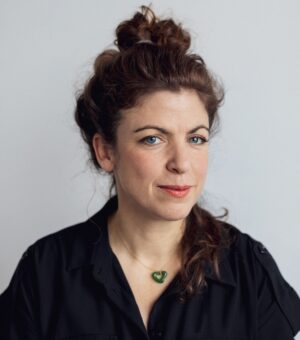
Catherine Bourgeois is Co-founder and Artistic and General Director of Joe Jack & John. Photo credit: Thibault Carron.
Catherine Bourgeois is Co-founder and Artistic and General Director of the Montréal-based theatre company Joe Jack & John. The company works at the intersection of theatre and life, creating theatrical productions with inclusive teams, including neurodivergent artists and artists with intellectual disabilities. Catherine has co-designed and directed most of the company’s productions, has received several accolades, and pursues more equitable professional recognition for women and artists living with disabilities. She spoke with PANL Perspectives as part of our “Making Canada Accessible” series.
Question: What have been your funding and production strategies in the face of barriers?
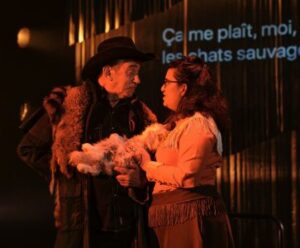
Neurodivergent artist Michael Nimbley directed and starred in “Les waitress sont tristes” (“The Waitresses Are Sad”). Photo credit: Joe Jack & John.
Catherine Bourgeois: Through two decades of work, one of the barriers has been recognition of our work, recognition of the fact that people with disabilities can be professional artists. Recognition from our peers has been more difficult to obtain than recognition from audiences and the general public. Recognition from funding bodies has been challenging as well, but not as much as from peers.
We came to life before EDI (equity, diversity and inclusion) in the arts. For the first eight years, we rented bars, lofts or any place where we could produce our site-specific projects, because nobody wanted to program us. That was a real challenge. We’d design the locations and bring in audiences — and challenge the notion of audience, actor and the rapport between the two — but funding didn’t follow us, because we didn’t produce or present our work in professional theatres.
We got onto people’s radar when we were maybe 10 years old. The lack of recognition forced us to turn to philanthropic and private-foundation funding. We focused on the positive elements of what theatre means in the life of people living with a disability. Our strategy was to integrate people with a disability who were marginalized and outside of community, society and the arts. So, we emphasized the social and human impacts of our work.
It sometimes felt a bit stuck, because on one side, we were trying to be recognized for our work artistically, and on the other side, we looked like we were doing social work or community outreach, but our main strategy was to frame and create kick-ass work. We created the best work we could with the little means we had – and we wanted to people to see a show and say, “Oh, my God, that’s a great artistic production.”
Question: What productions stand out in terms of leadership and artistry?
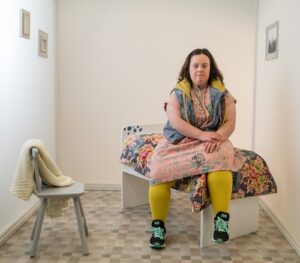
“Violette” starred Stéphanie Colle. Photo credit: Michel St-Jean.
Catherine Bourgeois: We’re rather proud of everything we accomplished in the last few years. “Violette” was a one-on-one spectator actor show involving Virtual Reality, pre-pandemic, and we went on tour with it later. It allowed the spectator to enter the privacy of the actor’s room — and then to enter her imagination. It was very intimate storytelling, with a lot of poetry around the way we were talking about a very harsh subject matter: the historical exploitation of women with an intellectual disability.
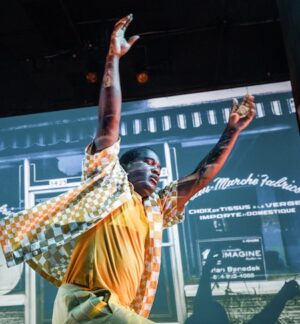
Edon Descollines starred in “Le magasin ferme” (“The Closed Store”). Photo credit: Marie Sébire.
After that, “Le magasin ferme” (“The Closed Store”) was created and performed by the exceptional Edon Descollines, an artist with an intellectual disability who is proof that the work of a creator is enriched when supported by human and material resources. Le magasin ferme offered “relaxed performances,” which means it was open to all, specifically to people who have a sensory or intellectual disability, a neurological or learning disability, and to people with newborns or special needs.
That was followed by another show, “Les waitress sont tristes” (“The Waitresses Are Sad”), as part of our program of inclusive leadership, a show directed by neurodivergent artist Michael Nimbley, artist-in-residence since 2018 and a regular performer with the company. It was about a cowboy who seeks adventure, but who we discover is an alter ego for Michael dreaming about escaping his lonely life. The show offered Quebec Sign Language (LSQ) and a few relaxed performances as well.
Question: Do your shows they take on current events and issues head-on?
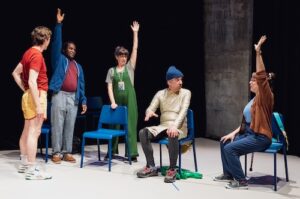
“Cispersonnages en quête d’auteurice” (“Cis-characters in Search of an Author”) opened two years ago and is still touring — and is a cheeky commentary on appropriation, privilege, cancel culture and the role of the artist in society. Photo credit: Thibault Carron.
Catherine Bourgeois: Our recent shows contained strong political stances, the kinds of shows we would not have pitched or produced five years before, because we were on project-based money back then, and every project had to have some kind of realistic or appealing aspect to it. Multi-year funding gave us more freedom to recruit people we identified as leaders in our community of intellectually disabled people.
Our most recent show, Cispersonnages en quête d’auteurice (“Cis-characters in Search of an Author”), opened two years ago, and is still touring. It’s a cheeky commentary on appropriation, privilege, cancel culture and the role of the artist in society. The show raises questions — and no answers – because, it’s like, “Oh, there’s actually grey zones and more complexities if we involve people with an intellectual disability to conversations about appropriation!” We asked non-disabled actor to act out a disability for example – and that created discomfort and many questions about who plays what, and why and why not.
Our main focus is the process, not the product. So, yes, there are productions, but our main focus has always been an inclusive process, such as collective writing, and not forcing words and ideas on actors. We work collectively, and that’s been part of the mandate since day one.
All our teams are inclusive in terms of non-disabled and disabled artists, and we’re always questioning the work. A new colleague just told me, “Everything here is getting questioned all the time,” and I said, “Oh, I didn’t even notice.”
Question: Over the years, have you noticed a change in who’s sitting in the audience?

Productions such as “Cispersonnages en quête d’auteurice” (“Cis-characters in Search of an Author”) have attracted diverse audiences across Canada. Photo credit: Thibault Carron.
Catherine Bourgeois: Yes. All our shows list Accessibility, with what’s available and not available, such as audio descriptions (for blind and low-vision patrons) or sign language interpretation (for the Deaf). On our website, “Accessibility” is a tab, along with “Synopsis” and “Credits” tabs, for each show.
In the past seven years, we’ve been doing more “relaxed performance” – with sound, light, smell and other accessibility cues that create an environment for different kinds of abilities and a wider range of people, whether it’s a mom breastfeeding or someone with Tourette Syndrome being shushed during a show. Overall, there’s more work with accessibility initiatives, Quebec sign language interpretation, and audio description. So, we see real change in terms of accessibility for audiences across Canada.
For us, it’s important to develop other audiences, for people who can recognize themselves on stage. We noticed that relaxed performances became more formalized in Montreal and in Canada – and we’ve shared knowledge, and supported that.
Joe Jack & John is on LinkedIn, Instagram and Facebook. Catherine Bourgeois is on LinkedIn.
Tuesday, October 21, 2025 in Accessibility, Arts, For homepage, News & Events, Shifting Power
Share: Twitter, Facebook