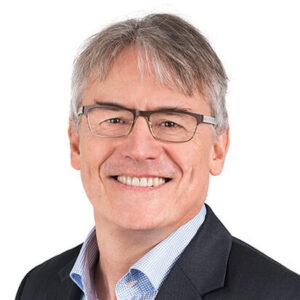
Bruno Ronfard, General Manager of Kéroul.
By Bruno Ronfard, General Manager of Kéroul, an organization that’s been making tourism and culture accessible to everyone in Quebec since 1979. This article is part of a series by PANL Perspectives called “Making Canada Accessible.”
Tourism for everyone
Kéroul’s mission is anchored in the belief that tourism must be for everyone, including people with disabilities. The organization has built a reputation as a driver of structural, educational and policy-based change, and its leadership, through the Destination for All program, reflects a commitment to building inclusive, accessible, sustainable communities.
Kéroul’s approach to reducing barriers is multi-pronged
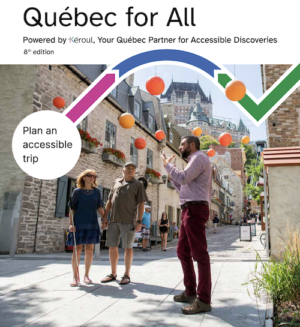 Knowing and evaluating the situation. Kéroul maintains and updates Québec for All, a database of the more than 5,000 tourism and cultural organizations and businesses that our team evaluates. In 2025, we also published a new “Québec for all” (“Le Québec pour tous”) to help travellers understand what support is available.
Promoting Destination for All, the provincial program that encourages municipalities to make urban infrastructure, transportation, tourism and local commerce more accessible and inclusive. As of 2024, several pilot projects are underway with cities such as Victoriaville, Carleton-sur-Mer, Shawinigan, Rawdon and Coaticook, thereby demonstrating a growing commitment to inclusive tourism development.
Mounting training and awareness campaigns continues to be central. In 2024–2025, Kéroul provided more than 100 training sessions in accessible customer service and universal design, reaching not only tourism staff but also municipal employees, students and transport operators.
Obstacles Kéroul has encountered
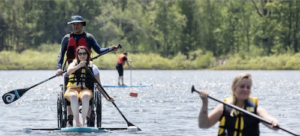
Photo credit: Bromont © Kéroul / Harmony Le Reste – Pierre Akkaoui.
In pursuing this strategy, we’ve faced challenges, including:
Fragmented service delivery. A common obstacle is the disjointed nature of accessibility across sectors. For instance, even if a hotel is accessible, poor coordination with local transit or tourism attractions can undermine the overall experience.
Funding and local capacity. Smaller municipalities often lack the expertise or budget to undertake comprehensive accessibility work. Kéroul’s response has been to decentralize its support, both by offering step-by-step support through Destination for All, which is tailored to each community’s context, and by leveraging regional tourism associations to build local momentum.
Under-recognition of non-visible disabilities. Many establishments still focus exclusively on physical accessibility. Kéroul has addressed this through new training modules and by promoting inclusive signage, quiet spaces and sensory kits.
One of the ways Kéroul has attempted to overcome such barriers is to deploy our accessibility advisors across Québec: a mobile team that visits and supports tourism businesses in implementing accessibility improvements.
Opportunities and successes
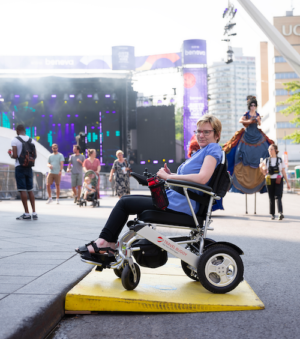
Just for Laughs festival, Montréal. Photo credit: © Kéroul / Harmony Le Reste – Pierre Akkaoui.
Kéroul’s work has opened numerous doors. For example, thanks to Kéroul’s advocacy and the leadership of Québec’s Ministry of Tourism, accessibility is now embedded in Québec’s Sustainable Tourism Action Plan and several regional development frameworks. Also, events in Québec, as well as elsewhere in Canada and abroad, have generated feedback and support, giving voice to travellers with disabilities and inspiring businesses to act.
There is also growing interest in the Destination for All program. Municipalities are increasingly eager to pursue the label, not just for recognition but as a roadmap for inclusive development. In 2024, Kéroul helped complete readiness evaluations in five new cities.
Lessons for other organizations
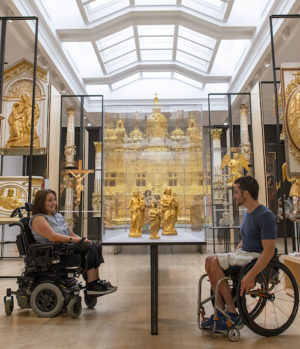
Musée national des beaux-arts du Québec, Québec. Photo credit: © TQ-G. Leroyer.
Kéroul’s work offers practical and strategic lessons:
Think comprehensively. For Kéroul, accessibility must link tourism, transit, urban design and commerce. The Destination for All model forces this systems-level thinking and breaks down silos.
Work with – not just for – people with disabilities. Our consistent co-development with community partners and people with lived experience has been key to trust and relevance.
Use recognition as motivation. Kéroul’s accessibility evaluation and consulting motivate organizations to act by publicly promoting their efforts.
Don’t wait for perfection. In our experience, progress is iterative. Small improvements, such as clearer signage, service-dog policies or staff training, can have immediate impact.
Advice for non-disabled individuals
Everyone has a role to play in building an inclusive society. For those without disabilities, observe your environment. Where are the stairs without ramps? Which websites lack alt-text? Whose voices are missing from the conversation?
You can advocate and amplify – by supporting inclusive design in your workplace, for instance, or asking questions when attending events and constructively highlighting accessibility gaps. Choose accessible options; use and recommend businesses and destinations that invest in accessibility, because demand drives change.
Educate yourself. Kéroul offers free resources online. Whether you’re an employer, traveler or community member, there’s something to learn.
Driving accessibility forward
Kéroul, with the help of Québec’s Ministry of Tourism, proves that accessible tourism isn’t just a human right. It’s also a smart, sustainable and socially enriching investment. With Destination for All as a blueprint and partnerships across sectors, Kéroul is setting the standard for what it means to travel – and belong – without barriers.
Bruno Ronfard is on LinkedIn. Photos are courtesy of Kéroul.
Tuesday, November 4, 2025 in Accessibility, For homepage, News & Events
Share: Twitter, Facebook