The Rick Hansen Foundation works on breaking down physical and attitudinal barriers and on increasing accessibility for people with disabilities. As part of PANL Perspectives‘ series, Making Canada Accessible, Doramy Ehling, Chief Executive Officer, spoke to us about how proud she is that for 35 years, the organization has been working with the public and private sectors — and with individuals and organizations representing people with disabilities — to find solutions.
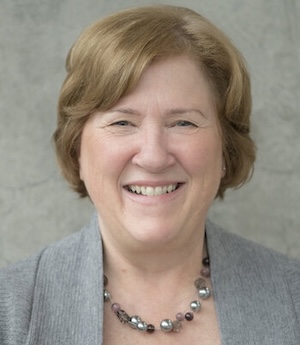
Doramy Ehling, CEO of the Rick Hansen Foundation
“We aim to ensure that our programs are beneficial to people with varying disabilities, as well as their friends and loved ones,” she says. “One of my colleagues talks about TAB — ‘temporarily able-bodied.’ He’s a quadriplegic. He says in an instant, any one of us could end up with a permanent, temporary or episodic disability, especially as we age and experience mobility, hearing and vision challenges.”
Given the aging population in Canada, we all have to pay attention to how to increase accessibility in terms of infrastructure in communities, Ehling says.
“Another colleague who’s in architecture and design, not in the disability field, said to me, ‘This is an invisible crisis. Every day, infrastructure is being built in this country, and people assume building codes do what needs to be done in terms of accessibility — and we know that’s not true’.”
 “We hear all the time from politicians and people who have invested in grants and funds for facilities, and they discover they’ve unintentionally created more barriers for people with disabilities, which is hugely disappointing. How do we get ahead of that? What can we do to change? We brought industry, governments and community to the table. We had conversations about meaningful accessibility – and created a path forward.”
The certification program that started a new profession
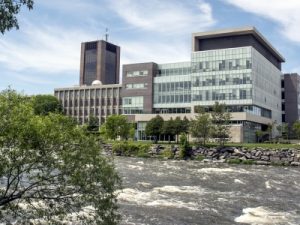
“Carleton University has become the first post-secondary institution in Canada to adopt Rick Hansen Foundation Accessibility CertificationTM (RHFAC) principles into policy. Carleton is in the process of rating over 40 sites on their campus and intends to have all new sites built to RHFAC Gold, and upgrade all existing buildings to meet certification. Additionally, they are one of six post-secondary institutions and four Associations across Canada to offer the RHFAC Professional Training course and have trained several internal staff to become RHFAC Professionals.”–Rick Hansen Foundation
Laura McBride, RHF’s Senior Director of Awareness points to innovative programs that involve coalitions with the private and public sectors. “The Accessibility Certification program, which piloted in 2016, also trains built-environment professionals to rate sites for meaningful accessibility,” McBride explains. “The program has helped to create a new profession and bring about culture change. So far, more than 2,200 sites across Canada and the US have been rated, including Surrey, Vancouver, Sudbury, Vaughan and other cities. Our latest innovation, launching this year, is the RHF Accessible Outdoors program, because barriers aren’t just indoors. We’re proud of both of these programs.”
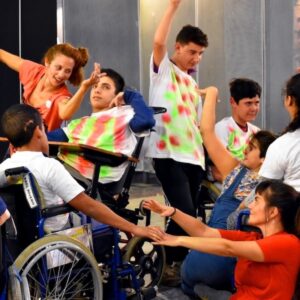
Read the other stories in PANL Perspectives’ “Making Canada Accessible” series, led by Daryl Rock and Calum Carmichael, in which charitable and nonprofit organizations outline their work in advocacy, barrier reduction and increased accessibility.
“Thanks to support from the Government of Canada, as well as provincial governments, such as BC and Ontario, we’ve been able to train thousands of individuals,” Ehling adds. “I can remember sitting at a board table where we talked about a vision for an accessibility certification program, and now, 10 years later, the movement is growing and design culture is changing to include accessibility. RHFAC is only one part of the accessibility journey, and we still have much further to go, especially on policy adoption, but we’ve at least created the conditions for success. There are people who’ve been through the training program and are working in a municipality, architecture firm, urban-design studio or wherever, and now they’re championing the changes.”
The school program that grew
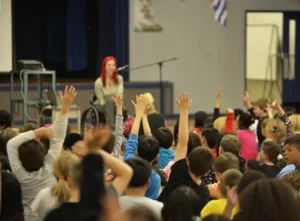
The Rick Hansen Foundation provides K-to-12 resources and speakers as part of its School Program to create more disability-inclusive and accessible classrooms in Canada.
RHF’s School Program is another country-wide innovation that’s involved coalitions and allies.
“Through self-directed online training and professional-development workshops with educators in any school or school district, we provide K-to-12 resources to create more disability-inclusive and accessible classrooms,” explains Teri Thorson, Manager of the School Program. “We also have classroom resources, like lessons, activities and Ambassadors with lived experience who talk to kids about their disability experiences. And there are also scholarships for youth with disabilities and Difference Maker of the Year awards.”
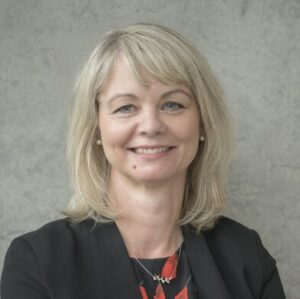
Laura McBride, Senior Director of Awareness at the Rick Hansen Foundation.
“Disability inclusion isn’t a mandatory part of school curriculums, so inclusion is incorporated, ad hoc, by teachers who are passionate about the issues,” McBride adds. “We support educators to include more conversations and disability representation for kids.”
“I’m super proud of what I see with the School Program team and the teachers and students singlehandedly creating more inclusive classrooms,” Ehling says.
What about broader policy and attitudinal barriers?
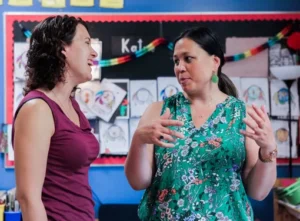 “I’ve seen great advancements in accessibility and inclusion in the past 35 years – more buildings are accessible, more research is being done, more schools are inclusive – but there have been setbacks, provincially and federally, that the disability community has been facing,” Thorson says. “Those are challenges. The fight has taken decades, so when you get a setback, it seems like it’s going to be another 10 years to put it back to where it was.”
“The attitudinal barriers are probably the biggest barriers we all face. There’s been an increased consciousness about Diversity Equity and Inclusion, but disability has often been left out of those conversations. We have to continue with education. Before people can be on side, and before we can change attitudes and stigmas, people have to be aware. We have various courses, from one-hour to eight-week courses.”
Coalitions and conversations are still key
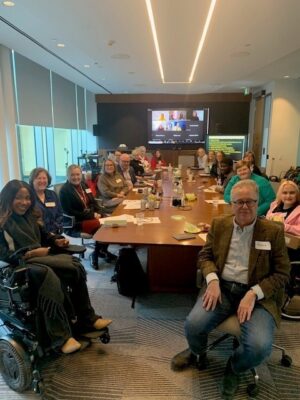
Members of the National Disability Initiative Working Group at its inaugural meeting in 2025.
“Nonprofit organizations don’t have to work alone,” McBride says. “In the last few years, we’ve been partnering with other nonprofits and philanthropists who are likeminded. This has helped to gain traction. For instance, the Slaight Family Foundation recently gifted $30 million to 11 different disability organizations, including RHF, for a National Disability Initiative – to come together and effect change.”
“If we want to innovate, if we want to tackle a barrier, we pull in a team of people who want to support that, and we test solutions, and we re-test and improve,” Ehling says. “We always involve people with disabilities, and we always involve the broader community, governments, corporations. We bring non-traditional partners to the table, so that we don’t just talk to ourselves, and we come up with collective solutions and understanding.”
“For governments especially, the message now is: be brave as leaders and make accessibility a priority” Ehling adds. “I worked for the government for many years, so I know the challenges and the multitude of priorities demanding time and attention — probably more demanding today than ever before, given everything that’s happening in the world.”
“But accessibility matters to everyone,” she says. “It’s an invisible crisis, because many people don’t think about it in their day-to-day lives. But people who’ve been through either our certification or school program say they walked away looking at the world differently. We’ve had so many champions over the last 40 years since Rick Hansen’s Man In Motion World Tour, champions who have stepped up in their own ways, in their own communities. I encourage everyone to learn more, so that they understand what the current challenges are and how they can contribute.”
The Rick Hansen Foundation is on LinkedIn.
Saturday, August 9, 2025 in Accessibility, For homepage, News & Events
Share: Twitter, Facebook