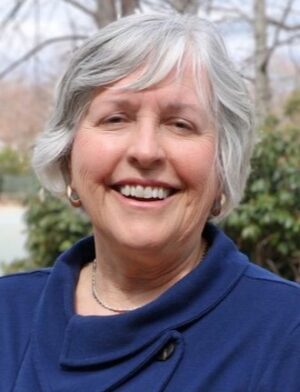
Patricia Bradshaw, author of “Concise Introduction to Nonprofit Governance.”
Patricia Bradshaw, Professor Emerita at Saint Mary’s University (in Nova Scotia, Canada), has just published a book, “Concise Introduction to Nonprofit Governance,” that provides an overview of governance in the nonprofit sector, including board responsibilities. The book draws on interpretive, structural and political perspectives on nonprofit governance and examines contingency factors, including how the external environment impacts governance. She spoke to PANL Perspectives about the value of her book and how it helps with organizational challenges.
Question: Your book is an important contribution to the nonprofit field. What’s the crux of it?
Patricia Bradshaw: The book challenges us to think about the difference between governance, leadership and management. It also looks at some of the processes and dynamics of governing at different systems levels. We’re seeing now that you govern boards and govern organizations, but there’s also a function for governance at different systems levels, such as network governance, social systems governance, global governance and even AI governance.
Governance is the function of challenging how we make sense of what’s happening around us. In a world often characterized by multiple and sometimes fractured interpretations and even distortions of reality, where does that function come in to say, “Are we telling the right story? Are there alternate stories that need to be told?” For me, that’s where governance best contributes and is what I call, in my own vernacular, “a loving challenge.”
Question: What governance trend have you noticed, and how does the book address it?
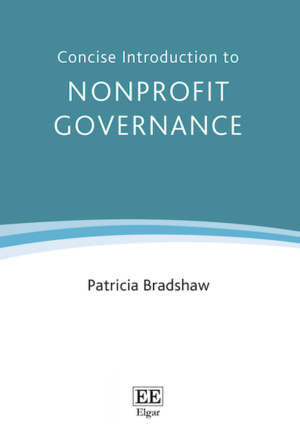 Patricia Bradshaw: The book looks at various theoretical perspectives of governance and looks at the roles, functions and responsibilities of boards. It also explores how we select governance models in different nonprofits. There’s a trend that I believe is driving the corporatization of the sector — a push to say that there’s one, best way — so the book celebrates the multiplicity of different ways of governing.
The book is based on Contingency Theory — the idea that there’s no one, best model — and it examines different contingency factors. So, what’s the best governance model? Well, it all depends, says Contingency Theory. There’s a place, in times of more complexity, for alternative models of organizing. The Ontario Nonprofit Network for instance, is looking at reimagining governance. There are exciting models that are looking at more flexible, more dynamic, more entrepreneurial models of governance.
The choice of governance model depends on the history of a nonprofit, on what stage in the life cycle the board is at, on values and mission, on external environments and on other variables.
I’m trying to challenge the dominant model and create space for innovation and alternatives but to do it in a way that’s theoretically grounded. Let’s have some fun. Let’s not be afraid of questioning this governance thing. Let’s keep it adapting to fit the circumstances that we’re in.
Question: Are organizations and the sector in Canada struggling with governance?
Read “Real-Life ‘Succession’,” a discussion with Cathy Barr and Susanna Kislenko about their report, “Good Governance and Leadership in Founder-led Organizations” (2025). It offers guidance for building effective boards, managing founder transitions and avoiding Founder’s Syndrome.
Patricia Bradshaw: I do think that we’re nervous about having candid conversations at the level of boards. For example: “We have a founder who’s dominating the board. We have different ideological perspectives. We have a lack of commitment.” Board members often tend to silence or avoid discussions of interest, conflict, power and different models of working. If we can have frank and honest conversations, I think we can start to have more meaningful governance.
In the book, I talk about latent conflicts; for example, fundamental disagreements and different perspectives, that stay under the surface and then eventually blow up. If we don’t normalize conversations about multiple constituents, multiple meanings and interpretations of reality, and different conflicting interests, we can’t have good governance.
Question: Why talk about power when looking at governance and boards of directors?
Patricia Bradshaw: I’ve frequently felt like the work that the nonprofit sector does is informed by good intentions — the charitable model, that desire for making a difference in the world — but unless we talk about power, inequality and systemic oppression, we’re not going to get to the kind of meaningful change we want.
There’s nothing wrong with power. Power is the ability to get things done. It’s when we don’t talk about power, don’t talk about who’s got the power and what interests their power is being used to advance, and have those conversations that are frank and honest, we’re not going to get to the place where we need to be resilient and move forward.
So, it’s having the courage to surface those conversations, because they’re tough ones: you’re right into talking about oppression, racism, white supremacy and a lot of topics that we’re sometimes veering away from.
Patricia Bradshaw is on LinkedIn. She suggests considering buying the e-book rather than the paperback: https://www.e-elgar.com/shop/usd/concise-introduction-to-nonprofit-governance-9781035328499.html
Monday, January 12, 2026 in For homepage, Governance, News & Events, Social Justice & Change
Share: Twitter, Facebook