911 Call-Taker Training for Mental Health Calls
Announcing a New Training Program for 911 Call-Takers!
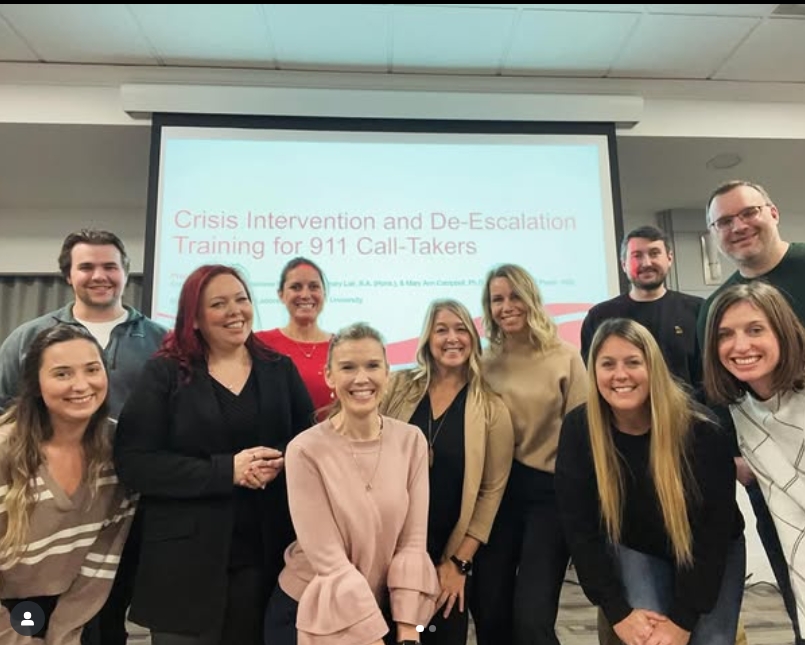
Across Canada, 911 call-takers play a critical role in helping our communities. They are the first point of contact for people requiring emergency assistance. Many of the calls that 911 call-takers receive are from people in crisis, including those experiencing a mental health crisis. Yet, 911 call-takers typically don’t receive specific training on how to effectively manage these calls. Our new training program was designed for that purpose.
Background
The purpose of this training course is to provide 911 call-takers with the knowledge and skills they need to better manage the mental health crisis calls they receive. While training programs are widely available for frontline police officers who interact with people experiencing mental health distress, virtually no similar training is available for 911 call-takers. As a result, call-takers are often sent to take training designed for frontline officers, but often report back that the training does not transfer well to the 911 context. Whereas police officers have the opportunity to interact in a face-to-face format with people experiencing mental health crises, and can draw out those interactions as long as is needed to stabilize the situation, 911 call-takers must manage challenging mental health calls over the phone, do so in a time-efficient manner, and extract useful information from the caller to provide to first responders.
Goals of the Training
By the end of the training course, participants will:
- Understand what is meant by crisis intervention and de-escalation in the context of 911 mental health calls
- Know the major indicators of key mental health conditions, including psychosis, dementia, neurodevelopmental disorders, emotional reactivity, and disorders of mood (e.g., depression), and how to identify these indicators over the phone
- Be aware of general communication strategies that can be used for all mental health calls and have the skills to implement these strategies with a reasonable degree of proficiency
- Be able to apply specific communication strategies with callers displaying particular mental health symptoms to facilitate crisis intervention and de-escalation
- Be familiar with how to implement communication strategies in a trauma-informed and culturally-sensitive fashion
- Be comfortable assessing suicide risk and communicating with suicidal callers
- Understand the importance of self-care – to enhance call-taker well-being and performance – and be able to apply key self-care strategies, such as controlled breathing techniques
Structure and Content of the Course
The course is a 1.5-day train-the-trainer course. The course is designed to prepare selected 911 call-takers to deliver a 1-day training program to call centre staff.
The train-the-trainer course is delivered in person and has the following special features:
- An Instructor’s Guide is provided, which includes advice for trainers who will be delivering the 1-day training to their staff, speaking notes for each PowerPoint slide to help trainers deliver the training, role-play scripts, pre- and post-training attitude and knowledge checks to confirm that the training is having an impact, and course evaluation forms
- Trainee Guides are also provided, which will be used by trainees in the 1-day training of call centre staff to follow the training and take notes
- PowerPoint slides covering relevant terminology; crisis intervention and de-escalation frameworks; information about mental health indicators that can be identified over the phone for various mental health issues; general communication strategies for call-takers that can be applied to all calls and specific communication strategies for dealing with certain mental health issues (e.g., delusions and hallucinations); suicide risk factors and communication advice for suicidal callers; information related to trauma-informed and culturally-sensitive communication; and self-care strategies to improve call performance and overall well-being
- Audio clips of 911 calls for the purpose of table-top role-plays and group discussions
- Audio clips of people experiencing each of the mental health conditions covered in training
- Role-play scripts to be used in the portion of the training dedicated to scenario-based training, along with advice about how to run this aspect of the training so that it mimics the conditions of a call centre
Customers
To date, we are proud to have provided training to the following organizations:
 |  |  |  |
Trainer Page
If you’ve already taken the train-the-trainer course, click here to access all the material from that course so that you can deliver the 1-day 911 call-taker training course to your staff. Announcements will be made when any of the material on this page gets updated so that you can be sure you’re using the most recent training material. Get in touch with Craig if you notice any problems with the training material.
Acknowledgments
This training was developed with the generous support of the Canadian Police Association, the National Police Federation, and the Ottawa Police Service.
Contact Form