Welcome
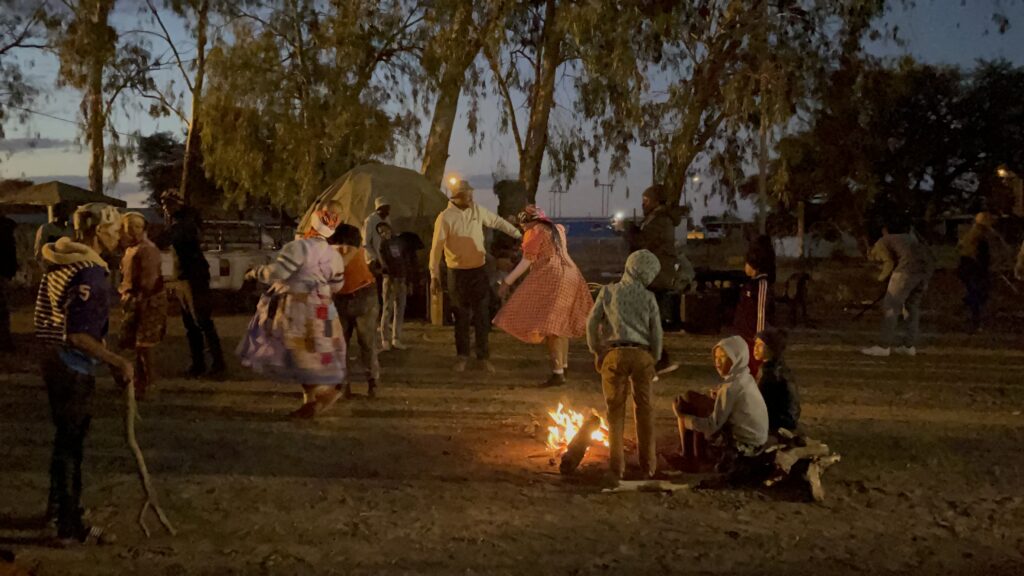
“Sounding Indigenous in South Africa” is a collaborative research project concerning the music and performance heritage of Indigenous communities in South Africa.
This project investigates and archives the music and performance practices of people in South Africa’s Northern Cape region who identify as Khoesan (also Khoisan, Khoi-San, Khoe-Sān) and who are known as the “first people”. Settler colonialism in southern Africa and centuries of violence against the region’s indigenous peoples decimated their populations. Today, the ancestors of numerous and distinct social groups across South Africa identify as “Khoesan” and claim Indigenous status under this name. Buoyed by global indigenous rights movements, Khoesan activists have made considerable effort in recent decades to revive indigenous practices in South Africa, including languages, cosmological beliefs, song repertoires, and performance heritage.
With community permissions and in collaboration with Indigenous partners, the project’s team of academic researchers and Khoesan scholar-activists will collaboratively archive and study Khoesan heritage performances of music and dance with communities across the Northern Cape. Of central concern is how heritage performance—in particular, of dances and song lines—functions in the contemporary imagination and telling of Khoesan social history in South Africa. What role does performance heritage serve in the contemporary construction of Khoesan identity? How are performances leveraged in the ongoing Khoesan cultural revival and political movement? And how does heritage performance support the interests of Khoesan communities as against those of the South African government, private organizations, and tourists?
This collaborative project aims to recognize and conserve Khoesan cultural knowledge as well as produce new research data for the future comparative study of cultural strategies deployed by Indigenous groups in diverse contexts. Project outcomes—including open-access and digitized community archives of Khoesan music and dance heritage—will proffer concrete materials for Khoesan communities to use in their cultural conservation and political mobilization efforts. Many Khoesan activists make recourse to inherited cultural practices, such as music, dance, and storytelling, as evidence of their Indigenous legal status and right to land. We anticipate that this research will be of special relevance to Khoesan Councils engaged in state policy reform.
“Sounding Indigenous in South Africa” is funded by Canada’s Social Sciences and Humanities Research Council (SSHRC).
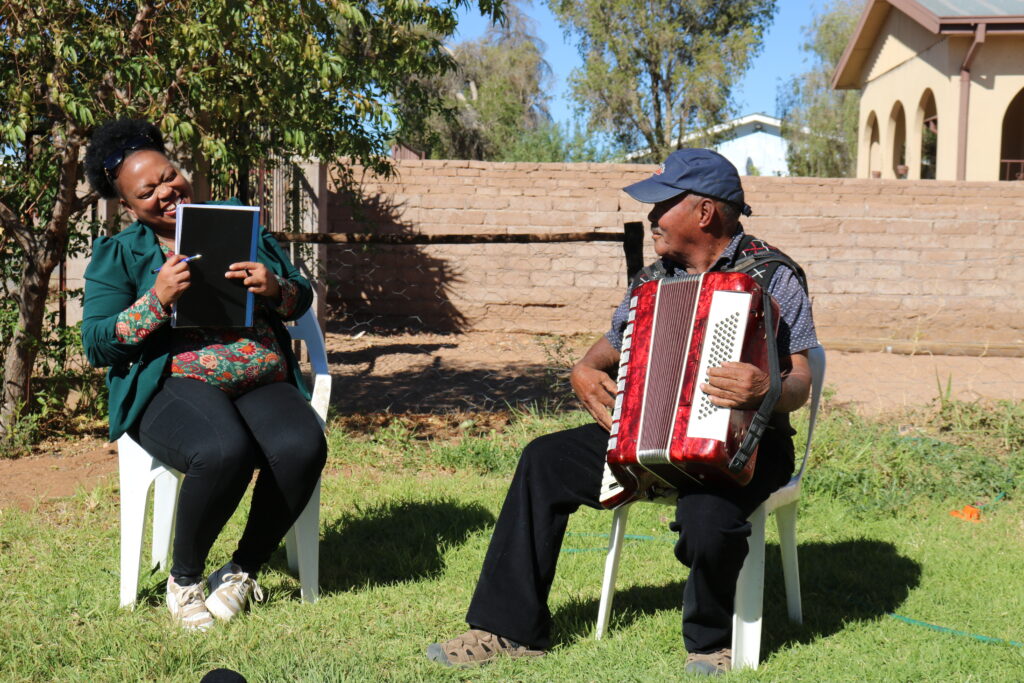
Recent News
AMS-SEM 2026 Conference
Team members Dr. Lyndsey Copeland and Mr. Boetles Gewers co-presented a paper at the joint conference of the American Musicological Society and the Society for …
Field trip to the Karoo and Richtersveld regions
In December 2025, team members Dr. Lee Watkins, Mr. Leonard Boetles Gewers, and Dr. Lyndsey Copeland conducted research in the Karoo region of the Western …
SEM 2025 Conference
Team members Dr. Lee Watkins, Dr. Sharon Gabie, Mr. Leonard Boetles Gewers, and Dr. Lyndsey Copeland presented at the 2025 annual conference of the Society …