Classroom Connections: Linking Contemporary Youth with Historical Students’ Transnational Experiences of Disasters
On December 17th and 18th 2024, two groups of grade 10 Geography students from Colonel By High School journeyed to Carleton University to tour the campus and participate in a workshop hosted by two Disaster Lab team members: PhD candidates Emma Awe and Rebecca Friend. Together, workshop participants situated their own understandings of what qualifies as a disaster within the context of the definition used by the Canadian Disaster Database. They were then invited to study past Ottawa university students’ transnational connections to global disasters using historical inquiry methods, with the ultimate goal of visualizing their findings in an ArcGIS Story Map. Combining these approaches created a stimulating workshop that put contemporary students into conversation with students from the past and teased out connections to disasters across geographic space and historical time.
Defining ‘Disaster’
Our workshop opened by asking the high school students how they would define the term “disaster.” This was an important grounding exercise that generated many different responses and examples about what might qualify as a ‘disaster.’ Across both groups, students suggested that disasters are often events with negative consequences and causing significant, unexpected, lingering, and/or dramatic changes.Their collective definition also described how these could be damages to infrastructure, humans, animals, and productivity. One group further explained how a disaster’s impact is compounded by social, religious, cultural, demographic, and economic realities of affected regions.
When asked to provide examples, students covered a full range of events that were either caused by environmental or human activity, or a mix of the two. While some were standard examples like hurricanes, earthquakes, and tsunamis (with some examples of each provided), and major historical events like the Halifax Explosion, mass plagues including Covid-19, and Chernobyl, other examples took on a more political tone, pushing up against the limits of their definitions. These included events like the murder of George Floyd and other members of Black communities across the United States, 9/11, Russia’s invasion of Ukraine, the French Revolution, the 2008 Economic Crisis, 9/11, and the rise in anti-Asian hate post-Covid.
Even though some of these examples may not be the typical ones that spring to mind when thinking about past disasters, they all fit within the both specific, yet amorphous, definition offered by the Canadian Disaster Database, wherein a disaster meets one or more of the following criteria:
- 10 or more people killed
- 100 or more people affected/injured/infected/evacuated or homeless
- an appeal for national/international assistance
- historical significance
- significant damage/interruption of normal processes such that the community affected cannot recover on its own
The students’ thinking encouraged us to push back against conventions implicit in common conceptions of disaster definitions and examples, moving the needle to encapsulate more political interpretations of what has been disastrous for different communities.
Tracing Transnational Student Connections
Following the establishment of some baseline definitions and examples, students were then invited to engage with the second part of our workshop: an examination of transnational connections between past Ottawa university students and disasters occuring in international contexts. We defined the term ‘transnational’ as historical processes, events, ideas, movements, and more that transcend national borders. We looked to underscore the fluidity and porosity of borders in order to show students how events occurring in an international arena may still have impacted students studying in Canadian contexts. To have participants begin looking at these convergences, a selection of archived articles were pulled from The Charlatan – Carleton’s student newspaper started in 1945 as The Carleton, but operating as The Charlatan since the 1970s. The Charlatan is written by, for, and about Carleton students and spreads awareness about student experiences at local, national, and international levels.
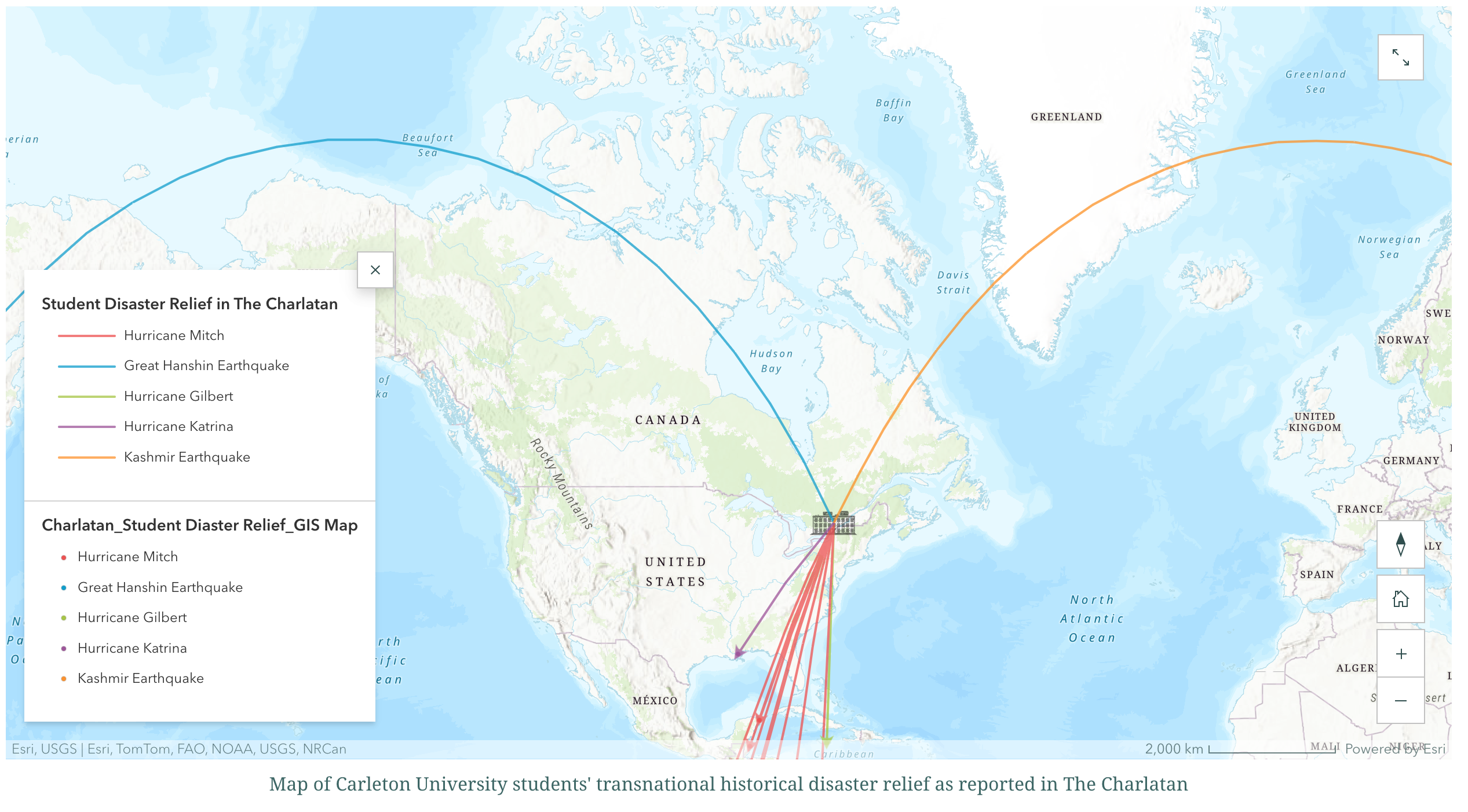
The five selected articles described a mix of student connections to disasters, from clubs like the Carleton Caribbean Club raising funds for Hurricane Gilbert in 1988 and the Latin American Society fundraising for Hurricane Mitch relief efforts 1998, to longer profiles on diasporic students reacting to events back home, like the 1995 Great Hanshin Earthquake in Japan or the 2005 Kashmir Earthquake in Pakistan. Efforts by Canadian universities, including the University of Ottawa, to help enroll students displaced by Hurricane Katrina served as the final article selection.
With scans of the articles in hand, alongside archival Charlatan volumes on loan from the library and available for perusal, students worked in groups to read one of the selected articles and reflect on student-led disaster relief efforts. They were asked to consider why students were responding to a disaster, how they led their relief campaigns, and how the disaster was represented in the article. In order to do so, they were asked to analyse their articles, conduct additional research on the disasters in question, and then prepare a blurb about the disaster emphasizing connections to Carleton students. Each group then presented their findings to the class.
Their presentations demonstrated that the students were able to establish important context for the disasters in question and to make connections between Carleton students and diasporic disaster experiences. Through guided discussion, students reflected on similarities across the presentations, the reasons why students might be well positioned to want to help or care about disasters in a global context, and finally what some of the values are of studying and mapping historical disasters.
Mapping
These presentations then served as the main data points for a pre-configured ArcGIS Story Map. With Carleton University as the starting point, arrows follow the path of relief efforts outwards to affected areas around the world and across time. Flipping through slides in the StoryMap, students’ analysis of unique responses, as outlined in The Charlatan articles, is paired with an interactive map and images of the disasters. Students identified several types of disaster responses, including material donations, raising funds, and spreading awareness.
In both the StoryMap, students’ collaborative research findings are visualized for wider audiences.
Throughout this workshop, students learned critical methods of historical analysis by reading The Charlatan as a primary source, supported by their secondary source research about disasters. Importantly, students also remarked how reading about past student-led relief campaigns inspired them to think about how they can revive some of these tactics and approaches to engage in climate advocacy and awareness today. They recognized similarities across their advocacy efforts and those led by past studDisaster Lab Activity Guide Transnational Student Disaster Connectionsents in crisis. As educators, we hoped that providing examples of student-led campaigns, as reported upon by students, would act as historical learning, but also as community-building. Urging students to reflect on these historical case studies, the workshop bridges and empowers student communities across time.
If you’re interested in adapting this workshop for your own class, a copy of the lesson plan is available for download here.
– Emma Awe and Rebecca Friend