Leon Mwamba Tshimpaka
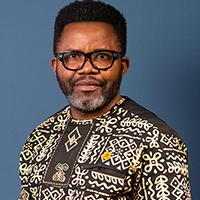
2026 Fellow
Unthinking and Rethinking the Global Compacts: Indigenous Knowledge Systems, Conflicts, and Refugees in the Copperbelt–Katanga–Lunda Borderlands
Dr Leon Mwamba Tshimpaka is a political scientist specializing in people-centric approaches to governance. He holds a PhD in Political Sciences from the University of Pretoria, where he serves as a senior research fellow at the Centre for the Study of Governance Innovation (GovInn) under the SARChI Chair in the Political Economy of Migration in the SADC Region. Dr Tshimpaka is also an adjunct professor in the School of Liberal Arts and Humanities at Woxsen University in India and an affiliated scholar in James Madison University’s Department of Political Sciences in the USA.
He also served as a tutor at the University of South Africa, a sessional senior lecturer at the Wits School of Governance, and a postgraduate external examiner for Zululand University in South Africa. His research and teaching focus on Africa-Canada relations, intercontinental citizenship of African migrants, borders, and diaspora; indigenous knowledge production and systems; the political economy of Pygmies; international political economy; civil society and democracy consolidation in Africa; anti-corruption initiatives and public accountability; sustainable development in Africa; and Africa-EU relations. Dr. Tshimpaka is a recipient of the Andrew Mellon Foundation Doctoral Scholarship (2016–2018) from New York, USA, and the GIGA Institute of African Affairs (IAA) 2017 Research Seed Scholarship from Hamburg, Germany. He has held fellowships at James Madison University in the USA, KU Leuven University in Belgium, the University of Luxembourg in Luxembourg, and the German Institute for Development and Sustainability (IDOS) in Germany. His work has been published by renowned publishers such as Palgrave and Routledge. Dr. Tshimpaka is fluent in English, French, and Swahili and has fair proficiency in Portuguese and several other African languages.
For the AIReKEMA Fellowship, Dr. Tshimpaka explores the potential of Indigenous Knowledge Systems (IKS) and refugee knowledge as glocalisers of the Global Compacts on Migration, with the aim of addressing conflict-induced forced displacement and fostering peaceful regional cooperation to improve livelihoods across borderland regions. Drawing on the Angola–DR Congo–Zambia borderlands, his study focuses on how homogenous communities in the Chavuma–Caripande borderlands negotiate mobility, identity, and coexistence beyond rigid colonial and state-centric territorial boundaries.